



Kidney Stones
Latest News
Advertisement
Latest Videos







CME Content

Advertisement
More News

The company plans to announce full market availability of the RenaFlex ureteroscope system at a later date.

"We know that surgical intervention for ureteroscopy for both renal and ureteral stones does result in a relatively rapid and also quite substantial improvement in quality of life that does exceed preoperative baseline," says Justin B. Ziemba, MD, MSEd.
ADV7103 is currently being studied in the phase 2/3 CORAL-1 study, enrolling patients with cystinuria across centers in France and Belgium.
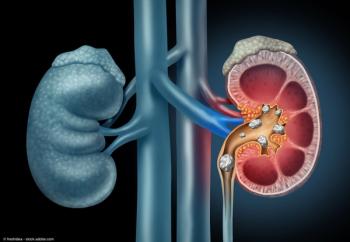
"What we did find was that a preoperative ureteral stent, and when we did semi rigid ureteroscopy initially, seemed to be protective against worse symptoms," says Justin B. Ziemba, MD, MSEd.

"In fact, on multivariate analysis, they wanted to look at other health concerns that raise people's risk of getting kidney stones and the 3 things that came up from the study where the history of gallstones, hypertension, and chronic kidney disease," says Ben H. Chew, MD, MSc, FRCSC.

"The main finding is that when you look at men with low testosterone, grouped 18 and above, we found that there is an association between low testosterone and kidney stone encounter diagnoses," says Austin Thompson.

"If you suspect that you have a calcium oxalate monohydrate stone, we found that the most effective settings are 0.4 J and 40 Hz, and maybe as a backup setting, 0.2 J and 100 Hz," says Ojas Shah, MD.
"While alkaline water products have a higher pH than regular water, they have a negligible alkali content–which suggests that they can't raise urine pH enough to affect the development of kidney and other urinary stones," says Roshan M. Patel, MD.

“There are a lot of people using this technology now, but it is not mainstream by any means,” says Ojas Shah, MD.
“These are key, because right now our sepsis rates following ureteroscopy are, quite frankly, unacceptable,” says Jordan L. Allen, MD.
As the year comes to a close, we revisit some of this year’s top content on kidney stones.
"If the diversity and robust functional potential of the healthy human microbiome is repeatedly assaulted by the average Westernized lifestyle via antibiotic exposure, diet, and other environmental factors, kidney stone prevalence will continue to increase," the authors write.
“We found that these genetic proxies of thiazide diuretics were associated with a 15% lower risk of kidney stones,” says Jefferson Triozzi, MD.

"We need improved efficiency. Part of that is being as optimal in our settings and in our techniques that we can," says Smita De, MD, PhD.
"I think there have been a lot of what I would consider incremental improvements over the past few years," Smita De, MD, PhD.

"I think that overall, one should do what one is comfortable with, within the scope of your practice and your resources," says Smita De, MD, PhD.

Drs Bechis and Semins discuss future developments in urinary stone management, emphasizing the potential for improved vacuum aspiration devices, combined intravenous and PCNL surgeries, and the hope for medications to dissolve stones.

"[The findings] certainly made me a lot less anxious for those patients who do need to continue their aspirin," says Smita De, MD, PhD.
"We did not find that there were any clotting or thrombotic complications in those who did stop their aspirin," says Smita De, MD, PhD.
Experts converse on the evolving methods for real-time intra-renal pressure monitoring, its benefits in improving surgical procedures, and the potential for future automated adjustments based on the monitored data.
Drs Bechis and Semins discuss their approaches to employing ureteral access sheaths, reviewing assessing the ureter's caliber, dilation techniques, and the potential need for stenting post-sheath use, considering patient history and logistical factors like on-call availability.
Data showed that plasma oxalate levels were maintained through 24 months of treatment with lumasiran.
Drs Semins and Bechis discuss the utility and benefits of ureteral access sheaths, emphasizing their role in optimizing visualization, reducing intra-renal pressure, and potentially mitigating postoperative complications, while also noting the importance of size selection and highlighting emerging technologies that measure pressures and manage thermal injury.
Dr Michelle Semins discusses strategies to minimize elevated intra-renal pressure, emphasizing the principle of ALARA (as low as reasonably achievable) by reducing inflow and increasing outflow, and suggesting tools and techniques such as stopcocks, gravity bags, ureter access sheaths, and new suction devices, while also highlighting the importance of controlling other risk factors like bacteria.
Seth Bechis, MD, emphasizes the potential complications from elevated intra-renal pressure, such as sepsis from bacterial spread, ruptures leading to pain and difficult recovery, impaired renal function, and hemorrhage, highlighting the need for understanding these risks for better postoperative outcomes and hospital efficiency.
Advertisement
Advertisement
Trending on Urology Times
1
FDA approves sildenafil oral film for men with erectile dysfunction
2
The UroOnc Minute: Adjuvant Therapy in Renal Cell Carcinoma, with Brian Shuch, MD
3
Integration of doublet and triplet therapy in metastatic prostate cancer
4
URO-1 prostate biopsy devices adopted across Novant Health System as clinical study continues
5