

Kidney Cancer
Latest News
Advertisement
Latest Videos


CME Content

Advertisement
More News

The median overall survival in renal cell carcinoma patients was similar, regardless of whether or not patients received a break from treatment.
“Now in 2023, it’s really a question of how to apply these agents and which combinations to use in the first line,” said Vincent (Wenxin) Xu, MD.

“As a whole, the benefits of the lenvatinib plus pembrolizumab combination proved to be durable, statistically significant, and clinically meaningful,” said senior author Camillo Porta, MD.
Published results from the phase 3 CONCEPT study showed improved outcomes with the combination compared with either agent alone.
The phase 2 Cyto-KIK study is exploring cytoreductive surgery plus immunotherapy with nivolumab and targeted kinase inhibition with cabozantinib in metastatic kidney cancer.
“As other factors such as access to care, socioeconomic conditions, patient preference, and other unknown confounders might have played a role in the observed disparity, it is still unclear whether overestimating the postoperative eGFR of Black patients contributes to the lower use of nephron-sparing approaches in this population,” the authors write.
"Augmented biopsy-based and noninvasive options are available to reduce benign resection rates of renal tumors with the consideration of PEER and 99mTc-sestamibi SPECT/CT," writes Hiten D. Patel, MD, MPH.

As the year comes to a close, we revisit some of this year’s top content on kidney cancer.

The FDA’s Fast Track Designation is designed to expedite the review and development of novel treatments that will fill an unmet medical need.
"What was surprising to me is that the incidence [of kidney cancer] has leveled off over the past 2 years," says Laura Bukavina, MD, MPH.
“Due to the rarity and poor molecular characterization of nccRCC, there is an underrepresentation in clinical trials evaluating patients with this type of RCC; because of this, patients are often treated with non-tailored therapies,” the researchers wrote.
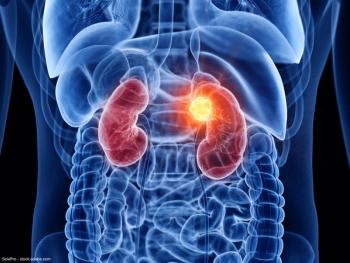
Findings shared during the 2022 International Kidney Cancer Symposium showed that patients with advanced renal cell carcinoma treated upfront with pembrolizumab plus lenvatinib were far less likely to need second-line therapy vs patients receiving first-line sunitinib.
The updated results were shared at the 2022 International Kidney Cancer Symposium.
"Up-front CN is associated with a survival benefit in selected patients with mRCC treated with either targeted therapy or ICI therapy," writes Badar M. Mian, MD.
“We really need to understand patient selection and treatment sequencing,” says Rana McKay, MD.
Rana McKay, MD, says that given the frontline shift from anti-VEGF monotherapy to immunotherapy doublets for advanced renal cell carcinoma, many of the studies informing the second-line setting have become “somewhat antiquated.”
Rana McKay, MD, says the CheckMate-214, KEYNOTE-426, CheckMate-9ER, and CLEAR trials have revolutionized the first-line treatment paradigm in advanced renal cell carcinoma.

“There has never been a clinical trial for these patients. It is unclear whether these patients should be treated with medication, surgery, or another approach. This represents an unmet medical need,” said Raquibul Hannan, MD, PhD.
The focus of the analysis was to determine the HRQOL of patients who were enrolled on the phase 3 KEYNOTE-426 trial.
Patients in the CheckMate-914 trial had received radical or partial nephrectomy and were at moderate or high risk of relapse.
“Survival differences can be due in part to genetic differences, but also a lot of socioeconomic issues as well,” says Ridwan Alam, MD.
Ridwan Alam, MD, discusses research exploring nonclinical factors affecting overall survival in patients with renal cell carcinoma.
Exelixis plans to discuss the top level results of the phase 3 COSMIC-313 trial with the FDA regarding a potential application submission for the triplet in this setting.
“One of the processes that is regulated by HIF2α is angiogenesis,” says James Brugarolas, MD, PhD.
Understanding the mechanisms of treatment resistance is among the areas of unmet need, says James Brugarolas, MD, PhD.
Advertisement
Advertisement
Trending on Urology Times
1
FDA approves sildenafil oral film for men with erectile dysfunction
2
The UroOnc Minute: Adjuvant Therapy in Renal Cell Carcinoma, with Brian Shuch, MD
3
Head-to-head analysis shows OS benefit with apalutamide vs darolutamide in mCSPC
4
Pearls & Perspectives: Modern Semen Testing and Male Fertility Care, with Thomas Masterson, MD
5