




Prostate Cancer
Latest News
Advertisement
Video Series


Latest Videos










Shorts

1:25
Patient selection for perioperative treatment in high-risk localized prostate cancer
4 days ago
by
Adam B. Weiner, MD(+1 more)

1:23
Daniel J. George, MD, on the significance of capivasertib for PTEN-deficient mHSPC
15 days ago
by
Daniel J. George, MD

1:02
The UroOnc Minute: Patient selection for MDT in the PSMA-PET era
23 days ago
by
Adam B. Weiner, MD(+1 more)

0:45
Praful Ravi, MB, BChir, MRCP, on residual disease detection using PSMA-PET
a month ago
by
Praful Ravi, MB, BChir, MRCP

0:28
What BULLSEYE's PFS data should—and shouldn't—mean
a month ago
by
James Nagarajah, MD

0:47
Louise Emmett, MD, PhD, MBChB, FRACP, on the potential role of 225Ac-PSMA-617 earlier in mCRPC
a month ago

0:22
Michael S. Cookson, MD, on darolutamide’s safety profile
a month ago
by
Michael S. Cookson, MD, MMHC, FACS
0:30
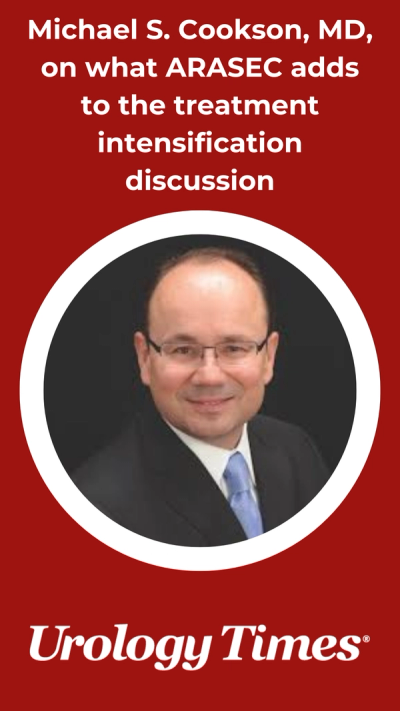
Michael S. Cookson, MD, on what ARASEC adds to the treatment intensification discussion
2 months ago
by
Michael S. Cookson, MD, MMHC, FACS

0:32
James Nagarajah, MD, on the headline finding of BULLSEYE in HSPC
2 months ago
by
James Nagarajah, MD

0:20
Zach Feuer, MD, on the impact of wait times for prostate biopsy referral
2 months ago
by
Zach Feuer, MD
Podcasts










CME Content









Advertisement
More News
Preston C. Sprenkle, MD, discusses the unmet needs, emerging solutions, and longer-term vision for MRI in prostate cancer care.

Daniel J. George, MD, discusses the clinical significance of the FDA approval of capivasertib, practical considerations for PTEN testing and toxicity management, and the broader implications of precision medicine for patients with advanced prostate cancer.

The approval is supported by data from the phase 3 CAPItello-281 trial.

The approval adds another commercially available source of the PSMA-targeted radiotracer.

The addition of aglatimagene and valacyclovir to radiotherapy with or without ADT significantly improved disease-free survival in patients with intermediate- to high-risk localized prostate cancer.
Clint D. Bahler, MD, reflects on key prostate cancer themes from AUA 2026, including the shift toward more personalized care.

PSA50 response rates were 58.8% overall in Group A (72.7% at 10 MBq), 85.2% overall in Group B (100% at 10 MBq), and 52.5% overall in Group C (56.3% at 10 MBq).

Tanya B. Dorff, MD, FASCO, shares phase 1 data on ABBV-969, an investigational antibody-drug conjugate being explored for metastatic castration-resistant prostate cancer.

Kim Chi, MD, highlights findings from a pre-planned analysis of the PLUDO trial examining the impact of crossover on survival outcomes between 177Lu-PSMA-617 vs docetaxel in mCRPC.

"Compared to placebo [plus] ADT, apalutamide [plus] ADT showed 9 times more pCR/MRD, a 20% improved MFS, a 29% reduction in prostate cancer recurrence, and a 3-year improvement in time to subsequent therapy," said Mary-Ellen Taplin, MD, FASCO.

Alicia K. Morgans, MD, MPH, discusses key findings from the ARACOG study, assessing cognitive outcomes between patients who received darolutamide vs those who received enzalutamide for advanced prostate cancer.


Enzalutamide associated with greater cognitive decline than darolutamide in advanced prostate cancer
The phase 2 ARACOG trial noted a greater decline in objectively measured cognitive function over 24 weeks among patients who received enzalutamide vs darolutamide for advanced prostate cancer.
"There is some evidence here, supported by our statistical analysis plan, that the classifier predicted the postulated benefits of adding docetaxel to ADT and enzalutamide," said Christopher Sweeney, MBBS, DHS.

Mark Garzotto, MD, discusses phase 3 data on aglatimagene besadenovec plus standard-of-care external beam radiation therapy with or without short-course androgen deprivation therapy in localized prostate cancer.

Bashir Al Hussein Al Awamlh, MD, MPH, discusses findings from an international registry study evaluating how baseline sexual interest may influence sexual bother outcomes after treatment for localized prostate cancer.

Rana R. McKay, MD, FASCO, shares results from the ARASEC study, which evaluated darolutamide plus ADT in mHSPC using a novel external control-arm design.

In this video, recorded at the 2026 American Urological Association Annual Meeting in Washington, DC, Murilo De Almeida Luz, MD, gives an overview of the DAROL study design and key findings.

Patients in the enzalutamide combination group were most likely to achieve a treatment suspension lasting a least 2 years.

Michael S. Cookson, MD, MMHC, FACS, unpacks the significance of the phase 2 ARASEC trial evaluating darolutamide in mHSPC.
ARASEC provides US-based, contemporary evidence supporting darolutamide plus ADT in metastatic hormone-sensitive prostate cancer, demonstrating a 71% reduction in prostate cancer-specific mortality compared with a historical ADT control—while its use of propensity score matching with an external phase 3 control arm represents a novel trial design that may inform future studies in rapidly evolving treatment landscapes.

Extended follow-up data from a phase 3 randomized trial show that aglatimagene besadenovec plus valacyclovir combined with radiotherapy produced a 39% improvement in prostate cancer-specific disease-free survival vs placebo plus standard-of-care radiotherapy in men with intermediate- to high-risk localized prostate cancer.

Health services research at UNC is informing community-based outreach efforts in prostate cancer—including engagement with HBCUs and patient groups across North Carolina—by centering patient and community perspectives to identify and address the barriers that prevent evidence-based care from reaching those who need it most.
Darolutamide plus ADT also significantly delayed time to mCRPC (HR 0.26; 95% CI 0.18–0.38; P <.001) and rPFS (HR 0.30; 95% CI 0.19–0.48; P <.001) vs ADT.

A real-world analysis found that PSADT was undocumented in most patients with high-risk biochemical recurrence of prostate cancer, potentially delaying treatment initiation and underestimating progression risk.
Advertisement
Advertisement
Trending on Urology Times
1
Gopa Iyer, MD, highlights data on anti-Nectin-4 ADC for metastatic urothelial carcinoma
2
FDA updates in urology: June 2026
3
Ac-225 rosopatamab tetraxetan shows promising activity in Lu-PSMA–pretreated mCRPC
4
Published VAPOR 2 data evaluate water vapor ablation for localized prostate cancer
5