

The results encompassed the first 100 patients enrolled in the registry.
The results encompassed the first 100 patients enrolled in the registry.

"The updated results from CLEAR trial confirming that the amount of tumor shrinkage correlates with prognosis through overall survival, PFS, as well as through IMDC prognostic scoring should add further weight to lenvatinib and pembrolizumab being a go-to standard of care in this setting," says Thomas E. Hutson, DO, PharmD.

"With the requirements for an E/M code as noted above, we agree with you that the supporting documentation, if appropriately documented, would support a level 3 outpatient visit for a visit regarding counseling for contraception or family planning," write Jonathan Rubenstein, MD, and Mark Painter.

The designation is supported by preliminary data from the ongoing phase 1/2a SECuRE trial.

According to ImmunityBio, shipments of rBCG are set to begin immediately via the EAP.

Median PFS was 35 months in the MDT plus SOC group vs 21 months in the SOC alone group.

PSMA staging did not appear to have a significant impact on radiation therapy utilization.
The conditional approval of belzutifan is valid for 1 year, with the opportunity for yearly renewal pending forthcoming data.

“Among active surveillance patients, 82% are metastases-free, and 60% were metastases-free and had an intact, unradiated bladder,” said Pooja Ghatalia, MD.
However, the triplet regimen did not lead to an improvement in overall survival.
“Over 80% of patients…had at least 2 lines of therapy, so this is a heavily refractory population,” said Toni K. Choueiri, MD, FASCO.
Anktiva is also currently under review for the CIS indication in the EU.
"The results [indicate] that neoadjuvant DV combined with toripalimab had promising efficacy and acceptable safety in patients with HER2-expressing MIBC,” said Xinan Sheng, MD.
ORR was 70% (95% CI, 55-82) in cohort 1 compared with 31% (95% CI, 19-45) in cohort 2.

“These data reinforce enfortumab vedotin and pembrolizumab as the new standard of care in frontline urothelial cancer," says Thomas Powles, MD, PhD.

The pCR was 37.3% (95% CI, 33.2-41.6) in the durvalumab arm and 27.5% (95% CI, 23.8-31.6) in the comparator arm.

OS was found to be prolonged with avelumab plus BSC vs BSC alone regardless of diabetes mellitus status.

The investigators reported that there were 24 evaluable patients with CIS with/without papillary disease, of whom 79% had a CR at 3 months.

A total of 37 studies included real-world OS as an outcome; in these studies, median real-world OS ranged from 9 months to 23.5 months.

"Efficacy outcomes with darolutamide plus ADT were improved vs placebo plus ADT regardless of disease volume," said Fred Saad, MD, FRCS.

The median number of re-injections was 6 (range, 1-12).

"Patients with metastatic hormone-sensitive prostate cancer benefited from treatment with darolutamide plus ADT and docetaxel regardless of age," said Joan Carles, MD, PhD.

In both racial cohorts, median MFS was not reached in the darolutamide group.
“Looking at our overall results, not surprisingly, we can show a clear benefit of ARPIs on overall survival," says David Fisher, MSc, MA.

The investigators reported an HR for OS of 0.796 (95% CI, 0.661-0.958; 2-sided P = .0155) for talazoparib/enzalutamide vs enzalutamide/placebo.
The median duration of response was 47.8 months among patients who achieved an initial complete response.
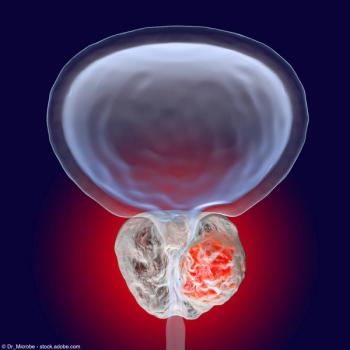
The treatment combination was associated with median radiographic progression-free survival of 14.3 months vs 6.2 months with enzalutamide alone.
Illuccix has been previously approved in the US, Australia, Canada, and Europe.

Overall, 85% of respondents indicated they experienced frequent bladder leaks.

Arpeet Shah, MD, highlights the shift toward precision medicine, ongoing work force challenges, the integration of AI, and more.