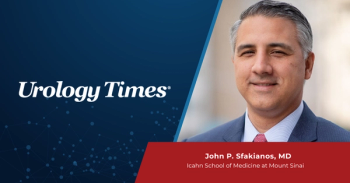
John P. Sfakianos, MD, discusses how ctDNA can be optimally integrated into bladder cancer clinical trials.
Beckermann explained that adenosine blockade may be better shown in the durability of response, so data collection in the study remains ongoing.
At the
Overall, the data indicated that the addition of ciforadenant, an adenosine A2a receptor agonist, to front-line ipilimumab and nivolumab did not lead to an improvement in initial efficacy, although the regimen did show an acceptable safety profile.1 However, Beckermann noted in an interview with Urology Times® that adenosine blockade may be better shown in the durability of response, so data collection in the study remains ongoing.
Beckermann is a GU medical oncologist and the medical director of GU clinical research at Tennessee Oncology in Nashville, Tennessee.
This phase 1b/2 trial intends to build on the data collection from the phase 3 CheckMate 214 trial (NCT02231749), which showed that nivolumab plus ipilimumab improved overall survival and objective response rate vs sunitinib in patients with untreated advanced RCC.2
Beckermann explained, “The rationale for this clinical trial was [that] unfortunately, we're not curing everybody in that trial, so are there things that we could improve upon?”
In total, the study enrolled 51 patients, of whom 29 had bulk RNA sequencing on baseline tissue samples. The primary end point was tumor burden reduction of greater than 50%.
At a median follow-up of 9.4 months, 34% of patients (n = 17) achieved greater than 50% tumor shrinkage. The objective response rate was 46% (95% CI, 33 to 60), with 16% of patients (n = 8) achieving progressive disease as best response. The median duration of response was 8.51 months (95% CI, 2.66 to NE), and the median progression-free survival was 11.04 months (95% CI, 7.1 to 13.8). At the time of data report, 19 patients remained on trial.
“So, most of those numbers are on par with what CheckMate 214 showed, and not necessarily dramatically increasing efficacy at this early time point,” Beckermann explained. “Part of the hypothesis is that blocking of adenosine might show in the durability of immune responsiveness.”
DISCLOSURES: Beckermann noted consulting disclosures with Alpine Bioscience, Aveo, Aravive, Arcus, Adicept, BMS, Exelixis, Eisai, J&J, Merck, Nimbus, Novartis, and Xencor.
REFERENCES
1. Beckermann K, Haas NB, George DJ, et al. Phase Ib/II trial of ipilimumab, nivolumab, and ciforadenant (adenosine A2a receptor antagonist) in first-line advanced renal cell carcinoma (RCC), a kidney cancer research consortium study. Presented at: 2025 European Society for Medical Oncology Congress. October 17-21, 2025. Berlin, Germany. Abstract 2596MO
2. Tannir NM, Albigès L, McDermott DF, et al. Nivolumab plus ipilimumab versus sunitinib for first-line treatment of advanced renal cell carcinoma: extended 8-year follow-up results of efficacy and safety from the phase III CheckMate 214 trial. Ann Oncol. 2024 Nov;35(11):1026-1038. doi:10.1016/j.annonc.2024.07.727