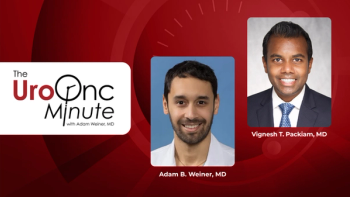
Vignesh Packiam, MD, discusses strategies to manage intravesical therapy toxicity in NMIBC, improve treatment tolerability, and preserve bladder function.
In this episode of The UroOnc Minute, host Adam B. Weiner, MD, speaks with Hashim U. Ahmed, BM BCh (Oxon), about patient selection, imaging, and the future direction of focal therapy for localized prostate cancer.
Welcome back to
In this episode of The UroOnc Minute, host Adam B. Weiner, MD, sits down with Hashim U. Ahmed, BM BCh (Oxon), at the
Framing the conversation within current guideline recommendations, Weiner emphasizes the importance of offering focal therapy within the context of clinical trials or prospective registries to ensure rigorous outcome assessment and patient safety. Ahmed, a global leader in focal therapy research, outlines the characteristics of the ideal candidate, stressing that focal therapy should not be viewed as an alternative to active surveillance. Instead, he explains that appropriately selected patients with intermediate-risk localized disease—typically with unilateral, MRI-visible grade group 2 or select grade group 3 lesions and limited contralateral disease—may derive the greatest benefit.
Throughout the discussion, Ahmed underscores the critical importance of high-quality imaging and biopsy techniques in patient selection. Drawing on the United Kingdom’s widespread adoption of prebiopsy MRI following landmark studies such as PROMIS (NCT01292291) and PRECISION (NCT02380027), he describes how standardized imaging infrastructure and close collaboration with radiologists have improved diagnostic confidence. Although evolving guidelines suggest that systematic biopsy may eventually be omitted in select cases, Ahmed explains why he still favors combining targeted and systematic sampling, particularly when considering patients for focal therapy. The stakes, he notes, are uniquely high in this setting because recurrence may arise not only from incomplete treatment of the index lesion but also from occult disease that was missed during initial staging. As focal therapy continues to mature, Ahmed believes advances in artificial intelligence, risk calculators, genomic tools, and biomarker integration may further refine patient selection and potentially reduce diagnostic burden in the future.
The conversation also explores where the field may be heading next. Ahmed predicts that active surveillance will increasingly expand into favorable grade group 2 disease. At the same time, focal therapy may gradually move toward treating more significant intermediate-risk and even select high-risk cancers in carefully staged patients. He highlights ongoing research efforts, including the IP2-ATLANTA (NCT03763253) trial evaluating ablative therapy in the metastatic prostate cancer setting, as evidence of the field’s growing ambition. For community urologists interested in establishing focal therapy programs, Ahmed offers practical advice grounded in caution and experience: prioritize MRI quality, master diagnostic accuracy, begin with well-established ablative technologies such as cryotherapy, high-intensity focused ultrasound, or irreversible electroporation, and initially select lower-volume, lower-risk lesions to build experience safely. Above all, he stresses the importance of disciplined follow-up protocols, prospective data collection, and registry participation to ensure responsible adoption of focal therapy as the evidence base continues to evolve.