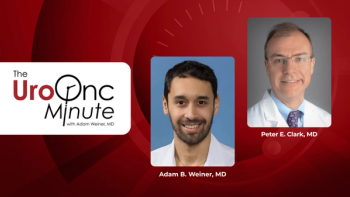
Peter Clark, MD, discusses key updates to NMIBC guidelines, including revisions to risk stratification, the emerging role of biomarkers, and how to navigate treatment options for BCG-unresponsive disease.
Isaac Y. Kim, MD, PhD, MBA, joins to discuss the evolving data surrounding neoadjuvant therapy before radical prostatectomy in prostate cancer.
In this episode of The UroOnc Minute, host Adam B. Weiner, MD, is joined by Isaac Y. Kim, MD, PhD, MBA, professor and chair of urology at Yale University in New Haven, Connecticut, to discuss the evolving role of neoadjuvant therapy before radical prostatectomy for patients with high-risk prostate cancer.
Kim highlights findings from a study (NCT02949284) currently under review evaluating a 3-month course of androgen deprivation therapy combined with apalutamide (Erleada) before surgery.1 According to Kim, the approach was associated with downstaging that enabled greater neurovascular bundle preservation, with improved functional outcomes related to continence and erectile function.
Kim also discusses how these findings relate to those from the phase 3 PROTEUS trial (NCT03767244), which evaluated neoadjuvant and adjuvant apalutamide plus androgen deprivation therapy (ADT) in patients with high-risk, localized or locally advanced prostate cancer undergoing radical prostatectomy.2 He notes several important differences between the PROTEUS design and his own study, including the duration of systemic therapy and the trial’s comparator. In PROTEUS, patients received 6 months of apalutamide plus ADT before surgery and an additional 6 months after surgery, while the control arm received 12 months of ADT. Kim emphasizes that these differences make direct comparisons between the studies difficult and says additional data, including outcomes from the radical prostatectomy only arm in PROTEUS, will be important in determining how the findings may inform clinical practice.
Looking ahead, Kim says ongoing follow-up in the PROTEUS trial will be important for clarifying the balance between oncologic benefit and functional outcomes with neoadjuvant treatment. He raises particular questions about whether longer courses of ADT may affect the technical ability to perform nerve-sparing surgery, citing fibrosis around the neurovascular bundle that he has observed following prolonged systemic therapy.
“I think this regimen is too aggressive,” Kim says, adding that future approaches may need to consider de-intensification if additional data demonstrate a meaningful cancer-control benefit while also prioritizing quality of life. The conversation underscores the need for further prospective data to define the appropriate duration and combination of neoadjuvant therapy before radical prostatectomy.
REFERENCES
1. Zhang A, Consalvo A, Ward B, et al. NEOADJUVANT APALUTAMIDE THERAPY ENHANCES POTENCY PRESERVATION FOLLOWING RADICAL PROSTATECTOMY BY DOWNSTAGING THE DISEASE IN MEN WITH HIGH-RISK PROSTATE CANCER: RESULTS OF A RANDOMIZED THREE-ARM PHASE II TRIAL. J Urol. 2026;215(5S):e790. doi:10.1097/01.JU.0001191508.89690.7a.02
2. Taplin ME, Gleave M, Shore ND, et al; PROTEUS Investigators. Perioperative apalutamide in high-risk localized prostate cancer. N Engl J Med. 2026. doi:10.1056/NEJMoa2603878