A real-world analysis found that PSADT was undocumented in most patients with high-risk biochemical recurrence of prostate cancer, potentially delaying treatment initiation and underestimating progression risk.
Freedland is a professor of urology at Cedars-Sinai in Los Angeles, California.
A real-world analysis found that PSADT was undocumented in most patients with high-risk biochemical recurrence of prostate cancer, potentially delaying treatment initiation and underestimating progression risk.
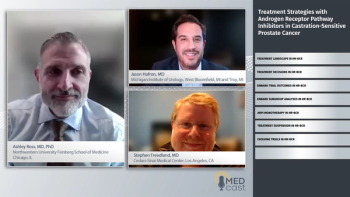
The faculty discusses how ARPI monotherapy may fit into the management of high-risk biochemically recurrent prostate cancer, with a focus on patient selection, trade-offs of monotherapy versus combination therapy, and practical counseling around efficacy, quality of life, and adverse events. The conversation also explores emerging questions around biomarkers, PARP inhibitors, treatment intensification, and how monotherapy may evolve as a therapeutic option in select patients.
The faculty discuss how androgen receptor pathway inhibitor–based strategies are reshaping the management of high-risk biochemical recurrence, with an emphasis on risk stratification, imaging, and patient selection for systemic therapy. The conversation also explores how long-term clinical evidence, treatment suspension, and emerging study designs are informing more individualized treatment decisions in practice.

Discover essential insights for managing metastatic prostate cancer, including the importance of clinical trials and early genetic testing.
Explore the complexities of treatment protocols for metastatic hormone-sensitive patients, focusing on therapy cessation and re-initiation strategies.
Affordability and Accessibility of Therapies in mCSPC Care
In this episode of The UroOnc Minute, host Adam B. Weiner, MD, speaks with Stephen J. Freedland, MD, about the role of diet and nutrition in prostate cancer risk and outcomes.
Experts discuss evolving treatment strategies for metastatic castration-resistant prostate cancer, emphasizing personalized therapy and innovative options.
Experts discuss evolving treatment strategies for metastatic castration-resistant prostate cancer, emphasizing personalized therapy and innovative options.
Healthcare professionals discuss patient selection, treatment strategies, and compliance tools for managing advanced prostate cancer effectively.
Experts discuss the importance of genetic testing in managing aggressive prostate cancer, emphasizing early testing and actionable mutations for treatment decisions.
It seems there is no text provided for summarization. Please provide the text you'd like summarized, and I'll be happy to help!
Healthcare professionals discuss the importance of patient counseling on treatment options, emphasizing the balance between efficacy and quality of life.
Identifying the Ideal Patient for Doublet versus triplet in mCSPC
Explore the latest long-term data on abiraterone and enzalutamide, revealing survival benefits and safety insights for prostate cancer treatments.
Explore the evolving landscape of prostate cancer treatments, focusing on efficacy, tolerability, and the nuances of various therapies.
Experts discuss the future of metastatic cancer treatment, focusing on risk stratification, personalized therapies, and the balance between intensification and de-escalation.
Healthcare professionals discuss the importance of patient characteristics and comorbidities in selecting effective and tolerable treatments.
Healthcare professionals discuss the importance of patient characteristics and comorbidities in selecting effective and tolerable treatments.

The series concludes with a forward-looking discussion on ongoing research and unresolved questions about long-term enzalutamide therapy. Freedland reflects on evolving treatment paradigms and offers key takeaways for practicing urologists to help guide their management of men with high-risk, biochemically recurrent prostate cancer.
Mechanisms of Action and Differentiation Among ARPI Therapies in mCSPC
Current Treatment Landscape and Guideline Recommendations in mCSPC
This discussion emphasizes practical implementation. Freedland outlines how urologists and medical oncologists can collaborate to ensure timely therapy initiation and shares insights into patient- and disease-specific factors that drive the choice of androgen receptor inhibitor in clinical practice.
Freedland reviews enzalutamide’s long-term safety profile, drawing from the EMBARK, ARCHES, and ENZAMET trials. He explains strategies for managing adverse events, balancing efficacy with tolerability, and comparing safety outcomes across other androgen receptor pathway inhibitors to help clinicians personalize care.
This segment centers on the landmark EMBARK trial, which demonstrated a significant overall survival benefit with enzalutamide plus leuprolide. Freedland discusses the clinical implications of these findings, how they may alter treatment guidelines, and the importance of counseling asymptomatic patients about the benefits of early systemic therapy.
Freedland explores how enzalutamide’s role has expanded from advanced settings to earlier use in high-risk, biochemically recurrent prostate cancer. He discusses the clinical rationale for early initiation, particularly for urologists less familiar with systemic therapy, and compares enzalutamide with other androgen receptor pathway inhibitors in this population.

Stephen J. Freedland, MD, shares 'unprecedented' overall survival data from the phase 3 EMBARK trial.

Stephen J. Freedland, MD, placed dietary guidance within the broader context of survivorship care.

Among men without prostate cancer at baseline, healthier dietary patterns appeared somewhat protective.

Surprisingly, the Mediterranean diet—which has shown benefits in other areas of health—was not consistently linked to prostate cancer risk reduction.
October 30th 2025

January 18th 2023
November 6th 2025