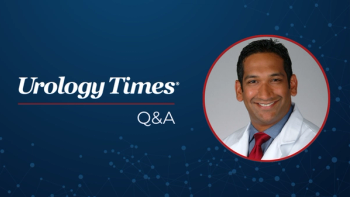
Sandip Prasad, MD, MPhil, discusses ENVISION trial findings on mitomycin for intravesical solution and patient selection in clinical practice.

Sandip Prasad, MD, MPhil, discusses the evolving role of chemoablation in recurrent low-grade, intermediate-risk NMIBC, including patient selection and treatment considerations.
The management of recurrent low-grade, intermediate-risk non–muscle invasive
In the following Q&A, Sandip M. Prasad, MD, MPhil, discusses the evolving role of chemoablation in this disease setting. Prasad served as the lead investigator for the pivotal ENVISION study (NCT05243550), which led to FDA approval of mitomycin for intravesical solution (Zusduri; formerly UGN-102) in June 2025. More than 1 year after its approval, he offers his perspectives on patient selection, treatment considerations, and the potential role of chemoablation in clinical practice.
Prasad is the vice chair of urology and director of the genitourinary surgical oncology program at Atlantic Health Morristown Medical Center and Garden State Urology.
Prasad: We have had a standard management strategy for many decades for this disease space. Low-grade, intermediate-risk non–muscle invasive bladder cancer is typically characterized by recurrence as the most important factor. It's a disease that uncommonly progresses but can be a burden to both patients and providers because of the degree of recurrence, frequency of recurrence, and utilization of resources both by patients in terms of their time and what they have to go through, as well as physicians in terms of what we schedule and take care of.
Historically, the management has always been the same. It's been some sort of surgical resection, typically a TURBT [transurethral resection of the bladder tumor], and then administration of medicine in the bladder, typically a chemotherapy agent—initially mitomycin, more commonly now gemcitabine. [Treatment] utilizes both a surgical strategy and a postoperative adjuvant strategy for prevention. The instillations that are given afterward are typically given once a week for 6 weeks initially and, if effective, then once a month for 12 months. So, you're talking about a surgical treatment and then up to 18 intravesical bladder treatments with a catheter for the year afterward. Even for 1 recurrence, it can be a fairly significant burden for patients in terms of what they have to go through.
More recently, though, we've had a changing paradigm for this disease space. Occasionally for small recurrences, we'll fulgurate in the office. That may not be a durable solution, but it can certainly knock down very small tumors and save patients from having to go into the operating room. I occasionally even do active surveillance on small recurrences for patients who are older or more frail, where I'm waiting for maybe more than just 1 tumor recurrence before I take them to the operating room, stop their blood thinner, and then put them through an operation.
Then most recently, we have, in the last couple of years, the inclusion of chemoablation. This is paradigm shifting—going from an operative approach primarily with cystoscopy and either fulguration or resection to actually using nonsurgical treatments to eradicate bladder cancers. There’s only 1 FDA-approved chemoablation option right now, which is UGN-102 that uses a chemoablative gel, but there are others being studied as well. This paradigm of chemoablation, nonsurgical management for low-grade intermediate-risk disease, is already here and will continue to expand.
Prasad: Part of your question answered the first aspect: All these patients have to be recurrent. For a patient with a de novo bladder tumor, you're looking because someone had gross hematuria and you see a papillary-looking tumor, that tumor needs to have a TURBT. You need to make sure that you can adequately establish the grade and stage of any tumor before you begin to put them into a risk category. I always tell patients the first step, no matter what, is full, complete resection with stage and grading.
Following that, intermediate risk is characterized by 3 features, and in post hoc analyses we found that Zusduri works quite well with any of these features. This can be large tumors greater than 3 cm, multiple tumors or multifocal tumors, and tumors that recur within a year. When we looked at the patients in ENVISION, 80% of patients had multifocal tumors and over 50% had a recurrence within a year; there were large tumors in the cohort as well. What we found is that there's efficacy across all 3 of those groups. There's no particular group that you should avoid in this space of recurrent low-grade, intermediate-risk non–muscle invasive bladder cancer.
I start off with a certain type of patient initially, and it's the patient [for whom] I don't think the current strategy is working. This may be a patient who's recurring every 3, 6, or even 12 months, and has done this for several years. Clearly, my existing strategy of TURBT or intravesical therapy isn't effective in that patient because they keep recurring, so for me it's a nice way to pivot to something novel that appears to have quite a bit of efficacy and durability. The second type of patient is the one who has complications from going through TURBT. These are patients who are on blood thinners chronically, and it's a risk for them to come off it because they have a valve, or they have a history of stroke or blood clots. It's patients who have anesthesia complications, so people with heart attacks or COPD [chronic obstructive pulmonary disease], where putting those patients to sleep can have some sort of adverse event on them as well. That's an easy second patient for me to pick to start a nonoperative approach because I can keep them out of the operating room.
But again, in the end, fortunately, because the efficacy data [are] so strong, there really isn't a patient population that you should not use Zusduri. I tell most providers, use Zusduri initially in those patients you don't want to operate on. I think most of us know who those patients are in our practices. Once you start there, you build confidence and comfort. Now that the drug has been on the market for over a year, I think that providers are beginning to expand the use of Zusduri across the entirety of the space, and that's how I use it as well. But I think, again, patients who either have operative risk or those patients who have recurrent disease despite what we're doing currently, those are no-brainers in my opinion.
Prasad: We’ve alluded to the benefits already: It's staying out of the operating room, avoiding general anesthesia, [and] avoiding discontinuation of blood thinners. When we ask patients about reporting their bladder symptoms after a TURBT, I think, and I'm guilty of this as well, we often tell patients, "You may have some dysuria, burning, or some urinary symptoms for a couple of days." But when we ask patients, those symptoms really last for weeks. I think sometimes we underestimate how much patients have to recover from a TURBT, whether that means lost work or discomfort and pain. That is clearly the benefit of avoiding an operative approach.
The downside is that patients have to come into the office once a week for 6 weeks. That's the standard of care in the adjuvant setting, but not all patients choose to get intravesical adjuvant therapy. There obviously is an alternative where you can go to sleep for 15 to 20 minutes, and we can eradicate the tumor that way. There is potentially a benefit of saying, "Listen, you don't have to come 6 times. You can get this all done in 1 setting." I offer alternatives equally to patients. You're going to see [an adverse-event] profile that may be a little bit more gentle with intravesical therapies over time, but obviously it does require coming in once a week for 6 weeks.
For patients who are interested in getting full adjuvant and maintenance therapy after TURBT, there's clearly a benefit in the reduction of the number of visits to a provider. The follow-up is the same in terms of the cystoscopy schedule, so we're not really changing follow-up. With durable responses, we're shifting from just going to the operating room and cutting out tumors and recovering to checking the bladder in the office periodically, and patients leaving and remaining disease-free. The important benefit is durability. As we have more data, now out to 3 years, we're seeing that 65% of patients who have a complete response maintain it, and this is in a patient population where the majority had recurred within a year. For those patients, you've radically changed their natural history of disease, where they were expecting to come back, have another tumor, and have it resected, to now just getting cystoscopies once or twice a year and knowing they're doing well. That, to me, is the primary benefit, but I think there are others as well.
Prasad: In some of our other chemoablative trials that we're doing right now, we have to test for certain types of disease-specific expression, for example, of a gene of FGFR. There's an oral agent being studied today where this is only going to be used in patients who are FGFR-expressing. There's no testing for Zusduri. We don't have to do additional testing beyond confirming this as low-grade, recurrent non–muscle invasive bladder cancer that's intermediate-risk—multifocal, recurring within a year, or greater than 3 cm. For patients, there's no additional step to make sure their tumor is amenable to this. You can simply meet with them after a cystoscopy is done and offer treatment. That is 1 less step than we may need for other chemoablative strategies that are being studied.
As I mentioned, all patients have had recurrent disease, so many of these patients have already gone through some episode of catheterization in the office, so they're somewhat familiar with that process. There's a little bit more in terms of preparation of the gel that takes place, but that's done by our staff ahead of time. The whole time in the office probably is about 45 minutes to an hour for the patient. We'll dip the urine, make sure there's no urinary tract infection, and then we’ll formulate the medication and put it on ice. It is administered when cold and then it solidifies as a gel inside the body. Patients then come in and they have a catheter placed like they're accustomed to. The urine is drained. The gel is then put into the bladder. We typically leave the catheter in place for about 15 minutes or so just to allow the gel to solidify. Then the catheter is removed and patients can leave the office. It's a similar process to what most of our patients are doing. There are no position changes because the gel solidifies within just minutes, so they're not rotating and trying to get anything in the bladder to touch all the surfaces like we do for BCG, for example, where there's a process of postinstillation manipulation by position change.
Many patients worry about the risk of leaking out the solution in the bladder. With BCG or some of our novel intravesical therapies for BCG-unresponsive carcinoma in situ, these drugs are very expensive, and if patients void 10 minutes after receiving them, we do worry that they haven't gotten the benefit of the agent. Because [Zusduri] is not an aqueous drug—it's given as a gel—even if the patient voids 10 to 20 minutes later, they're going to void out just urine. The gel will have already solidified and adhered to the wall of the bladder, so it takes a little bit of the pressure off in terms of having to hold the agent for longer, moving positions, etc. I think patients find that to be reassuring.
Prasad: I think it's important that we continue to publish data at 4 years and then again at 5 years when the study is closed and talk about those patients who received treatments years prior, showing a benefit that's been durable with a nonsurgical chemoablative intervention. Every year we can provide more data for that, I think it's to the benefit of both patients and providers to adopt these types of treatments.
The sea is also going to begin to rise in the whole concept of chemoablation. There are multiple other agents being studied currently in this space. Some are administered via catheter, and some are oral. We're going to allow even more opportunity for providers to understand the role of chemoablation in the management of this disease, and the more options we have for patients, the better it is for us. As more of these drugs are studied and hopefully eventually approved, the tide is going to keep rising on the whole space of chemoablation. It's like many things that we do: We may look back in 5 to 10 years and wonder why we did so much surgery in this space. As long as our treatments are efficacious and durable, I really hope that we're able to say that in the future.
Prasad: The drug has now been on the market for over a year. That gets us out of the window for some of the issues regarding insurance coverage that many people worry about when a drug is newly approved. In my experience, coverage for Zusduri has been excellent across all insurance plans. That hurdle that often exists for new medications following approval has been reached and passed for this agent. For providers who are interested in utilizing Zusduri for their patients with low-grade, intermediate-risk non–muscle invasive bladder cancer, it's easy to find it. You can find it online. It's a 1-page submission, and you can get patients on these treatments fairly rapidly. I encourage people to find those patients in their practice where they feel like the current paradigm isn't working and begin to offer those patients an alternative approach with chemoablation.