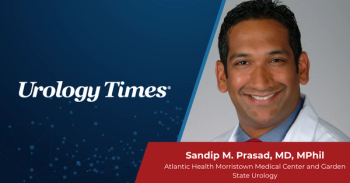
Sandip M. Prasad, MD, MPhil, discusses the safety profile of mitomycin intravesical solution, including common adverse events and patient counseling during chemoablation for NMIBC.
Lin Lin, MD, highlights a phase 2 trial of neoadjuvant SAbR followed by surgery in patients with newly diagnosed renal cell carcinoma and caval tumor thrombus.
Data presented at 2025
In an interview with Urology Times®, presenting author Lin Lin, MD, discussed the background and key findings from the study. Lin is a urologic oncology fellow at UT Southwestern Medical Center in Dallas, Texas.
"The goal of this study was to see if radiating the tumor thrombus before surgery would allow it to help prevent tumor thrombi [embolization] somewhere else and cause recurrences," Lin explained.
In total, the prospective phase 2 study included 23 patients with newly diagnosed RCC. Patients received neoadjuvant SAbR as 40 Gy over 5 fractions or 36 Gy over 3 fractions, followed by surgery. The median follow-up was 35.2 months.
Data showed a 12-month relapse-free survival (RFS) of 71.4% (80% CI, 56.6 to 82.0; P = .087). This compared favorably with the historical surgery-alone cohort, which had a 12-month RFS of 55.7%. Overall survival and cancer-specific survival at 12 months were both 95.2%.
Neoadjuvant SAbR was also found to be safe and feasible, with no radiation-related adverse events (AEs) of grade 4 or higher nor any reported cases of pulmonary embolism. Perioperative AEs of grade 3 or higher were reported in 36.4% of patients.
REFERENCE
1. Lin L. Late Breaking Abstract: Phase II trial of neoadjuvant stereotatic ablative radiotherapy for caval tumor thrombus in newly diagnosed renal cell carcinoma. Presented at: Society of Urologic Oncology Annual Meeting; December 2-5, 2025; Phoenix, Arizona