
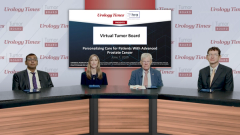
Opinion|Videos|July 3, 2026
Treatment Intensification in Metastatic Castration-Sensitive Prostate Cancer
In the final episode, “Treatment Intensification in Metastatic Castration-Sensitive Prostate Cancer,” the panelists explored the evolving role of treatment intensification strategies for patients with metastatic castration-sensitive prostate cancer (mCSPC). Using the case of a 63-year-old man with de novo high-volume metastatic disease, the expert faculty discussed how disease burden, patient fitness, comorbidities, and individual treatment goals influence decisions regarding doublet versus triplet therapy.
Advertisement
In the final episode, “Treatment Intensification in Metastatic Castration-Sensitive Prostate Cancer,” the panelists explored the evolving role of treatment intensification strategies for patients with metastatic castration-sensitive prostate cancer (mCSPC). Using the case of a 63-year-old man with de novo high-volume metastatic disease, the expert faculty discussed how disease burden, patient fitness, comorbidities, and individual treatment goals influence decisions regarding doublet versus triplet therapy.
The panel examined key considerations when selecting candidates for treatment intensification, including performance status, extent of metastatic disease, and patient willingness to accept treatment-related toxicity in exchange for potential improvements in long-term outcomes. Faculty members discussed the ongoing debate surrounding the role of docetaxel in the modern treatment landscape and highlighted the need for additional evidence to better define which patients derive the greatest benefit from chemotherapy-containing regimens. The discussion also focused on factors that influence androgen receptor pathway inhibitor (ARPI) selection, including tolerability, financial considerations, cardiovascular risk factors, steroid exposure, and patient comorbidities. Expert faculty reviewed findings from the ARASENS trial and discussed real-world evidence from the ARAAT analysis comparing darolutamide- and abiraterone-based triplet regimens. The panel considered how these data may inform treatment selection while acknowledging the strengths and limitations of real-world analyses.
Finally, the faculty addressed long-term management strategies, including monitoring for treatment-related toxicities, assessing neuropathy and quality of life, and planning subsequent therapies as patients progress through the advanced prostate cancer continuum. Throughout the episode, the panel emphasized individualized treatment planning and shared decision-making to optimize outcomes while maintaining patient quality of life. Thank you for watching this virtual tumor board series on advanced prostate cancer. Please subscribe to our newsletter for information on upcoming video series.
Advertisement
Related to this article

Engy Habashy, MD, discusses key takeaways from the 2025 AUA GSM guideline, including the role of androgens and hormonal therapies in managing genitourinary syndrome of menopause.

Chad R. Ritch, MD, MBA, FACS, discusses how PSMA-PET informs staging, treatment planning, recurrence workup, and the interpretation of equivocal findings.

Michael S. Cookson, MD, MMHC, FACS, discusses how Anktiva’s expanded FDA approval may broaden bladder-preserving treatment options for BCG-unresponsive papillary-only NMIBC.

Jeffrey M. Spier, MD, discusses how fatigue may impact patient quality-of-life and when dose reduction may be an appropriate treatment strategy.

This approval expands the perioperative use of pembrolizumab plus enfortumab vedotin to all patients with MIBC, regardless of cisplatin eligibility.
Take a look through some of the notable data presentations at this year's ESMO Congress.

The investigational HIF-2α inhibitor casdatifan demonstrated antitumor activity as monotherapy and in combination regimens across the ARC-20 platform study.

The agency issued a PDUFA target action date of June 14, 2027.
Advertisement
Advertisement
Trending on Urology Times
1
European Commission approves perioperative pembrolizumab plus enfortumab vedotin for MIBC
2
Michael Cookson, MD, reacts to Anktiva’s expanded approval in NMIBC
3
FDA accepts new drug application for UGN-103 in recurrent LG-IR-NMIBC
4
ESMO 2026: Key presentations across genitourinary oncology
5