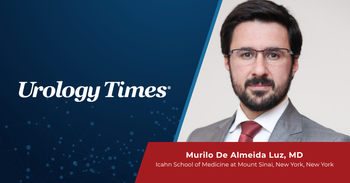
In this video, recorded at the 2026 American Urological Association Annual Meeting in Washington, DC, Murilo De Almeida Luz, MD, gives an overview of the DAROL study design and key findings.
Murilo De Almeida Luz, MD, is a urologic oncologist at Mount Sinai Icahn School of Medicine in New York, New York.
In this video, recorded at the 2026 American Urological Association Annual Meeting in Washington, DC, Murilo De Almeida Luz, MD, gives an overview of the DAROL study design and key findings.
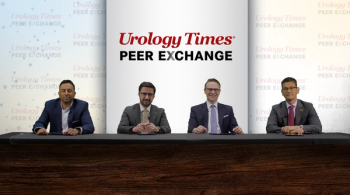
In this closing segment, Dr. Charles J. Ryan leads a discussion on how clinicians integrate multiple sources of evidence when making long term treatment decisions in metastatic castration sensitive prostate cancer (mCSPC).
In this segment, Dr. Charles J. Ryan invites the panel to discuss how clinicians evaluate evidence from observational studies and propensity matched analyses in metastatic castration sensitive prostate cancer (mCSPC).
In this segment, Dr. Charles J. Ryan presents a clinical case scenario to explore how real world evidence informs treatment decisions in metastatic castration sensitive prostate cancer (mCSPC).
In this segment, Dr. Charles J. Ryan and the panel explore how clinicians interpret subgroup analyses, pivotal trial data, and real world evidence when managing metastatic castration sensitive prostate cancer (mCSPC).
In this segment, Dr. Charles J. Ryan invites the panel to discuss how clinicians interpret clinical trial results in the context of real world patient populations with metastatic castration sensitive prostate cancer (mCSPC).
In this segment, Dr. Charles J. Ryan leads a panel discussion with Dr. Alan H. Bryce, Dr. Murilo De Almeida Luz, and Dr. Jayram on key clinical considerations that influence treatment selection when intensifying therapy for metastatic castration sensitive prostate cancer (mCSPC).
In this segment, Dr. Charles J. Ryan asks Dr. Murilo De Almeida Luz to discuss how clinicians interpret data from pivotal phase 3 clinical trials evaluating androgen receptor pathway inhibitors used in combination therapy for metastatic castration sensitive prostate cancer (mCSPC).
In this segment, Dr. Charles J. Ryan invites Dr. Jayram and Dr. Alan H. Bryce to discuss how potential central nervous system effects influence treatment selection in metastatic castration sensitive prostate cancer (mCSPC).
In this segment, Dr. Charles J. Ryan asks Dr. Murilo De Almeida Luz to discuss the importance of evaluating drug drug interaction profiles when selecting androgen receptor pathway inhibitors for patients with metastatic castration sensitive prostate cancer (mCSPC).
In this segment, Dr. Charles J. Ryan asks Dr. Alan H. Bryce to discuss how long term tolerability influences the selection of androgen receptor pathway inhibitors for patients with metastatic castration sensitive prostate cancer (mCSPC).
In this segment, Dr. Charles J. Ryan asks Dr. Jayram to discuss the key clinical considerations that guide the selection of androgen receptor pathway inhibitors when intensifying therapy for metastatic castration sensitive prostate cancer (mCSPC).
In this segment, Dr. Charles J. Ryan asks Dr. Jayram to discuss the patient specific considerations that influence the transition from deciding to intensify therapy to selecting a particular treatment strategy in metastatic castration sensitive prostate cancer (mCSPC).
In this segment, Dr. Charles J. Ryan asks Dr. Alan H. Bryce how clinicians balance the benefits of treatment intensification with the potential for added toxicity in patients with metastatic castration sensitive prostate cancer (mCSPC), particularly in older individuals or those with significant comorbidities.
In this segment, Dr. Charles J. Ryan asks Dr. Murilo De Almeida Luz to discuss how treatment intensification strategies may differ across various clinical presentations of metastatic castration sensitive prostate cancer (mCSPC).
In this segment, Dr. Charles J. Ryan asks Dr. Alan H. Bryce to explain why androgen deprivation therapy (ADT) alone is no longer considered adequate treatment for most patients with metastatic castration sensitive prostate cancer (mCSPC).
In this segment, Dr. Charles J. Ryan asks Dr. Jayram how the concept of survivorship has become an increasingly important consideration in the management of metastatic castration sensitive prostate cancer (mCSPC).
The discussion explores how the rising burden of comorbidities and polypharmacy in patients with metastatic castration-sensitive prostate cancer requires clinicians to carefully balance therapy intensification with overall health status, medication interactions, and long-term safety when developing individualized treatment plans.
The discussion introduces how the treatment landscape for metastatic castration-sensitive prostate cancer has evolved, highlighting that patients are now living longer with metastatic disease and often have multiple comorbidities, making long-term tolerability and quality of life key considerations in treatment planning.
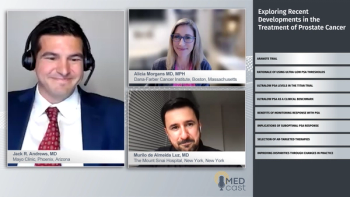
Jack R. Andrews, MD; Alicia Morgans, MD, MPH; and Murilo de Almeida Luz, MD, discuss how ultralow prostate-specific antigen thresholds (below 0.02) serve as important prognostic biomarkers in metastatic hormone-sensitive prostate cancer, with recent post hoc analyses from the ARANOTE trial showing that patients achieving these ultralow levels with combination androgen deprivation therapy plus darolutamide therapy have significantly better radiographic progression-free survival and time to castration-resistant disease compared with those who don't reach these thresholds.
Jack R. Andrews, MD; Alicia Morgans, MD, MPH; and Murilo de Almeida Luz, MD, discuss how ultralow prostate-specific antigen thresholds (below 0.02) serve as important prognostic biomarkers in metastatic hormone-sensitive prostate cancer, with recent post hoc analyses from the ARANOTE trial showing that patients achieving these ultralow levels with combination androgen deprivation therapy plus darolutamide therapy have significantly better radiographic progression-free survival and time to castration-resistant disease compared with those who don't reach these thresholds.
Murilo De Almeida Luz, MD, discusses data on PSA and ALP changes in patients receiving enzalutamide plus radium-223 vs enzalutamide alone.