


Salvage lymph node dissection results in an immediate complete PSA response in about one-third of patients with rising PSA and nodal recurrence following local therapy for prostate cancer, according to German researchers.
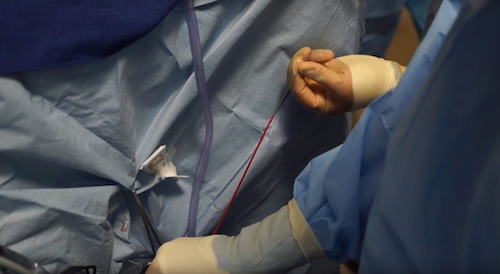
Salvage lymph node dissection results in an immediate complete PSA response in about one-third of patients with rising PSA and nodal recurrence following local therapy for prostate cancer, according to German researchers.
High-grade proctitis after radical radiation therapy with neoadjuvant or adjuvant hormonal therapy is significantly less likely in patients taking angiotensin-converting-enzyme inhibitors.
Adherence to guidelines for the use of combination radiation therapy and androgen deprivation therapy in the United States for the treatment of high-risk or locally advanced prostate cancer has decreased over time, according to data presented by Paolo Dell’Oglio, MD.
“It is clear that in order to reduce the morbidity of PSA screening and early detection of prostate cancer, more needs to be done,” writes Badar M. Mian, MD.
Results of a 2-year clinical trial support switching to a less frequent administration schedule when using zoledronic acid (Zometa) to prevent skeletal-related events in men with prostate cancer.
Findings from two new studies provide insight on the impact of changing recommendations for prostate cancer screening and management.
Other pipeline developments discussed include an implantable device for OAB treatment, a subcutaneous hypogonadism treatment, efficacy results for an HPV drug, and the status of a device-based BPH treatment.
In this edition of Men’s Health Mythbuster, Matthew Pollard, MD, Jesse N. Mills, MD look at what impact stress really has on the cardiovascular system.
Our #LetsTalkMensHealth section offers clinical tips on the care of male patients. In 2016, articles in this section tackled a variety of subjects, including the Affordable Care Act, epigenetics and genetics, and BPH and prostate cancer prevention.
These are Urology Times' most-read prostate cancer articles of 2016.
Researchers at UCLA have discovered a previously unrecognized type of progenitor cell in inflamed areas of the prostate that have the ability to initiate cancer in response to genetic changes.
Other products discussed include a stent system for treating ureteral obstructions, a male infertility test, and more.
These four videos depict expert techniques for buried penis repair.
Fewer than 20% of patients with biochemical recurrence after radical prostatectomy develop metastasis, and a smaller proportion die as a result of prostate cancer.
Other pipeline developments discussed include a bladder cancer test, a male infertility assay, and the first oral dosage treatment for hypogonadism.
"There are significant data examining the role of heat exposure to male sperm. However, none of it is very high quality and the data are murky at best," write James R. Craig, MD, MS; William Brant, MD; and James M. Hotaling, MD, MS.
A new approach to prostate cancer screening has been proposed by investigators who claim the idea of informed decision-making by primary care physicians is not working when it comes to PSA testing.
Other new products discussed in this article include a surgical training model, devices designed to improve prostate biopsy accuracy, an updated label and more.
Although a recent study of testosterone therapy does not fulfill the need for large-scale, randomized, controlled studies of the treatment, “it is very informative in several ways,” writes Arthur L. Burnett, II, MD, MBA.
Long-term testosterone therapy in hypogonadal men improves urinary function and erectile function compared with untreated controls, according to registry data from a single practice.
“I think we’re seeing more younger men coming in with erectile dysfunction, because there’s just a lot more publicity about the issue," one urologist said.
Other pipeline developments discussed in this article include the initiation of an intravesical bladder cancer study, a gel treatment for ED that has met its primary endpoint, a patent awarded for the first rechargeable implantable SNM along with some other advancements.
The risk of prostate cancer relapse after radical prostatectomy increases with lengthening delay between diagnosis and surgery. The impact, however, is significant only in high-risk patients, and even in those men, there may be a window of up to 12 months during which it may be relatively safe to postpone surgery, reported researchers from Milan, Italy.
In this interview, Daniel Shoskes, MD, discusses his evaluation of patients with scrotal pain, outlines his use of conservative treatments, and explains surgical approaches and how he decides whether to use them.