

Eugene Cone, MD, discusses recombinant BCG for NMIBC, including ongoing clinical evaluation and its potential to address ongoing BCG supply challenges.
Eugene Cone, MD, discusses recombinant BCG for NMIBC, including ongoing clinical evaluation and its potential to address ongoing BCG supply challenges.
Eugene Cone, MD, discusses SWOG S1602 findings comparing Tokyo-172 and TICE BCG and the potential role of alternative BCG strains in NMIBC

Eugene Cone, MD, discusses the impact of ongoing BCG supply challenges and the potential role of alternative and recombinant strains for NMIBC care.
Jack Andrews, MD; Eugene Cone, MD; and Akshay Sood, MD, discuss how real-world safety and efficacy data for androgen receptor inhibitors (apalutamide, darolutamide, and enzalutamide) in nonmetastatic castration-resistant prostate cancer (nmCRPC) show darolutamide may offer superior tolerability with lower discontinuation rates and fewer drug interactions, while emphasizing the importance of critically evaluating real-world studies by examining methodology rather than just conclusions.

Jack Andrews, MD; Eugene Cone, MD; and Akshay Sood, MD, discuss how real-world safety and efficacy data for androgen receptor inhibitors (apalutamide, darolutamide, and enzalutamide) in nonmetastatic castration-resistant prostate cancer shows darolutamide may offer superior tolerability with lower discontinuation rates and fewer drug interactions, while emphasizing the importance of critically evaluating real-world studies by examining methodology rather than just conclusions.

Jack R. Andrews, MD; Eugene B. Cone MD; and Edwin Posadas, MD, FACP, discuss how early intervention with individualized treatment approaches based on disease volume, patient characteristics, and biomarkers significantly improves survival outcomes in metastatic hormone-sensitive prostate cancer.
Jack R. Andrews, MD; Eugene B. Cone MD; and Edwin Posadas, MD, FACP, discuss how early intervention with individualized treatment approaches based on disease volume, patient characteristics, and biomarkers significantly improves survival outcomes in metastatic hormone-sensitive prostate cancer.

“If it is as efficacious as it looks, we will have more patients who are getting effective standard of care treatment, not needing to go on to further treatment, not having recurrences, [having decreased] morbidity from repeated resections, and saving bladders in the process," says Eugene B. Cone, MD.
Jack Andrews MD; Eugene Cone, MD; and Arash Rezazadeh, MD, discuss how metastatic hormone-sensitive prostate cancer presents clinically, explore current treatment standards including combination therapies, evaluate emerging data from the ARANOTE trial on darolutamide efficacy, consider quality of life factors in treatment selection, and examine how novel therapeutic approaches may reshape future care pathways.
Jack Andrews MD; Eugene Cone, MD; and Arash Rezazadeh, MD, discuss how metastatic hormone-sensitive prostate cancer presents clinically, explore current treatment standards including combination therapies, evaluate emerging data from the ARANOTE trial on darolutamide efficacy, consider quality of life factors in treatment selection, and examine how novel therapeutic approaches may reshape future care pathways.
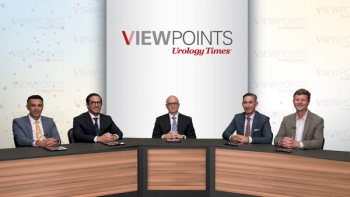
The panel concludes by offering key takeaways on the evolving treatment landscape for BCG-unresponsive non–muscle invasive bladder cancer.
Experts on non–muscle invasive bladder cancer discuss promising developments in the overall treatment landscape, highlighting potentially practice-changing clinical research.
Bladder cancer specialists discuss their strategies for monitoring patients with BCG-unresponsive non–muscle invasive bladder cancer.
A panel of experts provide clinical insights on factors that inform how they select treatments for patients with BCG-unresponsive non–muscle invasive bladder cancer.
Experts on bladder cancer discusses strategies to minimize adverse effects and the role of immunotherapy in BCG-unresponsive NMIBC treatment paradigms.
Bladder cancer experts discuss quality of life and progression considerations and their impact on treatment decisions for patients with BCG-unresponsive NMIBC.
Jason Hafron, MD, CMO, provides an overview of the QUILT trial investigating N-803 in patients with BCG-unresponsive high-grade non–muscle invasive bladder cancer.
The panel reviews data from the SunRISe-1 trial investigating TAR-200 and offers its impressions on the efficacy and safety findings.
Bladder cancer experts discuss the evolving treatment landscape in BCG-unresponsive NMIBC and give an overview of TAR-200, an emerging therapy.
A panel of experts on non–muscle invasive bladder cancer (NMIBC) discuss challenges associated with BCG shortages and the impact on treatment options and patients’ quality of life.

September 17th 2026
September 21st 2026

September 11th 2026

March 1st 2025

