Articles by Neal Shore, MD, FACS

Panelists discuss the impact of long-term care in patients with non–muscle-invasive bladder cancer (NMIBC), considering the unique needs of specific patient groups and highlighting advancements in NMIBC treatment that may support better care experiences for patients.

Panelists discuss the impact of long-term care in patients with non–muscle-invasive bladder cancer (NMIBC), considering the unique needs of specific patient groups and highlighting advancements in NMIBC treatment that may support better care experiences for patients.
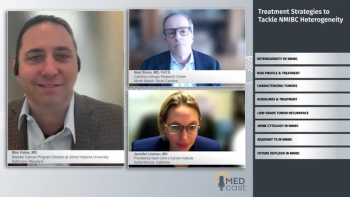
Panelists examine disease heterogeneity in NMIBC and discuss a balanced treatment approach that prioritizes patient quality of life and surgery effectiveness.
Panelists examine disease heterogeneity in NMIBC and discuss a balanced treatment approach that prioritizes patient quality of life and surgery effectiveness.

Panelists explore challenges in identification of intermediate risk patients and emphasize importance of risk stratification to improve outcomes in regards to NMIBC.
Panelists explore challenges in identification of intermediate risk patients and emphasize importance of risk stratification to improve outcomes in regards to NMIBC.

Neal Shore, MD, FACS, highlights the exciting advancements in radioligand therapy for prostate cancer, noting that ongoing trials are exploring its use in various disease stages and settings, and emphasizes the importance of reviewing the VISION and FORE trial publications for further insights.
Neal Shore, MD, FACS, discusses the evolving use of follow-up PSMA PET scans and the recent FORE trial, which showed that Lutetium-177 improves radiographic progression-free survival and PSA levels in prechemotherapy patients with mCRPC, with more data on overall survival and quality of life expected.
Neal Shore, MD, FACS, emphasizes the significance of the VISION and TheraP trials in supporting the FDA approval of Lutetium-177 for patients with mCRPC who have undergone androgen receptor inhibitor and taxane treatments, highlighting the role of PSMA PET imaging in treatment sequencing and patient selection.
Neal Shore, MD, FACS, discusses how the patient profile in the VISION trial, which involved progression on multiple therapies, reflects typical cases for Lutetium-177 treatment, emphasizing the crucial role of PSMA PET imaging in determining treatment suitability.
Neal Shore, MD, FACS, discusses the progress of a 65-year-old patient with mCRPC through various treatments and evaluation for Lutetium-177 therapy based on his PSMA PET scan and MRI.

Neal Shore, MD, FACS, and Brian Shuch, MD, provide closing thoughts on the potential of PET/CT imaging to improve patient care in kidney cancer.
Urologists review clinical trials investigating new imaging options in kidney cancer, including the ZIRCON study looking at girentuximab.
Kidney cancer specialists discuss recent advances in imaging for diagnosis and disease management, highlighting sestamibi and zirconium scans.
Brian Shuch, MD, and Neal Shore, MD, FACS, discuss the staging and treatment of kidney cancer, including when to biopsy and how often to do follow-up imaging.

Neal Shore, MD, FACS, offers clinical insights on optimizing patient selection and treatment sequencing in BCG-unresponsive NMIBC.

Key Takeaways on Evolving Bladder Cancer Treatment Landscape
ByAxel Merseburger, MD, PhD,M. Carmen Mir, MD, PhD,Shilpa Gupta, MD,Neal Shore, MD, FACS The expert panel concludes its discussion by providing key takeaways on the evolving bladder cancer treatment landscape following ESMO 2023.
A urologist discusses treatments in the pipeline that can further improve the therapeutic landscape in BCG-unresponsive NMIBC.
Approach to Collaborative Care in Bladder Cancer
ByAxel Merseburger, MD, PhD,M. Carmen Mir, MD, PhD,Shilpa Gupta, MD,Neal Shore, MD, FACS The panel discusses the Large Urology Group Practice Association and provides insights on collaborative care approaches in bladder cancer.
Comprehensive insights on the unmet needs addressed by TAR-200 in BCG-unresponsive non-muscle-invasive bladder cancer.
Neal Shore, MD, FACS, reviews agents and treatment options being researched in the BCG-unresponsive NMIBC treatment space.
Following a review of the limitations of current treatment options, Neal Shore, MD, MFACS, discusses the SunRISe-1 trial investigating TAR-200 plus cetrelimab in patients with high-risk NMIBC.
Enfortumab Vedotin and the Role of ADCs in Bladder Cancer
ByAxel Merseburger, MD, PhD,M. Carmen Mir, MD, PhD,Shilpa Gupta, MD,Neal Shore, MD, FACS Bladder cancer specialists discuss enfortumab vedotin and the role of antibody-drug conjugates in the treatment landscape.
Bladder Cancer: Highlights from ESMO 2023 and Ongoing Developments
ByAxel Merseburger, MD, PhD,M. Carmen Mir, MD, PhD,Shilpa Gupta, MD,Neal Shore, MD, FACS The expert panel reviews highlights from ESMO 2023 and discusses ongoing developments in the treatment landscape for bladder cancer.
Bladder Cancer: Treatment Options and Managing Adverse Effects
ByAxel Merseburger, MD, PhD,M. Carmen Mir, MD, PhD,Shilpa Gupta, MD,Neal Shore, MD, FACS Comprehensive insights on treatment considerations and managing immunotherapy-related adverse effects for patients with bladder cancer.
Monitoring Patients With NMIBC
ByAxel Merseburger, MD, PhD,M. Carmen Mir, MD, PhD,Shilpa Gupta, MD,Neal Shore, MD, FACS The panel discusses strategies for monitoring patients with non–muscle invasive bladder cancer and the potential role of biomarkers.
Treatment Considerations and Role of Trimodal Therapy in Bladder Cancer
ByAxel Merseburger, MD, PhD,M. Carmen Mir, MD, PhD,Shilpa Gupta, MD,Neal Shore, MD, FACS Expert perspectives on treatment options available for patients with bladder cancer and the role of trimodal therapy.
Overview of Non–Muscle Invasive Bladder Cancer (NMIBC)
ByAxel Merseburger, MD, PhD,M. Carmen Mir, MD, PhD,Shilpa Gupta, MD,Neal Shore, MD, FACS A panel of experts on bladder cancer provide an overview of the stratification, natural history, and treatment of bladder cancer.
An expert urologist reviews the clinical hallmarks of high-risk BCG-unresponsive NMIBC and discusses the unmet needs and treatment goals.
Neal Shore, MD, FACS, provides an overview of BCG-unresponsive non-muscle-invasive bladder cancer (NMIBC), with a focus on patient presentation and risk stratification.
