

New FDA-approved perioperative options reshape bladder cancer care; learn how teams coordinate referrals, biomarkers, and bladder-sparing follow-up.
Max Kates, MD
Johns Hopkins University
Baltimore, Maryland
New FDA-approved perioperative options reshape bladder cancer care; learn how teams coordinate referrals, biomarkers, and bladder-sparing follow-up.
New perioperative bladder cancer options reshape referrals and biomarker-driven planning, helping more patients get safer, personalized care.
Experts debate bladder MRI limits after TUR/chemo and how ctDNA/utDNA may refine staging and bladder-sparing decisions in muscle-invasive disease.
Experts debate bladder MRI limits after TUR/chemo and weigh ctDNA/utDNA promise, yet accuracy gaps keep bladder-sparing decisions cautious.
ctDNA and urine DNA reshape bladder cancer care, guiding surgery timing and adjuvant therapy—yet key questions await clearer trials.
EV+pembrolizumab drives deep nodal responses in bladder cancer, shifting decisions on cystectomy and retroperitoneal node dissection.
See how cystectomy after immunotherapy looks surprisingly routine, with insights on pelvic node dissection and post-op treatment decisions.
Watch surgeons review cystectomy after immunotherapy—tissue planes stay familiar, lymph node dissection matters, and adjuvant choices remain unclear.
EV-pembro and immunotherapy may shorten time to cystectomy, with fewer chemo-era blood issues but new immune toxicities to manage.
New bladder cancer trials test perioperative immunotherapy combos, weighing added enfortumab vedotin vs adjuvant de-escalation to boost durable cures.
EV/pembrolizumab in EV-304 delivers strong pathologic response, event-free and overall survival gains versus standard chemo, reshaping neoadjuvant bladder cancer choices.
This episode, titled “Comparing Perioperative Strategies in Cisplatin-Eligible MIBC,” features panelists discussing how the KEYNOTE-B15/EV-304 trial is reshaping perioperative treatment considerations for patients with muscle-invasive bladder cancer (MIBC). The expert faculty review the study design evaluating perioperative enfortumab vedotin plus pembrolizumab (EVP) compared with standard neoadjuvant gemcitabine-cisplatin (Gem-CIS), and discuss how these findings may influence treatment selection in cisplatin-eligible patients.
In “Perioperative Therapy Expansion in Cisplatin-Ineligible MIBC,” our panel explores how the treatment paradigm for muscle-invasive bladder cancer (MIBC) is rapidly evolving with the emergence of effective perioperative therapies for cisplatin-ineligible patients. The expert faculty discuss how traditional approaches that relied heavily on determining cisplatin eligibility are changing in light of recent clinical trial data supporting enfortumab vedotin plus pembrolizumab (EVP) in patients who historically would have proceeded directly to surgery.
In this episode, “The Emerging Perioperative Era in MIBC with the NIAGARA Trial,” the expert faculty explore how the NIAGARA trial is reshaping the treatment landscape for muscle-invasive bladder cancer (MIBC). The panel reviews the clinical data supporting perioperative durvalumab plus gemcitabine-cisplatin (GC) in cisplatin-eligible patients, including findings related to pathologic complete response, event-free survival, overall survival, and safety, and discusses how these outcomes are influencing treatment strategies in clinical practice.
Welcome back to another Urology Times Peer Exchange series. In this episode titled, “The Evolving Treatment Landscape in MIBC,” the expert faculty discuss how the treatment landscape for muscle-invasive bladder cancer (MIBC) is evolving with the emergence of perioperative treatment strategies that integrate systemic therapy before and after surgery.

Panelists discuss how patients with early recurrent low-grade bladder cancer, especially those on an anticoagulant or with multiple risk factors, represent ideal candidates for ablative therapy with UGN-102 to break the cycle of repeated transurethral resection of bladder tumors and provide a paradigm shift from purely surgical management to shared decision-making between surgical and medical treatment options.
Panelists discuss how patients with recurrent low-grade bladder cancer, particularly women who may face additional anatomical challenges during transurethral resection of bladder tumor (TURBT) procedures, can benefit from UGN-102 as an alternative to repetitive surgical resections, addressing the TURBT treadmill phenomenon where patients undergo multiple procedures with diminishing returns.
Panelists discuss how UGN-102, a reverse thermal hydrogel formulation of mitomycin, offers an FDA-approved ablative treatment option for patients with intermediate-risk non-muscle invasive bladder cancer (NMIBC), demonstrating 80% complete response rates in the ENVISION trial (NCT05243550) and allowing for the de-escalation of surveillance and reduced surgical burden.

Panelists discuss the impact of long-term care in patients with non–muscle-invasive bladder cancer (NMIBC), considering the unique needs of specific patient groups and highlighting advancements in NMIBC treatment that may support better care experiences for patients.

Panelists discuss the impact of long-term care in patients with non–muscle-invasive bladder cancer (NMIBC), considering the unique needs of specific patient groups and highlighting advancements in NMIBC treatment that may support better care experiences for patients.
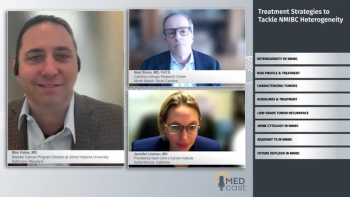
Panelists examine disease heterogeneity in NMIBC and discuss a balanced treatment approach that prioritizes patient quality of life and surgery effectiveness.

Panelists examine disease heterogeneity in NMIBC and discuss a balanced treatment approach that prioritizes patient quality of life and surgery effectiveness.

Panelists explore challenges in identification of intermediate risk patients and emphasize importance of risk stratification to improve outcomes in regards to NMIBC.
Panelists explore challenges in identification of intermediate risk patients and emphasize importance of risk stratification to improve outcomes in regards to NMIBC.

Max Kates, MD, discusses how the ability to deliver newer treatments in local urology clinics rather than specialized centers reduces patient travel burden and improves access to care, while suggesting that increased education about safety profiles and implementation protocols could encourage broader adoption among health care providers.
A panelist discusses how transitioning to quarterly treatment administration reduces clinic resource strain through decreased staff time and equipment usage, while therapies requiring minimal specialized handling further streamline operations and improve workflow efficiency.
Max Kates, MD, discusses how newer therapies for BCG-unresponsive NMIBC may have better long-term cost-effectiveness despite higher initial costs, emphasizing the importance of leveraging patient assistance programs, copay cards, and foundation support to ensure treatment access while using cost comparison tools to help patients make informed decisions.
A panelist discusses how treatment decisions involve balancing clinical efficacy with financial considerations, noting that patients often prefer treatments with fewer office visits and minimal lifestyle disruption when presented with multiple effective options.
Max Kates, MD, discusses how early complete response rates exceeding 50% at 3 months with newer therapies are encouraging, though long-term follow-up remains critical for evaluating durability of response and establishing real-world effectiveness compared with clinical trial outcomes.
A panelist discusses how targeted gene therapy, particularly nadofaragene firadenovec, represents a paradigm shift in BCG-unresponsive NMIBC treatment.

February 11th 2025
February 18th 2025

December 23rd 2024

January 29th 2025

February 5th 2025