

Practice Management
Latest News
Advertisement
Latest Videos





Shorts
0:44
Joy Maulik, CRNP, highlights LUGPA Advanced Practice Provider Forum
5 months ago
by
Joy Maulik, CRNP
0:55
Archan Khandekar, MD, on the future for AI in urology
5 months ago
by
Archan Khandekar, MD

1:13
Jennifer Miles-Thomas, MD, discusses areas of opportunity for urology APPs
7 months ago
by
Jennifer Miles-Thomas, MD, URPS, MBA

0:59
The Expert APProach: Preparing the Next Generation of APPs
7 months ago
by
Joy Maulik, CRNP(+1 more)

1:03
Giulia Almiron da R. Soares on social media and urology recruitment
8 months ago
by
Giulia Almiron da R. Soares

1:12
The Expert APProach: The importance of physician-directed care
9 months ago
by
Joy Maulik, CRNP
1:11
Kate Kraft, MD, discusses how to build leadership presence as an introvert
10 months ago
by
Kate H. Kraft, MD, MHPE, FACS, FAAP

1:02
Amanda North, MD, discusses imposter syndrome and reframing your thinking
10 months ago
by
Amanda C. North, MD
1:07
Farah Rahman, MD, discusses wearable tech in measuring burnout
10 months ago
by
Farah Rahman, MD, MPH
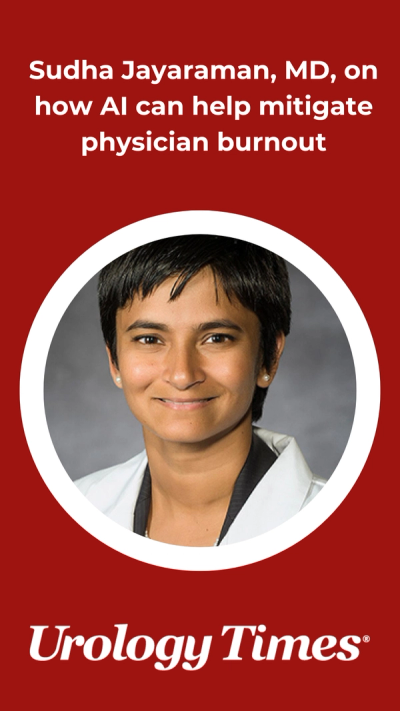
0:55
Sudha Jayaraman, MD, on how AI can help mitigate physician burnout
10 months ago
by
Sudha Jayaraman, MD, MSc, FACS
Podcasts




Advertisement
More News
Jennifer Miles-Thomas, MD, URPS, MBA, emphasizes that teleurology and team-based care models offer significant promise
This episode delivers an empowering, forward-looking conversation on how APPs and physicians alike can lead health care transformation.
"Although social media may not be for every health care worker, I hope that moving forward, more medical content creators will collaborate with the academic medical community to shape the world for the better," writes Maheetha Bharadwaj, MD.

As the year comes to a close, we revisit some of this year’s top content on urology coding and reimbursement.

"The overall 0% impact to urology does not help urology practices deal with increasing costs incurred for staff, rent, supplies, and other overhead," write Jonathan Rubenstein, MD, and Mark Painter.
"Once money is in a Roth IRA, the withdrawal rules depend on whether the funds are contributions, conversions, or earnings," writes Julie Khazan, CFP.

"Based on the code description, we recommend basing the code selection on the documentation and the effort required to complete the service, and not the number of foreign bodies removed from the bladder," write Jonathan Rubenstein, MD, and Mark Painter.
"Site neutrality is a pivotal issue for all independent practices, and really, it's a pivotal issue for all Americans because it affects both the global cost of care as well as the acceleration and the cost of care," says Mara R. Holton, MD.
Jonathan Henderson, MD, recaps his LUGPA 2025 session, “Lessons Learned: Avoiding Pitfalls in Urology Practice Management.”

Sisters Amy Pearlman, MD, and Michelle Pearlman, MD, provide an overview of their shared practice, Prime Institute.

"I think the most important thing, or take-home message that we try to share, is gathering data, understanding what those metrics are from the very beginning," says Brooke B. Edwards, MD.

"The main issue in DC now is the Medicare Physician Fee Schedule," says Scott Sellinger, MD, FACS.

"The OBBA includes broad and sweeping changes that will have a profound impact," writes Allan Shen, CFP.

Scott B. Sellinger, MD, FACS, discusses the challenges facing urologists, the loss of telehealth flexibility, and why bipartisan action remains urgent.

The code, J9282, will be effective on January 1, 2026.

Sevann Helo, MD, recaps an SMSNA 2025 session on setting patient boundaries.

Findings showed that although most applicants emphasized work ethic and interpersonal skills, these attributes were not predictive of receiving an interview invitation.

Miles-Thomas emphasized the importance of Northwestern’s thoughtful implementation strategy.

"Based on this proposal, some shifts may significantly impact the practice of urology," write Jonathan Rubenstein, MD, and Mark Painter.

Both urologists emphasized that Northwestern’s integrated structure and commitment to innovation allow any urologist within the network to contribute ideas and see them developed into practice.

Avani Desai emphasizes that inadequate or unclear parental leave policies carry significant consequences, particularly during residency.

Ultimately, Desai argues, increasing transparency in policies is not only about compliance but about fostering resident well-being and inclusivity.

Canes describes the challenges of modern urology practice, from the deluge of portal messages to the variability in how clinicians deliver pre- and post-visit instructions
Advertisement
Advertisement
Trending on Urology Times
1
LIB-01 enters phase 2b development for erectile dysfunction
2
Treatment Targets, Formulations, and the Future of Testosterone
3
Jonathan Rosenberg, MD, reacts to FDA approval of durvalumab plus EV for MIBC
4
Pearls & Perspectives: Exploring Radiofrequency Therapy for Erectile Dysfunction, With Mohit Khera, MD
5