





Men's Health
Latest News
Advertisement
Latest Videos





Shorts

1:03
Helen L. Bernie, DO, MPH, outlines how she evaluates hypogonadism
10 months ago
by
Helen L. Bernie, DO, MPH
0:59
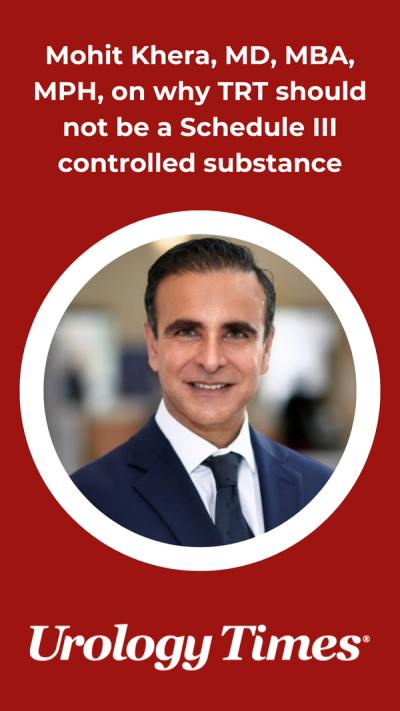
Mohit Khera, MD, MBA, MPH, on why TRT should not be a Schedule III controlled substance
10 months ago
by
Mohit Khera, MD, MBA, MPH

0:54
Jesse Mills, MD, on the effects of pairing anastrozole with TRT
10 months ago
by
Jesse N. Mills, MD

1:01
Jesse Mills, MD, on why low T requires more than a single blood test
a year ago
by
Jesse N. Mills, MD

1:26
Leila Momtazi-Mar discusses sperm retrieval in patients with Klinefelter Syndrome
a year ago
by
Leila Momtazi-Mar
Podcasts





CME Content



Advertisement
More News

Take a look back through some of the top stories from the first half of the year.

Justin Dubin, MD, discussed how patients' growing trust in digital tools could be leveraged to support lifestyle changes and improve health outcomes.

In healthy aging men without developing diabetes mellitus, modest increases in HbA1c were linked with declines in sperm motility and erectile function.

Mina M. Fam, MD, discusses some of the common misconceptions that patients have when seeking testosterone replacement therapy.

“With the right use, AI can and hopefully will play a massive role in patient education,” says Justin M. Dubin, MD.

Justin M. Dubin, MD, outlines the current ways that artificial intelligence is being used in the male infertility space.

Catch up on exclusive videos you may have missed from the first half of the year.

In this video, part 5 in a 5-part series, panelists examine the economic and logistical realities of bringing mitomycin for intravesical solution (Zusduri; formerly UGN-102) into private practice.
In this video, part 4 in a 5-part series, Nick Liu, MD, outlines key scenarios where surgical resection remains preferred for treating LG-IR-NMIBC.
In this video, part 3 in a 5-part series, panelists discuss the long-term clinical impact and health care system implications of mitomycin for intravesical solution (Zusduri; formerly UGN-102).
In this video, part 2 in a 5-part series, Nick Liu, MD, breaks down the formulation behind mitomycin for intravesical solution (Zusduri; formerly UGN-102).
In this video, part 1 in a 5-part series, panelists discuss how mitomycin for intravesical solution (formerly UGN-102, now marketed as Zusduri) fits into the evolving management landscape for recurrent bladder tumors.

The trial is evaluating the efficacy of leflutrozole in improving testicular function and promoting spermatogenesis.

Justin Dubin, MD, touches on the current landscape of men’s health, with a specific focus on the advent of AI.

The study also found racial differences in the time to proceeding with surgical therapy.

A recap of the FDA submissions and regulatory decisions in urology from May 2025.

The single-use test can deliver diagnostic results for chlamydia and gonorrhea in approximately 30 minutes.

“What [we] found was that those men who received a penile implant had a significant reduction in depression and psychological distress," says Mohit Khera, MD, MBA, MPH.

Explore the latest insights on testosterone therapy, its benefits, and practical applications from leading urologists in men's health.

The freedom from re-intervention rate was 71%.
Urologists discuss innovative BPH treatments, emphasizing personalized care, and the importance of ejaculatory preservation.

New research reveals GLP-1 receptor agonists may enhance sperm counts in overweight men.

A phase 3 trial reveals a combination therapy for premature ejaculation significantly enhances treatment outcomes.

A groundbreaking male contraceptive shows promising safety results, offering a reversible option for couples seeking effective birth control.

In February 2025, the FDA recommended a removal of the black box warning related to an increased risk of adverse cardiovascular outcomes for all testosterone products. This recommendation has important implications for urologists and the patients they treat.
Advertisement
Advertisement
Trending on Urology Times
1
How PSMA-PET shapes staging and recurrence workup in prostate cancer
2
European Commission approves perioperative pembrolizumab plus enfortumab vedotin for MIBC
3
ESMO 2026: Key presentations across genitourinary oncology
4
Engy Habashy, MD, on the role of androgens in GSM management
5