





Men's Health
Latest News
Advertisement
Latest Videos






CME Content


Advertisement
More News

“I think it's really important to understand the role of prevention and early detection,” says Michael Lutz, MD.

Urologists made up only 25% of shock wave therapy providers and 13% of the providers were not physicians.

"Now, men have the option to seek out something minimally invasive before surgical options are breached," says Denise Asafu-Adjei, MD, MPH.
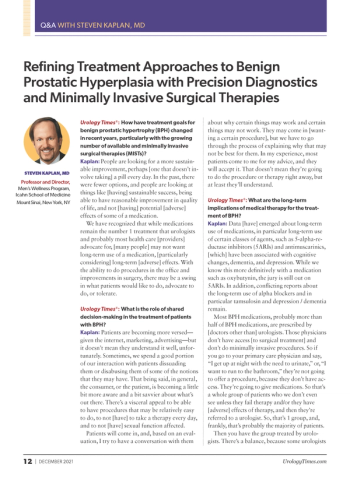
In this interview, Steven Kaplan, MD, from the Men's Wellness Program at the Icahn School of Medicine at Mount Sinai in New York discusses treatment goals, shared decision-making, and long-term implications of currently available therapies for patients with benign prostatic hyperplasia.

“Whether it is E-cigarettes or other products, the goal should be complete cessation,” says Omar El Shahawy, MD, MPH, PhD.

In this interview, Omar El Shahawy, MD, MPH, PhD, discusses patient counseling in regard to e-cigarette use or vaping by using data from a recent study on evaluating the association of e-cigarette use and erectile dysfunction.

“I think that the audience should know that there is a movement going on,” says Geo Espinosa, ND.

In this installment of the Urology Times' 50th Anniversary Innovation Celebration, Arthur L. Burnett, MD, MBA, FACS, discusses how sildenafil citrate (Viagra) has been an integral part of erectile dysfunction management for decades.
“We need to create this safe, comfortable, welcoming environment for men to talk about the things that they need to talk about,” says Justin Dubin, MD.

To destigmatize testosterone deficiency, Justin Dubin, MD, advises clinicians on how to create a comfortable space for their patients and advises patients on how to be comfortable with talking about their deficiency.

On this episode of Cleveland Clinic’s Cancer Advances podcast, Sarah Vij, MD, discusses the different fertility-sparing techniques used for both pre-pubertal and post-pubertal male cancer patients.

"Of note, there have been no studies demonstrating that vaccines negatively impact fertility or cause sterility in either sex," said Ranjith Ramasamy, MD.

“What's most important [is] that…one dose does not just fit all,” says Martin M. Miner, MD.

“The goal of this study was to look at that original phase 3 trial data [from 2013] and see if we could identify how much change in curvature patients were achieving with each of those 2 injections,” says Matthew J. Ziegelmann, MD.

"Interestingly, we found that the prevalence of male infertility in men with type 1 diabetes was 1.5%, comprising 33 out of more than 2000 men diagnosed with type 1 diabetes who reported male infertility," says Omer A. Raheem, MD, MSc, in this interview.

“Being able to have a follow-up visit that is convenient, that saves time, that saves money, but that can allow you to put everything together for the patient…is still a very valuable tool,” says Juan José Andino, MD.

"None of our patients had unexpected appointments that had to be made after their video encounters…supporting this idea that at least in urology, it seems that telehealth is a substitute for inpatient care when appropriately selected by the physician,” says Juan José Andino, MD.
According to recently published studies, having COVID-19 could have lasting impacts on fertility and sexual function.

“I think doctors should be aware that if men do complain of erectile dysfunction after [having] COVID-19 that it could be because of underlying endothelial dysfunction and underlying vasculature issues,” Ramasamy says.
Men with Peyronie’s disease have an increased risk of being diagnosed with a substance use disorder, anxiety disorder, depression, and self-injurious behaviors.

Investigators observed a decline in the number of men obtaining repeat postvasectomy semen analyses.
“The available information [on] male infertility websites right now is not of good quality,” Samplaski says.

O’Leary is 1 of 10 surgeons in the United States capable of performing the surgery to install the FDA-cleared Penuma penile enhancement implant.

Only 5% of websites studied discuss risks of treatments, investigators found.

A new drug application has been filed for SOV2012-F1 (Kyzatrex) for the treatment of adult men with primary or secondary hypogonadism.
Advertisement
Advertisement
Trending on Urology Times
1
The UroOnc Minute: Key Updates to the AUA NMIBC Guideline, With Peter E. Clark, MD
2
John Sfakianos, MD, on integrating ctDNA into bladder cancer trials
3
AMA issues Category I CPT codes for implantable tibial neuromodulation in UUI
4
Closing Risk Stratification Gaps in Localized Prostate Cancer With AI
5