
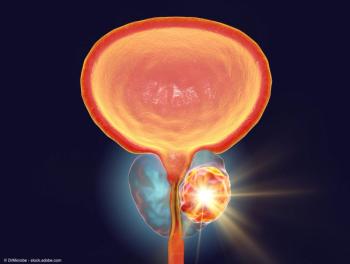
"Catheters go in, [and] they come out within 2 to 3 days for my patients. Therefore, the perioperative period is very easy for patients, whereas radical surgery requires catheters for 7 to 10 days," says Kevin R. Basralian, MD.
"Catheters go in, [and] they come out within 2 to 3 days for my patients. Therefore, the perioperative period is very easy for patients, whereas radical surgery requires catheters for 7 to 10 days," says Kevin R. Basralian, MD.
"Since transforming the BPH market, Aquablation has as given a degree of confidence for the surgeon as well as for the patient," says Ravi Munver, MD.

"Our research focused on the outcomes at 6 months, [and we] were looking at disease recurrence and hernia occurrence," says Jennifer Nguyen.
"Even though most urologists who do retroperitoneal surgery do it for posterior tumors, you actually can do it equally well with as equally good success for an anterior tumor," says Michael D. Stifelman, MD.

"We found out the using IRIS intraoperatively during partial nephrectomy does help us with preserving renal parenchyma," says Teona Iarajuli.
Press Release
"With intravesical chemotherapy, there aren't the side effects we see with intravenous chemotherapy because the drugs only treat the bladder lining and very little, if any, of the medicine gets absorbed in the bloodstream," said Nitin Yerram, MD.

"What was great about this partnership is we recognized that this is going to be the future of medicine at some point, and we want to be able to be a part of that cutting edge technology," says Nitin K. Yerram, MD.

"Aquablation therapy is as effective as other minimally invasive treatments [for these men] but with fewer side effects, including only a 10% to 15% risk of retrograde ejaculation," said Ravi Munver, MD.