

"[It’s about] understanding that as urologists, we are board certified to take care of all genders, and we do have data and evidence to support us in taking better care of our female patients," says Rachel Rubin, MD.
"[It’s about] understanding that as urologists, we are board certified to take care of all genders, and we do have data and evidence to support us in taking better care of our female patients," says Rachel Rubin, MD.
“Then finally, when we asked about Xiaflex, it was only two-thirds of programs, less than 70% of programs listed that they were having the residents exposed to Xiaflex,” says Justin Loloi, MD.

"We found that the prevalence of both depression and anxiety were significantly higher in the men's health clinic," says Nestor F. Suria Cordero, MD.

"This is a phase 1 clinical trial, so we're primarily looking at safety and adverse events. We’ve had none in the 46 participants that we have so far," says David Alejandro Velasquez.

"It's really great because that means we can look at treating men sooner even if they're still presenting, and in what we would traditionally or classically call the acute phase, we're able to offer an FDA approved therapy at an earlier timeline," says Jesse N. Mills, MD.

“This year in particular, we really attempted to highlight a novel conversation about financial toxicity,” says Mara R. Holton, MD.

Drs Bechis and Semins discuss future developments in urinary stone management, emphasizing the potential for improved vacuum aspiration devices, combined intravenous and PCNL surgeries, and the hope for medications to dissolve stones.

"[The findings] certainly made me a lot less anxious for those patients who do need to continue their aspirin," says Smita De, MD, PhD.

"I think the main take-home message from our study is that this is a really powerful prognostic prediction tool," says Charles Parker, MD.

“I think the takeaway from the active surveillance [session] is that we've increased the utilization of active surveillance for low-risk appropriate men,” says David S. Morris, MD, FACS.
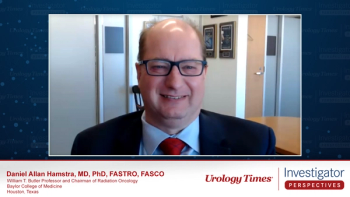
Analysis of SpaceOAR trial and pooled data found reduced penile bulb radiation dose correlated with better preservation of sexual function over long-term follow-up, suggesting rectal spacers help maintain erectile function in some men with prostate cancer undergoing radiation therapy.
The Phase 3 trials for the Barrigel and BioProtect rectal spacers demonstrated a dosimetric advantage and reduced rectal toxicity similar to SpaceOAR, but data on long-term toxicity and patient-reported outcomes is still needed to fully evaluate the newer spacers.

"The providers–the nurses and the physicians and the extenders–are checking out and burning out, which is affecting quality and delivery. To me, it's a national health care crisis," says Scott A. MacDiarmid, MD, FRCPSC.

"We did not find that there were any clotting or thrombotic complications in those who did stop their aspirin," says Smita De, MD, PhD.
"We are really engaged on ensuring that a lot of the progress that had been made and the care that was delivered through the pandemic is able to continue on," says Joshua Langston, MD.

"The background for this paper stems from the increasingly identified need to do a better job of management of urinary tract infection, not only from a recognition standpoint, but also from a diagnostic and treatment standpoint," says Roger R. Dmochowski, MD, MMHC, FACS.
"The biggest thing that we're seeing in prostate cancer now, and I think will continue to evolve, is really getting into narrowing our different types and stratifying patients differently," says Benjamin H. Lowentritt, MD, FACS.
"Being able to utilize advanced practice providers to extend us, to take care of our patients, [and] to treat them in a way that is beneficial and satisfying for them as a job is really important," says Neal Patel, MD.

"There are a couple of really exciting directions we want to take this work in," says Charles Parker, MD.
Experts converse on the evolving methods for real-time intra-renal pressure monitoring, its benefits in improving surgical procedures, and the potential for future automated adjustments based on the monitored data.
Drs Bechis and Semins discuss their approaches to employing ureteral access sheaths, reviewing assessing the ureter's caliber, dilation techniques, and the potential need for stenting post-sheath use, considering patient history and logistical factors like on-call availability.

"So, my takeaway with this part of the conversation is that you can use a 0.01% estradiol cream, 1 gram, twice a week, for any peri or postmenopausal patient, and they can safely take that forever," Ashley G. Winter, MD.
“One important takeaway that we wanted to hammer home is that AI will not replace urologists, but urologists who use AI will replace those that don't,” says Neal Patel, MD.
The SpaceOAR rectal spacer phase 3 trial showed reduced toxicity and improved quality of life, leading to FDA approval, but device-related side effects have emerged with broader clinical use.
Dr Hamstra describes the three FDA-approved rectal spacers SpaceOAR, Barrigel, and BioProtect, noting differences in placement technique, advantages, potential risks, and the need for long-term clinical data on patient outcomes.

"For those people in the intervention arm who did get the assay, the doctors were more likely to prefer active treatment with surgery or radiation compared to the control group," says Adam B. Murphy, MD, MBA, MSCI.
"Overactive bladder symptoms have been shown to be influenced by these other areas in their life that can create a lot of stress and problems," says Raveen Syan, MD, FPMRS.
"This all started because of the tidal wave of new therapies that are coming out for bladder cancer," says Jonathan Henderson, MD.

"There was also an emphasis on using pathways and navigation to help facilitate this large group of patients that are being seen by urologists," says Arpeet Shah, MD.