
Opinion|Videos|July 1, 2024
Future Directions for Imaging and Biopsy in Prostate Cancer
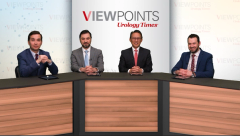
The panel offers key takeaways on the evolving landscape for imaging and biopsy in prostate cancer, highlighting the role for fusion-guided biopsy in the diagnosis and management of prostate cancer.
Advertisement
Episodes in this series

Video content above is prompted by the following questions:
- What clinical challenges and unmet needsremain regarding biopsy options in the diagnosis and management of patients with prostate cancer?
- What’s next? Are there any emerging technologies or data that you’re excited about in this area? Is there a role for fusion-guided biopsy with PSMA PET imaging in prostate cancer?
- Please share any closing thoughts or key takeaways regarding the use of fusion-guidedbiopsy in the diagnosis and management of prostate cancer?
Advertisement
Related to this article

Longer-term findings from the phase 2 ARACOG study suggest differences in objectively measured cognitive function between ARPIs.

Chad R. Ritch, MD, MBA, FACS, discusses how PSMA-PET informs staging, treatment planning, recurrence workup, and the interpretation of equivocal findings.

Jeffrey M. Spier, MD, discusses how fatigue may impact patient quality-of-life and when dose reduction may be an appropriate treatment strategy.

Jeffrey M. Spier, MD, reviews evidence on ARPI dose reduction in prostate cancer and discusses monitoring treatment response, tolerability, and dose reescalation.
Jeffrey M. Spier, MD, discusses managing ARPI-related fatigue through dose adjustments, patient monitoring, and strategies to maintain treatment adherence.

Moderators and participants reviewed ARANOTE, ARACOG, and ARASEC data and how they inform individualized treatment for mCSPC.

Jack R. Andrews, MD, discusses BED-PSMA-411 findings comparing PSMA-PET detection rates and urinary excretion in prostate cancer biochemical recurrence.

VIR-5500 is a PSMA-targeted PRO-XTEN dual-masked T-cell engager entering phase 3 development for prostate cancer.
Advertisement
Advertisement
Trending on Urology Times
1
How PSMA-PET shapes staging and recurrence workup in prostate cancer
2
ESMO 2026: Key presentations across genitourinary oncology
3
Engy Habashy, MD, on the role of androgens in GSM management
4
European Commission approves perioperative pembrolizumab plus enfortumab vedotin for MIBC
5