




Kidney Stones
Latest News
Advertisement
Latest Videos


CME Content


Advertisement
More News

Joshua M. Heiman, MD, details key findings from the POuND OUT study.

John Michael DiBianco, MD, discusses findings from the BLUES trial.

Patient-reported pain scores were significantly improved with stent omission.

“We do not feel that our results undermine the importance of fluid intake for stone prevention," says Alana C. Desai, MD.
DiBianco discusses findings from the Better Lithotripsy and Ureteroscopy Evaluation of Stenting trial.

The SOUL study is assessing patient-reported outcomes and unplanned health care utilization among patients who had stent placement vs stent omission after ureteroscopy.

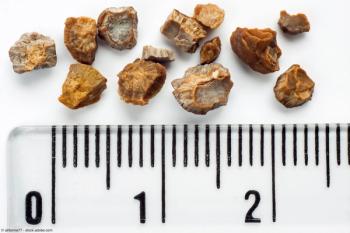
The investigators reported a median stone clearance of 96.44%.

New research links higher drinking water contaminants to increased kidney stone risk.
Data from the SOUND trial are intended to support submission for FDA 510(k) clearance of the Break Wave device.

“We have to understand as providers that we're not going to be the one and only conduit for this information anymore, which is a good thing, to be honest," says Ian Metzler, MD, MTM.

“You absolutely need to have a CT scan prior to the surgery to best identify and really intimately understand the kidney’s anatomy," says Perry Xu, MD.
Overall, 71% of patients had no fragment greater than 2 mm following treatment.

Ian Metzler, MD, discusses developments in imaging and treating stones.

“The benefit of being here at the University of Minnesota is that we have a bunch of different types of settings to be able to trial this," says Hailey Frye.
“The technology in the field of stone management is exciting, and I think it offers patients a lot more options than what they've had in the past,” says Brian Stork, MD.

“I think it's primarily due to dietary changes that are more and more prevalent regardless of sex,” says Ian Metzler, MD, MTM.

“I would say the take-home message for this study is that prescribing tamsulosin for a week prior to an anticipated surgery that involves flexible ureteroscopy is a very simple practice that certainly is within standard of care within pediatric urology," says Kate H. Kraft, MD, MHPE, FACS, FAAP.

"A lot of people are using [single-use ureteroscopes] nowadays, and part of it is because it really enhances our ability to provide guaranteed care, because we don't have to rely on the reusability of scopes," says Perry Xu, MD.
“The data presented at EAU25 add to the growing body of evidence supporting the CVAC System as the emerging standard of care in kidney stone removal,” says Brett Johnson, MD.

"We recognize that an 11% increase in success may not seem that clinically significant, but I think every little bit helps," says Kate H. Kraft, MD, MHPE, FACS, FAAP.
"For other health care professionals aiming to advocate for equitable changes within their system, it's really important to just start conversations about what you're noticing," says Hailey Frye.

“I think we can really use AI in several different facets of endourology," says Perry Xu, MD.

Calyxo has identified a new risk of injury when the CVAC System is used in patients with high viscosity fluid in their kidneys at the start of the procedure.

"When we compared the 2 groups, those that received tamsulosin and those that did not, we did find a significant difference with regard to success rates," says Kate H. Kraft, MD, MHPE, FACS, FAAP. .
Advertisement
Advertisement
Trending on Urology Times
1
Evidence for Combining Prostatic Urethral Lift With Radiotherapy
2
After curative-intent treatment, prostate cancer recurrence is still an unmet need
3
Rezūm outperforms combination pharmacotherapy for BPH symptoms at 1 year
4
AACU, WOCN Society urge safeguards in Medicare catheter bidding
5