



Kidney Stones
Latest News
Advertisement
Latest Videos








Shorts
1:12
Mathew D. Sorensen, MD, MS, FACS, on how Break Wave lithotripsy works without anesthesia
8 months ago
by
Mathew D. Sorensen, MD, MS
0:57
Matthew A. Love, MD, outlines the safety and efficacy of SURE for treating kidney stones
a year ago
by
Matthew A. Love, MD

0:59
Amy E. Krambeck, MD, discusses learning curve and advantages of FANS for treating stones
a year ago
by
Amy E. Krambeck, MD
CME Content


Advertisement
More News

In this episode, Gregory E. Tasian, MD, MSc, MSCE, Jonathan S. Ellison, MD, and patient partner Annabelle Pleskoff reflect on the origins, design, and key findings of the PKIDS trial.

We recap notable headlines from last month in the benign urology space.
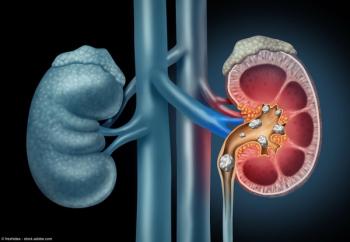
Krambeck pointed to the growing importance of medical management in stone disease prevention.

Margaret A. Knoedler, MD, discusses her experience using the Reverse Deflection CVAC System.

Both the Dornier Hoover Flexible and Navigable Suction Ureteral Access Sheath and the Dornier Axis II Slim single-use ureteroscope are FDA-cleared.
The Focalist device obtained FDA clearance in the US in July 2025.

Two-year outcomes from the ASPIRE trial continued to show that the SURE procedure led to significantly reduced health care consumption events compared with ureteroscopy.

Kevin Koo, MD, MPH, discusses the implications of a digital stone measurement tool for clinical care.

Kevin Koo, MD, MPH, discusses a recent study on the utility of a digital stone measurement tool for ureteroscopy.

We recap notable headlines from last month in the benign urology space.

Joseph Song, MD, discusses his approach to patient selection for the SURE procedure, particularly in comparison to more invasive options such as PCNL.
The findings suggest that urolithiasis continues to pose a significant healthcare burden worldwide.
New findings from the PKIDS trial raise questions about the preference for ureteroscopy in clinical practice.
"What we showed was that there's no difference in the pressures whether you use CVAC or standard ureteroscopy," says Roger Sur, MD.

Joseph Song, MD, details his experience using the CVAC device for SURE procedures.
The first patient has been dosed in the phase 1/2 redePHine trial, evaluating the safety and preliminary efficacy of ABO-101 for PH1.

According to Song, novel aspiration technologies are reshaping not only care delivery, but also long-term treatment outcomes.

The code, 0991T, will become effective on January 1, 2026.

One crucial recommendation is incorporating an ergonomic training module into the curriculum.

Amy E. Krambeck, MD, discusses how to define success and how to determine the optimal timing for adding on a new partner.

David Stanley, MD, FACS, discusses current trends and unmet needs in the treatment of patients with kidney stones.
Margaret A. Knoedler, MD, discusses the advantages of using the MONARCH platform for mini-PCNL.
Khurshid R. Ghani, MBChB, MS, FRCS, discusses how results from the SOUL trial may shape clinical decision-making regarding stent placement.

The study compared patient experiences with silicone vs polyurethane ureteral stents.
“It is possible to conserve fluid when we're trying to do these procedures without compromising patient care," says Roshan M. Patel, MD.
Advertisement
Advertisement
Trending on Urology Times
1
Evidence for Combining Prostatic Urethral Lift With Radiotherapy
2
After curative-intent treatment, prostate cancer recurrence is still an unmet need
3
Rezūm outperforms combination pharmacotherapy for BPH symptoms at 1 year
4
AACU, WOCN Society urge safeguards in Medicare catheter bidding
5