Exploring Recent Developments in the Treatment of Prostate Cancer

Panelists discuss how the recent FDA approval of darolutamide for metastatic hormone-sensitive prostate cancer (mHSPC) expands treatment options, offering improved tolerability with lower fatigue rates and fewer central nervous system adverse effects than other androgen pathway inhibitors, while exploring considerations for patient selection, trial design interpretation, and the evolving role of real-world evidence in clinical decision-making.
Panelists discuss how the recent FDA approval of darolutamide for metastatic hormone-sensitive prostate cancer (mHSPC) expands treatment options, offering improved tolerability with lower fatigue rates and fewer central nervous system adverse effects than other androgen pathway inhibitors, while exploring considerations for patient selection, trial design interpretation, and the evolving role of real-world evidence in clinical decision-making.
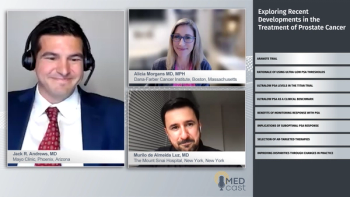
Jack R. Andrews, MD; Alicia Morgans, MD, MPH; and Murilo de Almeida Luz, MD, discuss how ultralow prostate-specific antigen thresholds (below 0.02) serve as important prognostic biomarkers in metastatic hormone-sensitive prostate cancer, with recent post hoc analyses from the ARANOTE trial showing that patients achieving these ultralow levels with combination androgen deprivation therapy plus darolutamide therapy have significantly better radiographic progression-free survival and time to castration-resistant disease compared with those who don't reach these thresholds.
Jack R. Andrews, MD; Alicia Morgans, MD, MPH; and Murilo de Almeida Luz, MD, discuss how ultralow prostate-specific antigen thresholds (below 0.02) serve as important prognostic biomarkers in metastatic hormone-sensitive prostate cancer, with recent post hoc analyses from the ARANOTE trial showing that patients achieving these ultralow levels with combination androgen deprivation therapy plus darolutamide therapy have significantly better radiographic progression-free survival and time to castration-resistant disease compared with those who don't reach these thresholds.

Jack Andrews, MD; Alicia Morgans, MD, MPH; and Ashley Ross MD, PhD, discuss how trial design, inclusion criteria, and end points like radiographic progression-free survival vs overall survival impact clinical decision-making in prostate cancer treatment, emphasizing the importance of quality of life data and the shift from using ADT alone as standard care toward combination therapies in prostate cancer management.
Jack Andrews, MD; Alicia Morgans, MD, MPH; and Ashley Ross MD, PhD, discuss how trial design, inclusion criteria, and end points like radiographic progression-free survival vs overall survival impact clinical decision-making in prostate cancer treatment, emphasizing the importance of quality of life data and the shift from using ADT alone as standard care toward combination therapies in prostate cancer management.
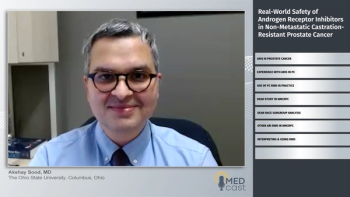
Jack Andrews, MD; Eugene Cone, MD; and Akshay Sood, MD, discuss how real-world safety and efficacy data for androgen receptor inhibitors (apalutamide, darolutamide, and enzalutamide) in nonmetastatic castration-resistant prostate cancer (nmCRPC) show darolutamide may offer superior tolerability with lower discontinuation rates and fewer drug interactions, while emphasizing the importance of critically evaluating real-world studies by examining methodology rather than just conclusions.

Jack Andrews, MD; Eugene Cone, MD; and Akshay Sood, MD, discuss how real-world safety and efficacy data for androgen receptor inhibitors (apalutamide, darolutamide, and enzalutamide) in nonmetastatic castration-resistant prostate cancer shows darolutamide may offer superior tolerability with lower discontinuation rates and fewer drug interactions, while emphasizing the importance of critically evaluating real-world studies by examining methodology rather than just conclusions.

Jack R. Andrews, MD; Eugene B. Cone MD; and Edwin Posadas, MD, FACP, discuss how early intervention with individualized treatment approaches based on disease volume, patient characteristics, and biomarkers significantly improves survival outcomes in metastatic hormone-sensitive prostate cancer.
Jack R. Andrews, MD; Eugene B. Cone MD; and Edwin Posadas, MD, FACP, discuss how early intervention with individualized treatment approaches based on disease volume, patient characteristics, and biomarkers significantly improves survival outcomes in metastatic hormone-sensitive prostate cancer.
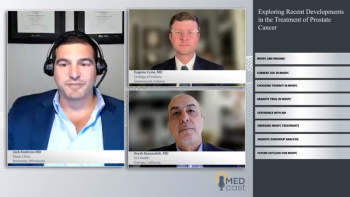
Jack Andrews MD; Eugene Cone, MD; and Arash Rezazadeh, MD, discuss how metastatic hormone-sensitive prostate cancer presents clinically, explore current treatment standards including combination therapies, evaluate emerging data from the ARANOTE trial on darolutamide efficacy, consider quality of life factors in treatment selection, and examine how novel therapeutic approaches may reshape future care pathways.
Jack Andrews MD; Eugene Cone, MD; and Arash Rezazadeh, MD, discuss how metastatic hormone-sensitive prostate cancer presents clinically, explore current treatment standards including combination therapies, evaluate emerging data from the ARANOTE trial on darolutamide efficacy, consider quality of life factors in treatment selection, and examine how novel therapeutic approaches may reshape future care pathways.
