

“There have been a lot of efforts to increase the diversity of the urologic workforce, and I think the fruits of our labor are starting to show themselves when we look at the residents,” says Amanda North, MD.
“There have been a lot of efforts to increase the diversity of the urologic workforce, and I think the fruits of our labor are starting to show themselves when we look at the residents,” says Amanda North, MD.

Dr. Andre Goy gives insight into the center’s personalized experience discussing his approach to a patient’s treatment journey. Watch now.
“From a patient care standpoint, anything that opens the door and makes the patient feel more secure and open is going to lead to better outcomes for them and allow us to serve their needs best,” says Benjamin Lowentritt, MD, FACS.
"The idea that we may have reliable and consistently interpretable tests for these patients is exciting for the future," says Benjamin Lowentritt, MD, FACS.
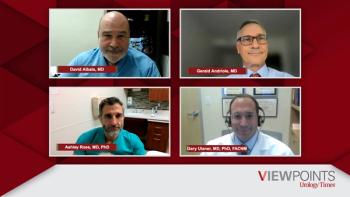
Citing recent guidelines recommendations, urologists share how they approach sequencing of conventional and PSMA-PET imaging for patients with prostate cancer, and discuss how use of each modality might affect subsequent patient management and treatment decisions.
Urologist Ashley Ross, MD, PhD leads a discussion of the benefits and limitations of PSMA-PET in patients with prostate cancer, as compared to older imaging modalities.

“There’s always going to be some criticism…but I think we can see what needs to improve and move toward a system that works well for everyone,” says Moben Mirza MD.

“New imaging has rapidly changed the advanced prostate cancer landscape, and all of the existing studies that we have are based on older imaging,” says Dr. Henderson.

“Number 1 to me is going to be an applicant who comes in ready to avail all the opportunity that will be afforded to them during their residency,” says Moben Mirza MD.

“When we think about all the other office-based procedures we do, such as transrectal biopsies and vasectomies that are done in-clinic, I think that technology can play a big role in these," says Dr. Myrga.
"With regards to utilization of buccal mucosa graft in ureteral reconstruction, it's revolutionized the way that we can take care of patients with ureteral strictures, just as buccal mucosa graft revolutionized how urethral reconstruction is being done," says Ziho Lee, MD.
“As the PSMA-PET market for access has grown, the coverage has actually been better than we anticipated when it first launched,” says David Morris, MD.

Silver also outlines an example of a patient who he would treat with high-intensity focused ultrasound.
“PSMA scanning is definitely a game-changer with regard to imaging in advanced prostate cancer in urology,” says Evan R. Goldfischer, MD.

"In a phase 2 clinical trial, we saw that erdafitinib had an objective response rate of around 40% in patients who received prior chemotherapy for their metastatic disease," says Dr. Siefker-Radtke.
“From just a regular business sense, we can’t raise prices to offset some of our supply cost problems,” says David Morris, MD.

"There's 3000 patient trials that are either done or going to be done within the next year or 2 in the BCG-naïve setting, and all of them have systemic therapy," says Joshua J. Meeks, MD, PhD.
"People are starting to retire, and there isn't that much production of urologists every year; there's about 270 that come out for the whole country," says Richard Harris, MD.
Radiologist Gary Ulaner, MD, PhD, FACNM provides a comprehensive discussion on the FDA-approved PSMA radiotracer options that are available for use as part of PSMA-PET imaging.
Panelists consider how they have incorporated some newer imaging modalities, including PSMA-PET, into their clinical practice, and discuss the terminology that urologists and radiologists have recently used to describe these modalities.

"We have more younger members here at the annual meeting than we've ever had before. We want to make that a priority," says Evan R. Goldfischer, MD, MBA, FACS.

“Don't make assumptions about any patients,” says Diana K. Bowen, MD.

Webster also shares his advice for young urologists entering community practice.
"We're seeing that it's beneficial to the patient—it’s easier, they don't require a general anesthetic, and we don't have to bring him to the hospital," says Dr. Hafron.

“The bar is high; we want to be curing these patients, not just delaying a recurrence of their cancer,” says Arlene O. Siefker-Radtke, MD.

"What we know for sure is [PSMA-PET is] just simply better imaging in terms of accuracy," says Ashley Ross, MD, PhD.

“We have to separate the need for germline testing and somatic testing,” explains Emmanuel S. Antonarakis, MD.

“What’s important is that we get these studies approved so that our patients aren’t suffering any further economic burdens by having this new type of imaging being put forward,” says David Albala, MD.
“There’s a lot of clinical utility to genetic testing, and there are familial implications and clinical trial implications,” explains Neal Shore, MD.

“The association between CKD and end-stage renal failure and increasing risk of kidney cancer is a really striking and important association to be aware of,” says Sarah P. Psutka, MD, MS.