

"The improvement is sustained, but over time it does tend to decrease and we're currently trying to figure out why," says David Sheyn, MD.
"The improvement is sustained, but over time it does tend to decrease and we're currently trying to figure out why," says David Sheyn, MD.

The data were presented at the recent American Urological Association Annual Meeting.
"One of the factors that goes into why transperineal [biopsies] aren't performed more readily in the US is lack of exposure," says Jim C. Hu, MD, MPH.
Siamak Daneshmand, MD, discusses the safety profile for TAR-200 from the phase 2b SUNRISE-1 trial, which explored the novel intravesical chemo delivery system in patients with BCG-unresponsive on–muscle-invasive bladder cancer.

“It's a challenge to get funding for these types of studies, and also to have the infrastructure to carry out a lot of these big studies. But there's no question that we need more data,” says Rachel S. Rubin, MD.
“Approaching wellbeing is a shared responsibility,” says Colin P. West, MD, PhD.
"What we found was a very different frequency of alterations in important genes," says Camilo Arenas-Gallo, MD.
Bradley Gill, MD, MS, recaps several presentations on benign prostatic hyperplasia from the 2023 American Urological Association Annual Meeting in Chicago, Illinois.

“Those who were on this vaginal DHEA had a huge decrease in the prevalence of urinary tract infections in the 1 year after getting the prescription,” says Rachel S. Rubin, MD.
Siamak Daneshmand, MD, discusses initial findings from the phase 2b SUNRISE-1 trial exploring the novel intravesical chemotherapy delivery system TAR-200 in non–muscle-invasive bladder cancer.
Katie S. Murray, DO, recaps several presentations on bladder cancer from the 2023 American Urological Association Annual Meeting in Chicago, Illinois.
"We have to be intentional in order to design our trials so that we have a better participation of those groups," says Larissa V. Rodriguez, MD.
Kelly L. Stratton, MD, FACS, recaps several presentations on prostate cancer from the 2023 American Urological Association Annual Meeting in Chicago, Illinois.

“PSMA-PET imaging gives us a more nuanced approach by giving us more accurate information,” says Jen-Jane Liu, MD.

"We have become more advanced over time. We understand that men's health is more than just testosterone. Men's health is more than just erectile function and prostate disease," says Michael D. Lutz, MD.

Jen-Jane Liu, MD, discusses how PSMA-PET imaging might help physicians decide whether or not a patient with prostate cancer needs lymph node dissection.

“We need to experience fairness and respect, and we need to see that our individual values align with the values of our organizations, and of our health care system as a whole,” says Colin P. West, MD, PhD.

"What we found is that AI+ score using continuous variables had the highest predictive ability of all oncologic outcomes that were measured," says Nour Abdallah, MD.
"A lot to be done in terms of moving PARP inhibitors earlier. Is that safe? Where do we get the most bang for our buck? And does the therapy have to be indefinite?" says Ashley E. Ross, MD, PhD.

“To convince the doctors pre pandemic of telemedicine was pretty difficult, but now we know that telemedicine works and the physicians are embracing it,” says Lisa J. Finkelstein, DO, FACOS.
"This study looks at comparing BCG, which is our classic mainstay in the treatment of high-risk non-muscle–invasive bladder cancer to intravesical gemcitabine-docetaxel," says Diana Magee, MD.
"When it comes to BPH therapy, we've seen a lot of innovation when it comes to the therapeutics; the diagnostics have been a tiny bit behind," says Bilal Chughtai, MD.

“We need to continue to advocate for the patient,” says Arthur L. Burnett II, MD, MBA.
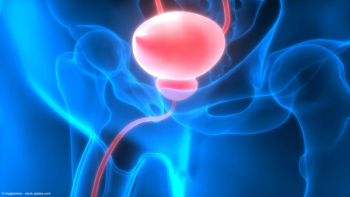
Adam B. Weiner, MD, and Ruchika Talwar, MD, discuss some of the notable urologic oncology abstracts that were presented at the 2023 AUA meeting.

“Resilience isn't just about being able to bounce back; it's about being able to bounce back better,” says Colin P. West, MD, PhD.
"Because we don't have calibration data on Black, or Hispanic, or Asian men in many of these risk tools, we don't know the impact of these tools as screening tests," says Adam Murphy, MD, MBA, MSCI.
“I think, overall, nomograms are a really powerful tools just because there are so many different clinical variables that we consider when we talk to patients about whether to proceed with prostate biopsy,” says Eric Li, MD.

“There really is a significant lack in sexual medicine research of cost information, care information, [and] outcomes information,” says Martin S. Gross, MD.
Vivally System is a neuromodulation system that uses a closed-loop control algorithm and electromyography to personalize treatment for each patient.
“The cost and the burden of being able to find permissions and licenses within different states to continue to offer these services once the waivers end will essentially negate all of these services,” says Kara L. Watts, MD.