
“The readers of our paper should really understand that in microhematuria specifically, a lot of the recommendations are based on small amounts of data,” says Jacob Taylor, MD, MPH.
“The readers of our paper should really understand that in microhematuria specifically, a lot of the recommendations are based on small amounts of data,” says Jacob Taylor, MD, MPH.
"Where it's feasible and where the patients are eligible, I and others are trying to use alternative therapies, which have probably a similar impact in terms of improving longevity of life for patients [with prostate cancer]," says Praful Ravi, MD, BChir, MRCP.

"The first main finding was after adjusting for individual physician characteristics as well as the characteristics of the actual patient case mix for each physician, we found that small practices performed poorly compared with larger practices," says Avinash Maganty, MD.
“This is a lifetime disease; you want to make sure that the battery not just has long enough life but still has the capacity,” says Colin Goudelocke, MD.

Michael S. Leapman, MD, MHS, highlights a study of patient experiences with tissue-based genomic testing during active surveillance for prostate cancer.
“First, we found that we should not be using voided samples for bladder cancer research,” says Laura Bukavina, MD, MPH.
"We unfortunately did not find any difference in pain scores [after ureteroscopy] at day 1, 2, or 3. We also didn't find any difference in use of rescue medication and rescue narcotic medication," says Karen L. Stern, MD.
“I think the most notable finding is that we did see continued benefit from each injection series,” says Matthew J. Ziegelmann, MD.
The FORMULA-509 trial evaluated post-operative salvage radiotherapy and 6 months of GnRH agonist with or without abiraterone acetate/prednisone and apalutamide post-radical prostatectomy.

"In the last couple of years, there have been at least 2 sets of great tissue simulators that have come out, and I think they're really providing an opportunity for learning HoLEP," says Smita De, MD, PhD.

“People and patients are so much more informed now, and they're so engaged in their health. It's fantastic,” says Raevti Bole, MD.
“We were a bit surprised that the males with IC/BPS didn't look more like the females with regard to the magnitude of decrease in urinary symptom severity required to feel better,” says Alisa J. Stephens-Shields, PhD.
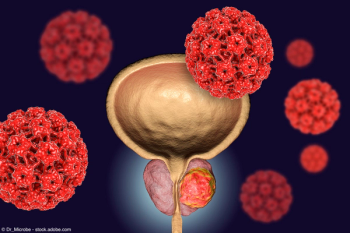
Amar Kishan, MD, highlights findings showing that MRI-guided SBRT is superior to CT-guided SBRT in localized prostate cancer.

“These shortages and declines in supply have forced practitioners to readjust their diagnostic algorithms or at least question the usual practices,” says Jacob Taylor, MD, MPH.

"UH is working on starting clinics throughout rural Northeast Ohio, and we're meeting to develop a FPMRS program, both virtual and in-person, so patients can have access to this point of care," says David Sheyn, MD.

“Many were concerned that what the MIPS policy is really measuring is an ability to track and report measures as opposed to the actual provision of quality care,” says Avinash Maganty, MD.

“If you have 100 bacteria in the voided samples and you have 50 bacteria in the catheterized samples, you assume that a lot of it from the cup is because of contamination,” says Laura Bukavina, MD, MPH.

“I am interested in looking at postpartum issues for sexual function,” says Rachel Pope, MD, MPH.

“As part of the [MAPP] network, and the research that it did, we recognized that it was really important to consider pelvic pain symptoms separately from urinary symptoms,” says Alisa J. Stephens-Shields, PhD.

"The ultimate goal is to have as much of our time spent on actual patient care and complex decision-making [as possible]," says David Canes, MD.
“Microbiome studies are small, and that's a problem. Usually, you have 20 patients here, 30 patients there…We were able to get about 120 patients,” says Laura Bukavina, MD, MPH.

“That's not something we're going to know potentially for many years, but I do think all of us are wondering, are we going to see much more interest in vasectomy reversals down the line?” says Sarah Vij, MD.
"The overarching goal is to both increase the identification of patients with urinary incontinence as well as shorten the time between diagnosis and appropriate treatment," says David Sheyn, MD.

“For a lot of women with lichen sclerosis, they actually go for years without being diagnosed,” says Rachel Pope, MD, MPH.
“You can really see the difference with the patients who go for physical therapy and the ones who don't,” says Ricardo M. de Oliveira Soares, MD.
"We wanted to make sure that it was highlighted that men really need to be screened, and it should be covered by insurance," says Adam Murphy, MD, MBA, MSCI.

“I would have to say the most exciting part of the whole conference was how many medical students and trainees were there,” says Rachel Pope, MD, MPH.

“We found a significant increase in men under 30 getting vasectomies,” says Raevti Bole, MD.
Regardless of the type of chemotherapy regimen received, there was a benefit with the use of frontline avelumab maintenance in patients with locally advanced or metastatic urothelial carcinoma, explains Srikala S. Sridhar, MD.
"When we think about what burnout does to our workforce, the ramifications are significant," says Andrew M. Harris, MD.