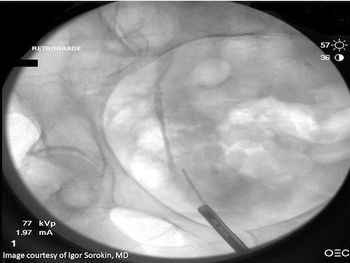
A study analyzing stone-free rates after ureteroscopy suggests that urologists might consider applying refined patient selection criteria in order to achieve better outcomes.

A study analyzing stone-free rates after ureteroscopy suggests that urologists might consider applying refined patient selection criteria in order to achieve better outcomes.

A preliminary analysis of data from a randomized controlled trial supports the efficacy of a low-oxalate diet for reducing urinary oxalate excretion in patients with idiopathic hyperoxaluria, but shows little or no benefit for daily dietary supplementation with vitamin B6 25 mg/magnesium 400 mg or a diet-supplement combination.

"The management of prostate cancer always requires caution to safeguard against avoidable risks from both the treatment and the monitoring protocol," writes Badar M. Mian, MD.

Urologist Henry Rosevear, MD, reflects on the three lessons he's learned in 5 years of practicing urology.

"Perhaps the biggest Medicare reform concern for urologists is the potential for provider reimbursements cuts, a threat that has continued to loom over the health care community for some time," writes the AACU's Ally Lopshire.

"It’s absolutely important. Because we have so much overlap in our patient population, our patients are best served by us working together," says one urologist.

In 2017, a flood of accusations against high-profile men in positions of power in Hollywood, the U.S. government, and the national media have focused the nation’s attention on sexual harassment and its consequences. The medical workplace is not immune from harassment, and the national conversation presents an opportunity for health care businesses to review their risk, policies, and prevention strategies.

Forming a student loan repayment strategy is not a one-size-fits-all process. What works well for a friend or colleague may not be an effective strategy for you.

Reconstruction of anterior compartment defects using magnetic resonance-visible vaginal mesh implants in combination with post-surgical three-dimensional imaging is feasible and yields reproducible results, researchers report.

Legislation that advocates believe would significantly reduce prostate cancer misdiagnoses is making its way through Congress and has the support of major urologic organizations and prostate cancer interest groups.

There are no national or international guidelines regarding penile transplants, raising a question without a concrete answer: What are the rules and the limits?

"[Penile transplantation] is a real advance for patients who have a penile deficiency or penile loss," says Arthur L. Burnett, II, MD, MBA.

Videos demonstrating ureteroscopy techniques, the debate over medical expulsive therapy, and research into ureteroscopy's possible effect on erectile function were among our most-read stone disease articles of 2017.

A 61-year-old female complains of acute-onset right-sided flank and abdominal pain. She describes associated nausea, but denied urinary symptoms, hematuria, fever, or chills.

A look at Urology Times' most-read articles on bladder cancer reveals a variety of topics, ranging from radical cystectomy to the role of protein- and cell-based urinary biomarkers for bladder cancer detection and surveillance.

Giving back. Studying and following AUA guidelines. Getting a scribe in order to spend more face-to-face time with patients. These are just a few of the responses we received when we reached out to our Editorial Advisory Board, Reader Reactor Panel, and you to find out what your professional resolutions are for 2018.

Ray Painter, MD, and Mark Painter address some misunderstandings involving evaluation and management coding.

A 46-year-old male underwent a left laparoscopic radical nephrectomy for a cT1b renal cell carcinoma. Intra-operatively, a rent in the descending mesocolon was made during bowel mobilization but was not closed. Subsequently, the patient presented to the emergency room 4 days later with complaints of sudden onset sharp abdominal pain and nausea. A non-contrast computed tomography scan was obtained. What is the diagnosis?

Bipolar transurethral resection of the prostate offers an economic benefit compared with monopolar TURP that follows from the clinical differences between the two procedures, concluded investigators who presented their findings at the 2017 Western Section of the AUA annual meeting in Vancouver, BC.

"You need to make sure you’re doing the right surgery on the right patient so the surgery does not interfere with longevity," says one urologist.

Dr. Henry Rosevear's most-read blog posts from 2017 cover topics including the AUA annual meeting, physician employment, and pain control.


"While I don’t know if I 'feel the Bern' about a single-payer system, I also don’t think I would have to start looking for a second job if we transitioned to that system," writes Henry Rosevear, MD.

Multiparametric MRI, USPSTF’s updated PSA screening recommendation, and the landmark STAMPEDE and LATITUDE trials were among this year’s highlights in the peer-reviewed literature for prostate cancer, according to Leonard G. Gomella, MD; Stacy Loeb, MD, MS; and J. Brantley Thrasher, MD.

Only one-fourth of urologists report understanding the choices available to them regarding the Merit-based Incentive Payment System and Advanced Alternative Payment Models created under Medicare’s Quality Payment Program, according to the Urology Times 2017 State of the Specialty survey.

Our most-read practice management articles covered topics including reimbursement, personal finance, and EHR fraud.

These videos depict key steps of office-based approaches to hydrocelectomy and vasectomy reversal.

Ranging from advice on telephone triage to reports on cases involving circumcision requiring revision surgery to a missed kidney cancer diagnosis, these were our most-read “Malpractice Consult” columns online from 2017.

Among men undergoing active surveillance for low-risk prostate cancer, biennial biopsies appear to be an acceptable alternative to annual biopsies.

Patients with non-suspicious digital rectal exam findings and total PSA in the 4.0- to 10.0-ng/mL range are far less likely to be biopsied if they’ve undergone Prostate Health Index (phi) testing than if they don’t.