

"The viability and survivability of practices is in jeopardy," says Bradley Gill, MD.
"The viability and survivability of practices is in jeopardy," says Bradley Gill, MD.
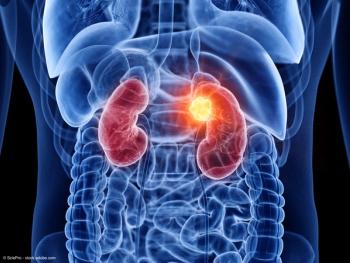
"I think the take-home message is that surgery is safe, even for these challenging surgical cases after this therapy," says Jason Scovell, MD.

"In the study, when taking into account other factors, such as the socioeconomic factors that are available to us in the NCDB, we find that African American and Hispanic patients are about 20% less likely to receive immune checkpoint inhibition for advanced RCC," says Solomon L. Woldu, MD.

"One of the biggest surprises was just how ubiquitous prescribing narcotics in all phases were, from intraoperatively to the PACU to postoperatively," says Aaron A. Laviana, MD, MBA.

“The efficacy analysis for all patients based upon a central pathology review revealed a complete response at any time point of 75.7%,” says Mark D. Tyson, MD, MPH.

"Specifically when we stratified by tertiles, we saw that at 15 years there was a significant difference in cancer-specific survival for those who had a high MMAI score vs lower MMAI scores," says Eric Li, MD.

"All forms of cancer start out by genetic changes in the DNA that cause cancer, so genetic testing becomes very important," says William J. Catalona, MD.
"The Inflation Reduction Act has changed the landscape, and we really still don't understand what those implications are going to be," says Mara R. Holton, MD.

"We need improved efficiency. Part of that is being as optimal in our settings and in our techniques that we can," says Smita De, MD, PhD.

"We knew that the MS or momentary squeeze pump, originally designed at AMS was a fine device, but it did have some issues. We thought we could make it even better," says Ronald A. Morton, MD.

"What we found is that overall, it was relatively effective at providing advice to patients on these pretty commonly encountered questions," says Sharath Reddy, MD.

“Health literacy pushed people towards active surveillance, which I thought was an interesting finding,” says Adam B. Murphy, MD, MBA, MSCI.

"I think there have been a lot of what I would consider incremental improvements over the past few years," Smita De, MD, PhD.

“We have definitely seen significant trends toward transparency in hospital pricing, and in regulations designed to promote that, as well as PBM reform,” says Mara R. Holton, MD.
"In general, I think there's a tremendous amount of variability in terms of how sexual medicine specialists treat patients who have had intimacy issues relating to robotic prostatectomy," says Stanton Honig, MD.

"We as a specialty have to do a better job of educating our colleagues and referring docs," says Roger R. Dmochowski, MD, MMHC, FACS
"This year, we saw a decrease of a couple percent for physician reimbursement to levels that were even lower than pre-COVID times," says Edward Karpman, MD, FACS.
"What we found is, in a retrospective review of nearly 500 patients over a 3-year span, none of those patients reported erectile dysfunction, none of them reported loss of penile sensation, and none of them required a trip to the operating room for intervention," says Amy Pearlman, MD.

"I think that overall, one should do what one is comfortable with, within the scope of your practice and your resources," says Smita De, MD, PhD.

"You can really gain so much insight from other people who have done what you're looking to do," says Helen L. Bernie, DO, MPH.
"So far, we have only 2 published, which is the cardiovascular results, which showed no increase in cardiovascular events, and the sexual function results, showing improvements in libido, but not erectile function, in up to 2 years," says Mohit Khera, MD, MBA, MPH.

“How we set up patients for success comes not just in our individual clinical encounters, but also how we approach patient care as an organization,” says Niels V. Johnsen, MD, MPH.
"We've seen that the rate of burnout among women in urology is rising particularly quickly," says Marah C. Hehemann, MD.
“One of our early findings showed that males who have IPPs use less depression medication, have less emergency room visits, and have less clinic visits for psychiatry-related conditions,” says Roei Golan.

“I do think that we have been leveraging opportunities like conferences to have meaningful discussions about these topics and see where we are and how we can get better,” says Denise Asafu-Adjei, MD, MPH.

"[It’s about] understanding that as urologists, we are board certified to take care of all genders, and we do have data and evidence to support us in taking better care of our female patients," says Rachel Rubin, MD.
“Then finally, when we asked about Xiaflex, it was only two-thirds of programs, less than 70% of programs listed that they were having the residents exposed to Xiaflex,” says Justin Loloi, MD.

"We found that the prevalence of both depression and anxiety were significantly higher in the men's health clinic," says Nestor F. Suria Cordero, MD.

"This is a phase 1 clinical trial, so we're primarily looking at safety and adverse events. We’ve had none in the 46 participants that we have so far," says David Alejandro Velasquez.

"It's really great because that means we can look at treating men sooner even if they're still presenting, and in what we would traditionally or classically call the acute phase, we're able to offer an FDA approved therapy at an earlier timeline," says Jesse N. Mills, MD.