

Meri-Margaret Deoudes discusses findings from BCAN's New Faces of Bladder Cancer Report.
Meri-Margaret Deoudes discusses findings from BCAN's New Faces of Bladder Cancer Report.

Daniel J. George, MD, highlights patient-reported outcomes and tolerability findings from the phase 3 CAPItello-281 trial, evaluating the addition of capivasertib to abiraterone in patients with PTEN-deficient de novo mHSPC.

Minas P. Economides, MD, discusses the evolving role of biomarkers such as KIM-1 in refining risk stratification and highlighted emerging innovations that may reshape how kidney cancer is both imaged and therapeutically targeted.

In this video, Jennifer Miles-Thomas, MD, recaps a SUFU 2026 discussion on leveraging surgeon–APP collaborations in urology.
In this episode, ‘Clinical Reliability of PSMA PET in Advanced Prostate Cancer,’ expert faculty examine the real-world reliability of PSMA PET imaging in evaluating tumor burden and disease extent in advanced prostate cancer.

In a controlled silicone kidney model, CVAC 2.0 outperformed a FANS sheath system for moderate-to-larger stone fragments across clearance efficiency, residual volume, and surgeon ergonomics, though the authors note the model was designed to isolate aspiration mechanics rather than replicate full clinical procedures.

In this segment, Dr. Charles J. Ryan asks Dr. Murilo De Almeida Luz to discuss the importance of evaluating drug drug interaction profiles when selecting androgen receptor pathway inhibitors for patients with metastatic castration sensitive prostate cancer (mCSPC).
In this segment, Dr. Charles J. Ryan asks Dr. Alan H. Bryce to discuss how long term tolerability influences the selection of androgen receptor pathway inhibitors for patients with metastatic castration sensitive prostate cancer (mCSPC).

Akanksha Mehta, MD, MS, highlights key recommendations on pre-vasectomy counseling from the American Urological Association’s 2026 Vasectomy Guideline.

Stacy Loeb, MD, MSc, discusses emerging data on microplastics and prostate cancer and highlights practical steps to reduce plastic exposure.
In this video, Gordon A. Brown, DO, FACOS, offers perspective on integrating PTEN testing and AKT inhibition into evolving biomarker-driven treatment strategies for mHSPC.

Michelle Van Kuiken, MD, highlights a SWIU 2026 panel discussion on setting boundaries.
Jonathan F. Anker, MD, PhD, discusses findings from the phase 2 HCRN GU 20-444 trial, evaluating a response-adapted, bladder-sparing approach using pembrolizumab monotherapy in patients with muscle-invasive bladder cancer who were ineligible for or declined cisplatin chemotherapy.

High-powered holmium and thulium laser platforms are expanding ureteroscopic options for complex patients, including those on anticoagulation, while emerging technologies such as Break Wave lithotripsy and ultrasonic propulsion may offer future office-based alternatives to traditional surgical stone management.
Daniel George, MD, discusses key efficacy findings from the phase 3 CAPItello-281 trial evaluating capivasertib plus abiraterone vs placebo plus abiraterone in patients with PTEN-deficient metastatic hormone-sensitive prostate cancer.

Alexandra Drakaki, MD, discusses guidance from a modified Delphi panel on managing peripheral neuropathy in patients with locally advanced or metastatic urothelial carcinoma receiving enfortumab vedotin.
This episode, titled ‘Clinical Considerations for PSMA PET Agents in Advanced Prostate Cancer,’ the expert faculty review the currently FDA-approved PSMA PET diagnostic agents and their labeled indications, which are largely similar and include initial staging, biochemical recurrence, and evaluation for radioligand therapy.
David Morris, MD, FACS, discusses expert panel recommendations on intravesical drug-releasing systems in bladder cancer, highlighting early drug release dynamics, tolerability, and optimizing patient comfort.

Giulia Almiron da R. Soares discusses survey findings examining the factors influencing women’s decisions to pursue careers in urology.
In this segment, Dr. Charles J. Ryan asks Dr. Jayram to discuss the key clinical considerations that guide the selection of androgen receptor pathway inhibitors when intensifying therapy for metastatic castration sensitive prostate cancer (mCSPC).
In this segment, Dr. Charles J. Ryan asks Dr. Jayram to discuss the patient specific considerations that influence the transition from deciding to intensify therapy to selecting a particular treatment strategy in metastatic castration sensitive prostate cancer (mCSPC).

Christopher M. Pieczonka, MD, discusses practical strategies to optimize tolerability and minimize early discontinuation with indwelling intravesical drug-releasing systems for bladder cancer.
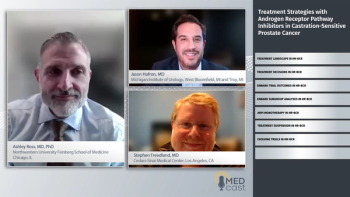
The faculty discusses how ARPI monotherapy may fit into the management of high-risk biochemically recurrent prostate cancer, with a focus on patient selection, trade-offs of monotherapy versus combination therapy, and practical counseling around efficacy, quality of life, and adverse events. The conversation also explores emerging questions around biomarkers, PARP inhibitors, treatment intensification, and how monotherapy may evolve as a therapeutic option in select patients.
The faculty discuss how androgen receptor pathway inhibitor–based strategies are reshaping the management of high-risk biochemical recurrence, with an emphasis on risk stratification, imaging, and patient selection for systemic therapy. The conversation also explores how long-term clinical evidence, treatment suspension, and emerging study designs are informing more individualized treatment decisions in practice.
Gordon A. Brown, DO, FACOS, summarizes overall survival trends, safety findings, and clinical considerations for managing adverse events with dual pathway inhibition.

Hugo's 7-degree-of-freedom instrumentation, power-based electrosurgical architecture, and visual haptic feedback support precise reconstructive performance, while the platform's strong IDE trial outcomes are attributed to a proficiency-based progression training model that assesses both surgeons and operative teams before independent practice.

Matthias Saar, MD, discusses findings from the phase 2 INDUCTA study, evaluating the use of inductive hormonal therapy to achieve operability in patients with T4 prostate cancer.

Despite promising candidates across tumor, immune, and systemic marker categories, no biomarker yet reliably predicts BCG response or identifies which NMIBC patients would benefit from adding checkpoint inhibitor therapy—a gap that limits informed shared decision-making and broader adoption of IO-BCG combinations despite positive trial data.
Meri-Margaret Deoudes discusses findings from the Bladder Cancer Advocacy Network’s "New Faces of Bladder Cancer" survey.