

“There are a lot of social determinants of health as it relates to urge urinary incontinence,” says Joseph Kim, MD.
“There are a lot of social determinants of health as it relates to urge urinary incontinence,” says Joseph Kim, MD.

"Here, we've lowered the age to initiate screening to 45 to 50 years," says Badrinath R. Konety, MD, MBA.

Scott Sellinger, MD, FACS, shares a historical perspective on use of conventional imaging modalities in prostate cancer.
"Even though most urologists who do retroperitoneal surgery do it for posterior tumors, you actually can do it equally well with as equally good success for an anterior tumor," says Michael D. Stifelman, MD.

Michael Cookson, MD, MMHC, explains the NCCN criteria used to stratify patients with clinically localized prostate cancer into risk groups.

"Our main finding was that participants who experienced food insecurity in the past year were at 55% increased odds of reporting at least 1 episode of urge urinary incontinence in the past month, compared with those who have not experienced food insecurity," says Joseph Kim, MD.

"We found out the using IRIS intraoperatively during partial nephrectomy does help us with preserving renal parenchyma," says Teona Iarajuli.
"I think there's a lot of interest now on intraoperative navigation," says Jihad Kaouk, MD.

“The take-home message is that as a practicing urologist, you should be treating genitourinary syndrome of menopause and giving any woman over 45 vaginal hormones, whether in the form of vaginal estrogen or vaginal DHEA,” says Rachel S. Rubin, MD.
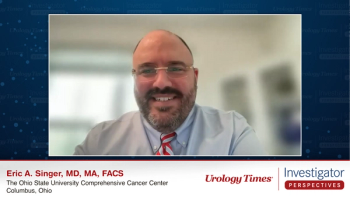
Eric A. Singer, MD, MA, FACS, looks to the future of bladder cancer treatment and offers advice for community urologists and urologic oncologists treating patients with the disease.
An expert on non-muscle-invasive bladder cancer discusses how data on Cohort B of KEYNOTE-057 presented at the AUA 2023 meeting might impact treatment strategies.

“We really wanted to give the general urologist the tools to go back to the clinic the next day and say, "I know how to prescribe this. I know where to prescribe it. I know the cheapest options. I know the best deals around and I know how to talk to patients about the risks and the benefits,” says Rachel S. Rubin, MD.
The data were presented at the 2023 American Urological Association Annual Meeting in Chicago, Illinois.

Anthony V. D’Amico, MD, PhD, discusses key factors that determine his radiotherapy treatment selection in the management of patients following radical prostatectomy.

“PSMA-PET technology is helping urologists think about how to individualize a treatment plan for a patient based on what's discovered with this sensitive imaging modality,” says Christopher W. Ryan, MD.

“The purpose of health care is to provide health care. And...the more we can focus on that, the more we can leverage the hope that I do think that we have,” says Colin P. West, MD, PhD.
Closing out his discussion on prostate cancer, Michael S. Leapman, MD, MHS, highlights practical advice and shares hope for future improvements in the treatment landscape.
Focused discussion on the Decipher Prostate Genomic Classifier and real-world data from the American Urological Association (AUA) Annual Meeting in the setting of prostate cancer management.
Expert urologist Michael S. Leapman, MD, MHS, provides comprehensive insight to the classification of prostate cancer and current treatment modalities available to patients.

"The improvement is sustained, but over time it does tend to decrease and we're currently trying to figure out why," says David Sheyn, MD.
"One of the factors that goes into why transperineal [biopsies] aren't performed more readily in the US is lack of exposure," says Jim C. Hu, MD, MPH.
An overview of the study design, patient populations, and eligibility of the KEYNOTE-057 trial, which studied pembrolizumab in patients with high-risk NMIBC.
Eric A. Singer, MD, MA, FACS, an expert urologic oncologist, discusses the use of Bacillus Calmette-Guerin (BCG) as a first-line therapy for non-muscle-invasive bladder cancer (NMIBC), and reviews subsequent treatment options for patients with high-risk NMIBC who are found to be unresponsive to BCG.
Siamak Daneshmand, MD, discusses the safety profile for TAR-200 from the phase 2b SUNRISE-1 trial, which explored the novel intravesical chemo delivery system in patients with BCG-unresponsive on–muscle-invasive bladder cancer.

“It's a challenge to get funding for these types of studies, and also to have the infrastructure to carry out a lot of these big studies. But there's no question that we need more data,” says Rachel S. Rubin, MD.

“Approaching wellbeing is a shared responsibility,” says Colin P. West, MD, PhD.
"What we found was a very different frequency of alterations in important genes," says Camilo Arenas-Gallo, MD.

Bradley Gill, MD, MS, recaps several presentations on benign prostatic hyperplasia from the 2023 American Urological Association Annual Meeting in Chicago, Illinois.

“Those who were on this vaginal DHEA had a huge decrease in the prevalence of urinary tract infections in the 1 year after getting the prescription,” says Rachel S. Rubin, MD.
Siamak Daneshmand, MD, discusses initial findings from the phase 2b SUNRISE-1 trial exploring the novel intravesical chemotherapy delivery system TAR-200 in non–muscle-invasive bladder cancer.