
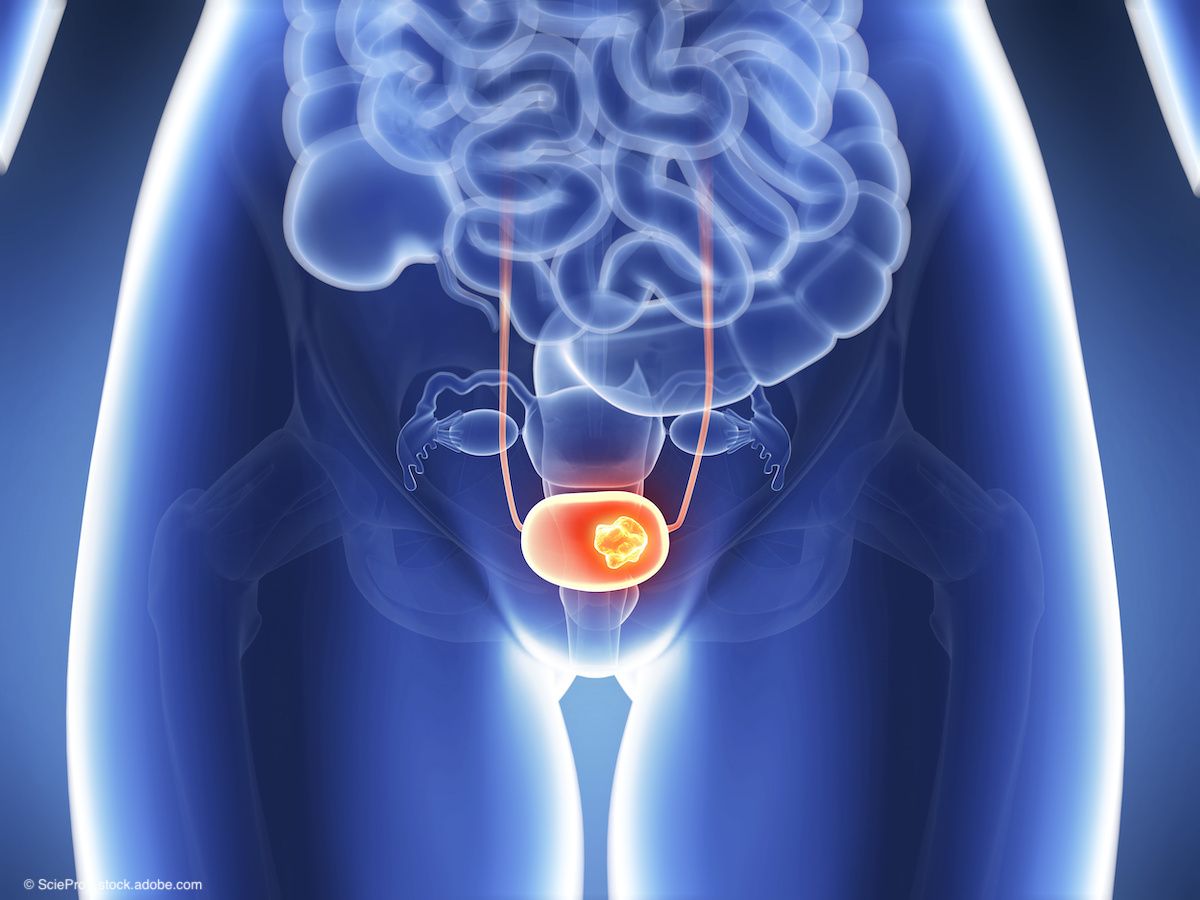




Bladder Cancer
Latest News
Advertisement
Latest Videos








CME Content


Advertisement
More News

The approval is based on results from the phase 3 THOR trial.

A phase 3 study is expected to initiate in 2024 to explore the safety and efficacy of UGN-103 in LG-IR-NMIBC.
The mHealth mobile app provides patients with incremental education on post-cystectomy recovery, delivering information at various timepoints after the patient is discharged from the hospital.

“These [patient-reported outcome] data are supportive of the use of [enfortumab vedotin plus pembrolizumab] as a 1L therapy option for patients who are cisplatin-ineligible," write the authors.
Nadofaragene firadenovec received FDA approval in December 2022 for the treatment of patients with high-risk BCG-unresponsive NMIBC with carcinoma in situ with or without papillary tumors.

This video episode discusses various new therapies and strategies for treating patients with high-risk BCG-unresponsive NMIBC. It includes a review of nadofaragene firadenovec-vncg, its FDA approval, dosing schedule, and patient response rates. The conversation also explores the practical aspects of treatment, such as the balance between efficacy and treatment frequency, and the potential sequencing of therapies in clinical practice.
This video segment provides insights into various innovative trials and agents being explored for high-risk BCG-unresponsive NMIBC. The discussion covers a range of approaches including oncolytic immunotherapy, gene therapy, systemic IO agents, antibody-drug conjugates, and cytokine therapies. It emphasizes the need for personalized dosing regimens based on individual immune responses and highlights the significance of longer-term efficacy evaluations beyond initial three-month response rates.
In total, the study plans to enroll approximately 100 BCG-unresponsive NMIBC CIS patients across 15 clinical study sites in the US and Canada.

"It's really gratifying to see how the field has changed over the last 10 years," says Daniel P. Petrylak, MD.
This episode provides an in-depth discussion on Cretostimogene Grenadenorepvec (CG), an investigational agent for high-risk BCG-unresponsive NMIBC, including the mechanism of action, its efficacy and safety data from clinical trial trials like CORE01 and BOND-003 (NCT04452591), and the rationale behind combining CG with anti-PD-1/PD-L1 antibodies. Experts also provide their insights on future directions in clinical development and application of CG in various NMIBC treatment scenarios, such as a monotherapy and in combination with IO, including its potential use in intermediate-risk disease.
This episode explores the potential of emerging therapies in providing effective treatment alternatives for challenging NMIBC cases. Current clinical trials and investigational treatments for high-risk, BCG-unresponsive NMIBC are highlighted, including the use of N-803, an IL-15 superagonist, in combination with BCG, and discusses TAR-200, an intravesical drug delivery system, which releases gemcitabine directly into the bladder over time.

Previously reported data showed promising efficacy signals and a manageable safety profile for the combination in patients with advanced solid tumors.

"When we think about a typical procedure for performing a radical cystectomy for cancer with an ileal conduit, that would typically involve lymph node dissection, and therefore CPT 51595 would be best chosen to report that combined procedure," write Jonathan Rubenstein, MD, and Mark Painter.
Data from the EV-302 trial showed a doubling of progression-free survival and overall survival with the ADC/checkpoint combination versus standard chemotherapy.

Neal Shore, MD, FACS, offers clinical insights on optimizing patient selection and treatment sequencing in BCG-unresponsive NMIBC.

This monthly series will begin in January 2024, and attendees can earn one category 1 CME credit per session.

Sam S. Chang MD, MBA leads a discussion of various treatment approaches for a hypothetical case of a 74-year-old female patient with T1 bladder cancer and associated CIS, exploring the necessity of repeat resections. The conversation emphasizes the importance of personalized treatment plans, considering BCG therapy, clinical trials involving immunotherapy, and the possibility of cystectomy, while also addressing the complexities and risks associated with high-grade bladder cancer in elderly patients.
This episode focuses on the complex management of recurrent low-grade bladder tumors and highlights the limitations and challenges of current treatments, including intravesical chemotherapy and BCG, and underscores the need for better therapies and clinical trials in this area.

“The primary outcome will be feasibility of in-home treatments,” says Timothy D. Lyon, MD, FACS.
“We were pleased and excited to see that 72% of patients reported openness to receiving in-home intravesical therapy,” says Timothy D. Lyon, MD, FACS.

The expert panel concludes its discussion by providing key takeaways on the evolving bladder cancer treatment landscape following ESMO 2023.
A urologist discusses treatments in the pipeline that can further improve the therapeutic landscape in BCG-unresponsive NMIBC.
The panel discusses the Large Urology Group Practice Association and provides insights on collaborative care approaches in bladder cancer.
Comprehensive insights on the unmet needs addressed by TAR-200 in BCG-unresponsive non-muscle-invasive bladder cancer.
The various treatment approaches for NMIBC in the context of a BCG shortage, with a focus on initial cases, are shared. Urologists discuss their strategies for treating a hypothetical patient with a 3 cm bladder tumor, weighing options like perioperative chemotherapy, the importance of thorough resection, and adapting treatment protocols based on tumor characteristics and the ongoing BCG shortage.
Advertisement
Advertisement
Trending on Urology Times
1
AI-generated profiles impersonate female urologists to market ED products online
2
Alternative BCG strains may help address ongoing supply challenges in NMIBC
3
Doublet or triplet? Urologists weighs in on mCSPC options
4
Pearls & Perspectives: Sexual Health and Intimacy in Midlife, With Karen Bigman, MBA
5