
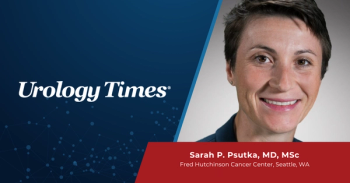
Sarah P. Psutka, MD, MSc, reflects on her AUA 2026 talk regarding frailty and surgical outcomes in urologic oncology.
Sarah P. Psutka, MD, MSc, reflects on her AUA 2026 talk regarding frailty and surgical outcomes in urologic oncology.
Patients in the enzalutamide combination group were most likely to achieve a treatment suspension lasting a least 2 years.
The phase 1/2 ResQ133A-NMIBC trial (NCT06800963) is evaluating intravesical recombinant BCG in patients with BCG-naïve high-risk NMIBC across US sites, with safety as the primary end point and complete response and disease-free survival as secondary end points, building on European data showing 50% response rates and no dose-limiting toxicities in BCG-unresponsive disease.

The lower bound of the 95% CI (57.6%) exceeded the prespecified noninferiority effectiveness performance goal of 50.9%, thereby meeting the primary effectiveness end point.
The 2025 AUA Census documents significant geographic maldistribution of the urologic workforce—with 62% of US counties lacking a urologist—alongside a median practitioner age of 54 and generational shifts in career expectations that together pose near-term workforce sustainability challenges.
The INTIBIA Pivotal Study—the first sham-controlled, double-blind RCT of an implantable tibial nerve stimulation device—demonstrated significantly greater clinically meaningful improvements in symptom bother, health-related quality of life, and patient global impression at 3 months compared with sham, with durable benefits through 12 months.
Chad A. Reichard, MD, highlights real-world data presented at AUA 2026 on re-induction with nadofaragene firadenovec in patients with BCG-unresponsive non–muscle-invasive bladder cancer.
Extended follow-up data from a phase 3 randomized trial show that aglatimagene besadenovec plus valacyclovir combined with radiotherapy produced a 39% improvement in prostate cancer-specific disease-free survival vs placebo plus standard-of-care radiotherapy in men with intermediate- to high-risk localized prostate cancer.
In this interview, Kari A.O. Tikkinen, MD, PhD, explains why effective nocturia management in geriatric patients requires systematic phenotyping across 4 primary subtypes—nocturnal polyuria, reduced bladder capacity, bladder outlet obstruction, and sleep-driven causes—rather than empiric pharmacologic treatment, with many cases requiring interdisciplinary referral rather than urologic intervention alone.
Adam B. Weiner, MD, is joined by Mary Beth Westerman, MD, FACS, to discuss the landmark CISTO trial—a large pragmatic study examining patient-reported outcomes among individuals with high-risk non–muscle invasive bladder cancer who underwent either bladder-sparing therapy or radical cystectomy.
"I think these data clearly support one year of durvalumab in combination with induction maintenance BCG as a potential new treatment for patients with BCG high-risk NMIBC with the appropriate shared decision-making conversation," said Neal D. Shore, MD, FACS.
Darolutamide plus ADT also significantly delayed time to mCRPC (HR 0.26; 95% CI 0.18–0.38; P <.001) and rPFS (HR 0.30; 95% CI 0.19–0.48; P <.001) vs ADT.
A comprehensive guide to the practice-changing, paradigm-shifting studies across benign urologic conditions.
A comprehensive guide to the practice-changing, paradigm-shifting studies across urologic oncology.
The 2026 AUA Annual Meeting will feature significant bladder cancer data, a plenary lecture on screening and overdetection, and programming that integrates advanced practice providers across sessions, against a backdrop of AUA-driven policy wins including removal of the vaginal estrogen black box warning and early steps toward a federal Office of Men's Health.

Yeonsoo Sara Lee, MD, highlights the key networking and education opportunities she's most looking forward to at AUA 2026.

Hear from 5 experts as they recap some of the top data from this year's AUA.
“[These are] very good numbers for these patients who otherwise would undergo a radical cystectomy," says Félix Guerrero-Ramos, MD, PhD, FEBU.

Take a look through some of the notable studies that were spotlighted during this year’s meeting.
The SOUL study is assessing patient-reported outcomes and unplanned health care utilization among patients who had stent placement vs stent omission after ureteroscopy.

These results are expected to support submission of the Hugo system to the FDA for use in urologic procedures.
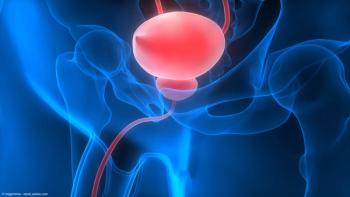
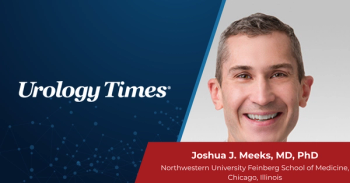
Data showed an overall CR rate of 82.4%.
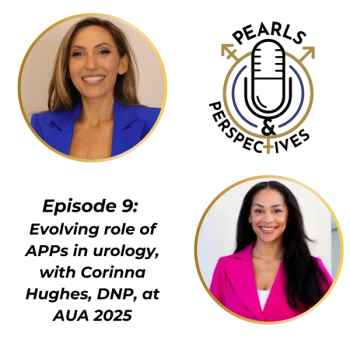
Corinna Hughes, DNP, sits down with Amy Pearlman, MD, to discuss the evolving recognition of APPs in urology.
Twelve-month physical functioning scores were comparable between the radical cystectomy arm and the bladder-sparing therapy arm.
“It is likely that more and more, these newer agents are going to play earlier and more central roles in the early treatment of BCG-unresponsive disease," says Shreyas S. Joshi, MD, MPH.
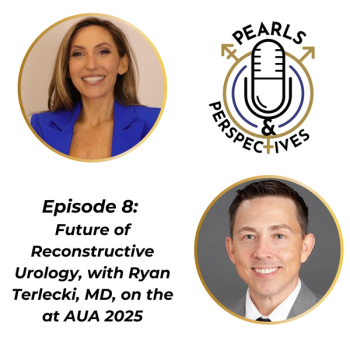
A discussion on evolution of surgical education, importance of video training, and the future of patient-centered care in reconstruction.
Data showed a disease-free survival rate of 85.3% at 6 months and 81.1% at 9 months.

Shay Rajavel, MS3, shares details on an AUA 2025 presentation on CO2 gas embolism during laparoscopic surgery.