

Lin Lin, MD, highlights a phase 2 trial of neoadjuvant SAbR followed by surgery in patients with newly diagnosed renal cell carcinoma and caval tumor thrombus.
Lin Lin, MD, highlights a phase 2 trial of neoadjuvant SAbR followed by surgery in patients with newly diagnosed renal cell carcinoma and caval tumor thrombus.
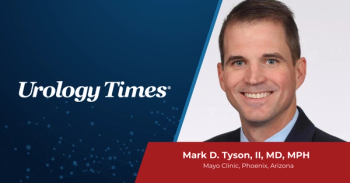
Mark D. Tyson, II, MD, MPH, recapped topline results from the BOND-003 trial of cretostimogene grenadenorepvec in papillary only BCG-unresponsive NMIBC.
DFS rate was 85.3% at 6 months (95% CI, 71.6-92.7), 74.3% at 12 months (95% CI, 59.2-84.6), and 69.2% at 18 months (95% CI, 53.4-80.6).
In patients with high-grade T1 disease, high-grade EFS was 100% and 3 months and at 6 months and 87.5% at 9 months.
Following treatment with SYNC-T, all bone metastases had resolved in 7 of the 13 patients.

The overall CR rate was 83.7% (95% CI, 70.3-92.7).

Forty-one of the 85 patients experienced disease persistence, progression, or recurrence.


Complete response at any time was 92% (23/25 patients), 84% (21/25) at 3 months, 87% (20/23) at 6 months, and 85% (17/20) at 9 months.
Cameron J. Britton, MD, highlights key findings from a study of the MyProstateScore 2.0 in predicting upgrading to GG≥3 prostate cancer.
The data come just days after the FDA approved IsoPSA to aid in the diagnosis of high-grade prostate cancer.
Roger Li, MD, discusses the development and validation of a CHAI-based biomarker to identify patients with LG NMIBC who are at higher risk of progression.

For micro-ultrasound compared with true cancer status, estimated sensitivity was 0.8000.
INVITE is a 2-part clinical trial designed to evaluate the safety, feasibility, and patient experience of administering intravesical bladder cancer therapies in the home.
Health care providers and allied health care professionals described insertion and removal of the system as “straightforward” and done in less than 5 minutes.

The ENLIGHTED trial is evaluating the safety and efficacy of padeliporfin vascular targeted photodynamic therapy for low-grade upper tract urothelial carcinoma.
At a median follow-up of 25.8 months, the CR rate at any time was 75.5%.
The 510(k) clearance was supported by 12-month data from the VAPOR 2 trial, which were presented at the 2025 SUO Annual Meeting.

The investigators reported that new onset of CNS-related conditions was lower in patients in the apalutamide cohort at 12 months and 24 months post index.
“It's the sustained release and constant exposure to the gemcitabine that's most likely responsible for the high efficacy rates of that we're seeing with the TAR-200 system,” says Siamak Daneshmand, MD.
“This is another therapeutic that adds to UroGen [profile] as a potential treatment that could be used to preserve kidneys while treating low grade upper tract urothelial carcinoma going forward,” says Sarah P. Psutka, MD, MSc.

“Some of the main implications for urologists is that the risk adapted utilization of BCG, which has been implemented as guidelines, should continue,” says Madison M. Wahlen.
“We really want to understand whether by using this beta emitter, together with the combination of cabazantinib and the nivolumab, we're getting better outcomes than we would expect with the doublet alone,” says Eric Jonasch, MD.

"We found that patients whose care was impacted by shortages did not have statistically significantly worse recurrence outcomes compared to patients whose care was not impacted by shortages," says Madison M. Wahlen.
“With the Expanded Access Program, it is an opportunity for patients to receive the drug in real-world practice,” says Sarah P. Psutka, MD, MSc.
"Overall, our trial shows promising early oncological efficacy with a favorable toxicity profile," says Gal Wald, MD.
ProstACT GLOBAL is assessing the safety and efficacy of 177Lu-TLX591 plus SOC vs SOC alone in patients with mCRPC.

Cretostimogene grenadenorepvec is an investigational oncolytic immunotherapy for patients with BCG-unresponsive high-risk NMIBC.
“We can now see that we can find a proportion of those men that have an elevated STHLM3 tests that actually have a quite substantial risk of biochemical recurrence after the radical prostatectomy,” says Tobias Nordström, MD, PhD.
“Without Congressional action, all the progress that has been made—the new normal, so to speak—that patients, physicians, and providers alike have become used to, is at risk of potentially going back to pre-pandemic, 2019 levels,” says Juan J. Andino, MD, MBA.