

The investigators reported that pCR was significantly higher in the neoadjuvant chemotherapy + RNU group vs RNU alone, with an OR of 2.49 (95% CI: 1.75 – 3.54, P < .001).
The investigators reported that pCR was significantly higher in the neoadjuvant chemotherapy + RNU group vs RNU alone, with an OR of 2.49 (95% CI: 1.75 – 3.54, P < .001).

PSMA-PET is becoming an invaluable tool for the diagnosis and management of oligometastatic prostate cancer patients, a sub-group for whom novel treatment strategies are continuing to emerge.
Concomitant abiraterone or enzalutamide did not boost the radium-223 survival benefit in patients with bone-dominant metastatic castration-resistant prostate cancer.

Surgery following neoadjuvant immune checkpoint inhibition with durvalumab plus tremelimumab was shown to be safe in patients with locally advanced renal cell carcinoma.

"Specifically when we stratified by tertiles, we saw that at 15 years there was a significant difference in cancer-specific survival for those who had a high MMAI score vs lower MMAI scores," says Eric Li, MD.

"All forms of cancer start out by genetic changes in the DNA that cause cancer, so genetic testing becomes very important," says William J. Catalona, MD.
"However, these patients have an overall poor prognosis,” noted Mohamed E. Ahmed, MD.

At the 2022 SUO Annual Meeting, Grant Stewart, MD, PhD, discussed the potential of neoadjuvant therapy as a tool to help optimize the management of patients with localized kidney cancer.
“[The 2022 Huggins Medal Lecture from Harry Herr, MD] was a fascinating talk, and something that I think anyone could learn from,” says Kelly L. Stratton, MD, FACS.
“It's very interesting to see how this continues to progress as a field,” says Kelly L. Stratton, MD FACS.
Laura Bukavina, MD, MPH, discusses a highlight from the 2022 Society of Urologic Oncology Annual Meeting.
Laura Bukavina, MD, MPH, summarizes a presentation from the 2022 Society of Urologic Oncology Annual Meeting from Sarah P. Psutka, MD, MS.

“It’s important for us to get the tools necessary to deal with patients who come with a unique set of difficulties,” says Laura Bukavina, MD, MPH.

The median DOR among the 15 patients in the study was 24.4 months (range, 10.1 to 30.7 months).
"Jelmyto provides an effective and durable kidney-sparing treatment option and should be considered as primary therapy for adult patients with LG-UTUC,” said Phillip Pierorazio, MD.

“Stereotactic radiation can delay the initiation of systemic therapy; it can locally control oligometastatic RCC patients for as much as 2 years,” says Raquibul Hannan, MD, PhD.

Matthew Galsky, MD, discusses the discordant results of the pivotal phase 3 CheckMate-274 and IMvigor010 trials of adjuvant immunotherapy in urothelial cancer.

Raquibul Hannan, MD, PhD, describes patients with renal cell carcinoma who may be appropriate for treatment with stereotactic radiotherapy.
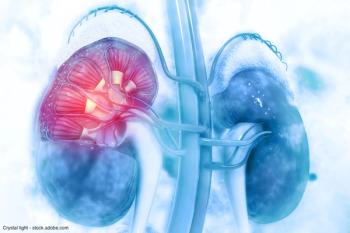
“So I think what we can take away from this study is that just because your patient [has a higher BMI], doesn't mean that they're a poor candidate for a partial nephrectomy,” said Lachlan Shiver.

Pembrolizumab monotherapy continued to demonstrate durable complete responses, while rates of upstaging at the time of radical cystectomy were consistent with previous findings in the KEYNOTE-057 trial in patients with BCG-unresponsive NMIBC.

“We showed that in the oldest patient cohorts, age became an independent risk factor for development of de novo CKD after surgical intervention in patients who underwent radical nephrectomy," says Mimi Vu Nguyen.
“In the adjuvant setting, we have a ‘double biomarker problem.’ Not only don’t we know which drugs work best in which patients, we actually don’t even know which patients need additional systemic treatment because many patients are already cured with surgery,” says Matthew Galsky, MD.
“Neoadjuvant axitinib seems to be successful in allowing some patients to undergo a partial nephrectomy who had previously been deemed unable to undergo this procedure," said Kevin Hakimi.
As stereotactic ablative radiation therapy enters further into the treatment space for metastatic RCC, integration of the approach is vital for physicians to focus on, according to Raquibul Hannan, MD, PhD.
Risk of tumor recurrence in the BLC Registry group was significantly lower than in patients who received WLC alone.
OS was also found to be prolonged in the propensity score matched analysis, with a median that was not reached in the pembrolizumab arm vs 21 months in the IRC arm.

Compared with data from the KEYNOTE-057 study, the use of pembrolizumab monotherapy in the real-world setting was similar in the treatment of patients with high-risk non-muscle invasive bladder cancer.

“This is the perfect situation for the development of biomarkers to inform [patient selection for] adjuvant treatment with immune checkpoint blockade,” says Matthew Galsky, MD.

In this interview, Curtis A. Pettaway, MD, reflects on what innovations and research led to his becoming the first Black recipient of the Society of Urologic Oncology’s Huggins Award.

"I was very early among the first women in urology, and in those days it was really going out on a limb to go into that field," said Eila C. Skinner, MD.