

The test is intended to aid in the decision for prostate biopsy in men aged 50 years or older who present with elevated PSA levels.
The test is intended to aid in the decision for prostate biopsy in men aged 50 years or older who present with elevated PSA levels.

In this episode, Farnoosh Nik-Ahd, MD, joins host Adam Weiner, MD, to discuss emerging guidance on prostate cancer screening in transgender women.

"Based on the code description, we recommend basing the code selection on the documentation and the effort required to complete the service, and not the number of foreign bodies removed from the bladder," write Jonathan Rubenstein, MD, and Mark Painter.

"Site neutrality is a pivotal issue for all independent practices, and really, it's a pivotal issue for all Americans because it affects both the global cost of care as well as the acceleration and the cost of care," says Mara R. Holton, MD.

According to the authors, the optimal duration of treatment could be tied to individual patient factors such as cancer risk.

The authors suggested that a greater treatment effect may be observed with a more antigenic vaccine.

AVZO-103 is a Nectin-4/TROP2 biospecific antibody-drug conjugate for adult patients with urothelial carcinoma whose tumors have progressed on enfortumab vedotin.
John Lam, MD, outlines the legislative efforts underway, the impact of prior authorization on patient care, and the role organized medicine can play in pushing for meaningful change.
The approval is supported by results from the phase 3 KEYNOTE-905/EV-303 trial.

Notably, 81% of patients said that they were interested in trying new or different treatment options.

In September 2024, the FDA granted an Orphan Drug Designation and a Rare Pediatric Disease Designation to YOLT-203 for PH1.
The clearance supports new ultrasound imaging and workflow enhancements to the Focal One i, which was launched earlier this year.

The ExactVu micro-ultrasound platform demonstrated noninferior detection of clinically significant prostate cancer vs MRI.

The subcutaneous formulation of pembrolizumab also received FDA approval in September 2025.

Zubert highlights the expanding technological and clinical landscape—from laser therapies and Testopel to emerging female sexual health interventions and menopausal care.
The test is designed to deliver actionable molecular results in approximately 15 minutes.

The CxBladder Triage Plus Test identifies patients with hematuria who are at higher risk for urothelial carcinoma.
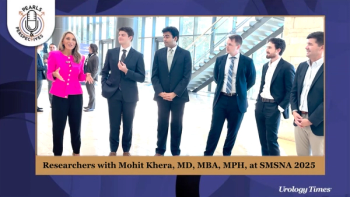
Across the board, the researchers' work offers answers that could transform guidelines, reduce invasive procedures, improve diagnostic accuracy, and empower clinicians with more personalized tools.

[68Ga]Ga-DPI-4452 is a gallum-68-radiolabeled PET imaging agent that forms a theranostic pair with the therapeutic candidate, [177Lu]Lu-DPI-4452 (ITM-91).

The phase 1b trial is assessing ORIC-944 both in combination with darolutamide and apalutamide.
John Eifler, MD, highlights new real-world evidence on nadofaragene firadenovec-vncg for BCG-unresponsive NMIBC.

Alice Bernard-Tessier, MD, highlights preliminary results from a phase 1 trial of gedatolisib plus darolutamide in mCRPC.

The safety and efficacy of testosterone undecanoate was demonstrated in the phase 3, six-month MRS-TU-2019EXT trial.

"I think MRI has really been perhaps the most transformative development in the realm of prostate cancer screening since I came into the field," says Stacy Loeb, MD, MSc, PhD (Hon.

"It's been a very exciting time for the radioligand space," says J. Travis Mendel, MD.

The rectal spacer showed sustained preservation of bowel, urinary, and sexual quality of life through 4 years of follow-up.
The agency is working with companies to update the language on HRT to remove references to risks of cardiovascular disease, breast cancer, and probable dementia.

Mobley also shares her treatment approach to BPH and explains the challenges of treating OAB.

Pearlman and Griggs tackle the real-world challenges of innovation—from surgeon comfort zones and patient perceptions to equipment logistics in private practice.

"I'm very excited to bring this therapy to our patients in the Philadelphia area and to be able to offer it at MidLantic," says David Cahn, DO, MBS, FACOS.