

Experts share high-level results from the investigation of cretostimogene grenadenorepvec, an investigational targeted immunotherapy delivered intravesically for the treatment of non–muscle-invasive bladder cancer (NMIBC).
Experts share high-level results from the investigation of cretostimogene grenadenorepvec, an investigational targeted immunotherapy delivered intravesically for the treatment of non–muscle-invasive bladder cancer (NMIBC).

Panelists discuss how early implementation of RAD-ENZ combination therapy requires careful consideration of patient characteristics, disease burden, and long-term treatment planning while potentially offering the greatest benefit when initiated before significant disease progression occurs.
Panelists discuss how patients with bone-predominant mCRPC, good performance status, adequate bone marrow function, and limited visceral disease are ideal candidates for RAD-ENZ combination therapy, particularly when proper bone health monitoring and prophylaxis can be implemented.
Experts briefly discuss investigational mitomycin delivery systems UGN-102 and UGN-103, which are being evaluated in intermediate-risk non–muscle-invasive bladder cancer (NMIBC), and share their impressions of the safety and efficacy results from the ENVISION phase 3 trial for UGN-102.

“In 5200 men, very clearly, definitively, irrefutably, it has been shown that testosterone therapy is not associated with MACE over the course of the 12 to 24 months after commencement of testosterone therapy," says John P. Mulhall, MD.

“[There’s] a lot going on in bladder cancer in the non–muscle invasive, muscle-invasive space, as well as in some of the biomarkers, which is exciting and will definitely have a huge impact on the management of your patients," says Jason M. Hafron, MD, CMO.

"We found that female patients, Black patients, and patients with non-private insurance had a decreased odds of receiving opioids,” says Hailey Frye.

“A key point is the supply chain is very fragile, and there's not really a good financial incentive to make these drugs," says Ruchika Talwar, MD.

"Personally, I think monitoring and analyzing PSA kinetics is a great one because it's cheap and it's readily available,” says Dr Louise Kostos.

The trial is assessing the safety and tolerability of adaptive radiation therapy with concurrent sacituzumab govitecan in patients with MIBC.
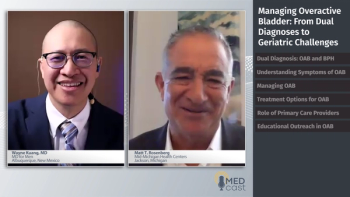
Wayne Kuang, MD; and Matt T. Rosenberg, MD, discuss how overactive bladder presents with distinct pathophysiological mechanisms between genders, requires different diagnostic approaches when distinguishing from benign prostatic hyperplasia in men, impacts quality of life in older adults, benefits from early primary care intervention, and necessitates improved patient advocacy and educational initiatives for optimal management outcomes.

"This certainly does feel like the beginning of the light at the end of the tunnel coming out of the BCG shortage," says Chad A. Reichard, MD.

An expert discusses how the SunRISe-1 phase 2b trial, presented at the European Society for Medical Oncology 2024 Congress (ESMO 2024), evaluated TAR-200 alone and with cetrelimab in BCG-unresponsive, high-risk non–muscle invasive bladder cancer (NMIBC). TAR-200 monotherapy achieved an 84% complete response rate, with most adverse events being mild to moderate. The combination therapy showed higher rates of severe adverse events. TAR-200 is particularly promising for patient’s ineligible for or refusing radical cystectomy.

“Identification of significant predictors [of upstaging] has improved our pre-op counseling," says Neeraja Tillu, MD.

"I think that testosterone is really a medication that can be life changing for so many men, says Helen L. Bernie, DO, MPH.

“The main challenge at the moment is patients are being diagnosed with metastatic disease far earlier than they would have been otherwise, and therefore [are being] considered for combination systemic therapy potentially years earlier than they would have been if we just looked at conventional imaging," says Dr Louise Kostos.

"The relaxation of the restrictions that started during COVID are critically important for continued access," says Mark T. Edney, MD.
Panelists discuss how regulatory approval of the radium-223 and enzalutamide combination would likely lead to significant guideline updates, particularly in treatment sequencing recommendations for patients with metastatic castration-resistant prostate cancer (mCRPC) with bone-predominant disease and adequate bone marrow function.
Experts briefly mention other ongoing phase 3 studies investigating TAR-200 for the treatment of non–muscle-invasive bladder cancer (NMIBC).
Experts discuss the patient demographics and clinical trial design of the phase 2b SunRISe-1 study investigating the use of TAR-200 as a monotherapy and in combination with cetrelimab (a PD-1 inhibitor), with results presented at the recent European Society for Medical Oncology 2024 Congress, as well as the safety and efficacy data from the SunRISe-1 trial.
Panelists discuss how adapting the PEACE-3 protocol to real-world US patient populations requires careful consideration of broader patient demographics, comorbidities, and prior treatment histories than were represented in the trial’s relatively strict eligibility criteria.

"We need to be aware that patients have options for treatment of high-risk biochemical recurrence, and in order to identify that they have high-risk biochemical recurrence...we need to calculate PSA doubling time,” says Alicia Morgans, MD, MPH.

“We might need to do a better job in general about education of the importance of follow-up,” says Christina B. Ching, MD.

"A 14-month delay in disease progression is a very meaningful end point to our patients, because that basically means delay in symptoms, delay in fractures, [and] delay in pain in the castration-resistance setting," says Neeraj Agarwal, MD, FASCO.

"I'm so excited about them finally removing this boxed warning," says Helen L. Bernie, DO, MPH.

“For someone that might be looking at getting into sacral neuromodulation, and has had some reluctance in the past, this does simplify the procedure somewhat," says Colin Goudelocke, MD.

"In terms of how I select patients, I really look at the timing of metastatic disease, so whether it's metachronous or synchronous and the volume, and I think at this stage, the data are most robust for the synchronous and high-volume patients," says Dr Louise Kostos.

“Now, at 1 year, the 1-hour pad test has been done again, as it's part of the protocol, and she suffered 4 g of incontinence on this test, opposed to 125 g at the beginning,” says Emmanuel Chartier-Kastler, MD, PhD.

"I would also like us to be able to reliably use even smaller scopes, but keep them efficient," says Amy E. Krambeck, MD.
An expert discusses how non–muscle invasive bladder cancer (NMIBC) treatment involves evolving delivery systems, transitioning from traditional systemic and intravesical approaches to advanced targeted technologies. Current research focuses on innovative platforms such as nanoparticle carriers, thermosensitive hydrogels, and personalized molecular delivery mechanisms to improve therapeutic efficacy and minimize systemic toxicity.