

"It's really critical to recruit and retain diverse talent in urology to improve patient care and our health care system overall," says Alexandra Tabakin, MD.
"It's really critical to recruit and retain diverse talent in urology to improve patient care and our health care system overall," says Alexandra Tabakin, MD.

“I think ultimately, when we think about when do we deliver MDRT and to whom, it comes down to a goals of care discussion,” says Angela Jia, MD, PhD.

"We identified 12 discrete workflow steps for outpatient flexible cystoscopy, with 5 of those being able to be eliminated by the transition to the single-use scope," says David Barquin, MD.

"Our first question is, in patients who were on the GLP1R agonists for a prolonged period of time, were those patients at increased or decreased risk of developing the most common GU malignancies?" says Laura Bukavina, MD, MPH.

"I would say the take-home message is that usage of this mobile health platform could potentially improve patient quality of life and compliance with recommendations," says Jenny Guo, MD.
“Cancer is a journey which is very emotional as much as it is physical. And not only for the patients, but it is also for their caregivers, whoever that person is,” say Joy Maulik, CRNP.
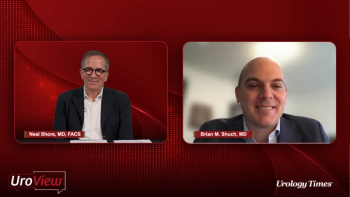
Neal Shore, MD, FACS, and Brian Shuch, MD, provide closing thoughts on the potential of PET/CT imaging to improve patient care in kidney cancer.
Urologists review clinical trials investigating new imaging options in kidney cancer, including the ZIRCON study looking at girentuximab.

"The other was that we found that about half of the patients in the CIS cohort and two-thirds of those in the Ta/T1 or papillary cohort had bladder preservation, meaning they were able to avoid cystectomy," says Vikram M. Narayan, MD.
"What we saw among over 400 patients [was] that indeed, subcutaneous heparin did not increase the hematoma chance, but it reduced the chance to have venous thrombotic events," says Thairo Pereira, MD.

"I think these findings suggest that for clinicians who treat a lot of older adults with neuromodulation, caution should be exhibited when recommending the single-stage approach," says Leo Dreyfuss, MD.
“When we looked at the risk of bleeding and takeback for fulguration, the reported rate was 0.46%. Less than 1% of patients had any significant bleeding,” says Dean S. Elterman, MD, MSc, FRCSC.

"We saw that Black men within this cohort had lower Decipher scores across all ages and Gleason scores different than what had been reported in other data sets, which was interesting," says Samuel L. Washington III, MD, MAS.
“But more importantly, there are patients who have no insurance, there are patients who have no other resources and are maybe even on the poverty line. We feel, importantly, that we have an obligation that the drug be made free for these patients in the United States,” says Patrick Soon-Shiong, MD.

"We found that the GetWell patients have shown increases in their Wisconsin Stone Quality of Life scores, or the WISQOL score, of about 3 points from baseline to 6 months," says Jenny Guo, MD.

"In the study, about two thirds of the residents did undergo PNE and one third underwent Stage 1, and those who underwent PNE were less likely to progress to device implant than Stage 1," says Leo Dreyfuss, MD.

"In our commercial all-comers cohort of patients undergoing Aquablation, efficacy was similar to and safety was improved compared to the WATER I and WATER II clinical trials," says Shawn H. Marhamati, MD, MS.

"One of the main summaries/focuses of this discussion was, how do we create action to improve screening, and what that actually means," says Samuel L. Washington III, MD, MAS.

"[The care plan] incorporates patient-specific data to reinforce dietary management, fluid intake, and medication adherence based on the patient's 24-hour urine collection results," says Jenny Guo, MD.

"So I think these findings overall are reassuring and support the use of neuromodulation in this population," says Leo Dreyfuss, MD.

“Along those lines, we've taken away the traditional step therapy that has dictated overactive bladder care for quite some time,” says Ariana L. Smith, MD, FPMRS.
Kidney cancer specialists discuss recent advances in imaging for diagnosis and disease management, highlighting sestamibi and zirconium scans.
Brian Shuch, MD, and Neal Shore, MD, FACS, discuss the staging and treatment of kidney cancer, including when to biopsy and how often to do follow-up imaging.
“The 2018 AUA guidelines for testosterone therapy that were co-chaired by Dr. John P. Mulhall say that we have an absence or a paucity of data on using testosterone therapy on active surveillance,” says Helen L. Bernie, DO, MPH.

"The biggest take home point is that patients with node-positive disease at the time of radical prostatectomy are a heterogeneous group of patients," says Daniel A. Triner, MD, PhD.

"We did discuss a couple of future research ideas, a number of which would have been controlling for those potential factors we thought could contribute to the increased UTI risk that we were not able to control for in the study like loss of commensal bacteria or anything of that nature," says David Gilbert.
"I asked the group of urologists, what if we already had a solution to this problem? What if it's already something that so many of us are already doing: replacing testosterone?" says Amy Pearlman, MD.

"But more excitingly, as early as 9 months, even though they were small numbers, the comparison between BCG and Anktiva vs BCG alone showed a statistical significance in the duration of ongoing complete response," says Patrick Soon-Shiong, MD.

"The wide variability that we found across MUSIC practices suggests an opportunity for us for quality improvement initiatives and additional evidence surrounding who should receive secondary treatment and what modalities," says Daniel A. Triner, MD, PhD.

"I think right now, a lot of the focus is on perioperative management, as well as some of the technical considerations of the surgery itself," says Jay Simhan, MD, FACS.