
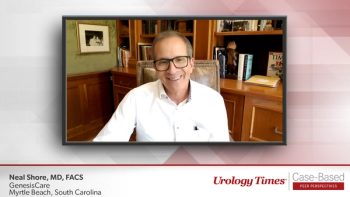
Neal Shore, MD, FACS, muses about the unmet needs in metastatic prostate cancer treatment and shares clinical pearls for community oncologists.
Neal Shore, MD, FACS, muses about the unmet needs in metastatic prostate cancer treatment and shares clinical pearls for community oncologists.
A review of whether PARP inhibitors such as olaparib could potentially be used in earlier lines of therapy for mCRPC.
Dr Neal Shore shares how he would have treated the patient with metastatic prostate cancer from the presented case.
An overview of safety and efficacy data from the phase 3 PROfound trial evaluating the PARP inhibitor olaparib.
Neal Shore, MD, explains the available first-line treatment options for chemotherapy-naive, metastatic castration-resistant prostate cancer (mCRPC).
A focused discussion on the significance of mutations in homologous recombination repair (HRR)-related genes in prostate cancer.
An expert urologist highlights the vital importance of genetic testing in cases of prostate cancer.
Dr Neal Shore gives his first impressions of a patient case and gauges the risk of progression.
Neal Shore, MD, presents the case of a 64-year-old man with metastatic prostate cancer and a BRCA2 mutation.
The study showed that the PSMA-targeting fluorophore IS-002 enabled enhanced intraoperative tumor detection during robotic prostatectomy.
In the PADRES trial, neoadjuvant axitinib facilitated partial nephrectomy in patients with clear cell renal cell carcinoma and complex masses with an imperative indication for nephron-sparing surgery but no viable pathway to receive the procedure.
“We found that men with an elevated FSH but a normal semen test were more likely to have a decline in their sperm concentration and their total motile sperm count over time…when compared to men also starting with the normal semen test but with a normal FSH,” says Joshua Halpern, MD.
“It’s an exciting time in UTUC,” says Joseph Jacob, MD.

“A ureteral stent can be bothersome, but it’s quite variable. Some people don’t even feel the stent and some people have severe symptoms,” says Johnathan Harper, MD.

“In using an immune therapy approach, and using your own cells, it's very innovative in the mechanism that it works,” says Kelvin A. Moses, MD, PhD.
Dr Steven Finkelstein explains a clinical example of a 65-year-old patient with a history of robotic radical prostatectomy for Gleason 9 adenocarcinoma.

Dr Lawrence Saperstein describes the patient profile of a 78-year-old man with a history of intensity-modulated radiation therapy for adenocarcinoma.

Katie Murray, DO, discusses findings from a real-world study of antegrade administration of reverse thermal mitomycin gel for primary chemoablation of upper tract urothelial carcinoma via percutaneous nephrostomy tube.
In the phase 3 SPOTLIGHT trial, PET imaging with 18F-rhPSMA-7.3 frequently led to post-scan disease upstaging compared with baseline conventional imaging in men with prostate cancer recurrence.

“Focal therapy represents a middle ground between active surveillance and more radical options,” says Rafael Sanchez-Salas, MD.
“We really try to be careful about testing, especially when it's a potential burden of costs on the patient. What we really look at is where it's going to have an impact,” says Stephen J. Savage, MD.

“SWIU has just, in my humble opinion, gained incredible traction in the last few years, and it's a really great organization,” says Kara L. Watts, MD.
The AUA partnered with ASTRO on the guideline and it was endorsed by the SUO.

A regimen combining the PARP inhibitor and the androgen receptor pathway inhibitor plus prednisone showed promise in patients with metastatic castration-resistant prostate cancer and homologous recombination repair gene alterations who had progressed on prior treatment with an androgen receptor–targeted therapy.

“I think this represents an entirely new way of treating bladder cancer,” says William C. Huang, MD.

No grade 3 TEAEs were reported in more than 1 patient at a time, and investigators deemed these grade 3 TEAEs to be unrelated to darolutamide treatment.

“I had long thought that vitamin D deficiency could be a risk factor for prostate cancer,” says Adam B. Murphy, MD, MBA, MSCI.

Tanya Dorff, MD, discusses findings from a phase 1 clinical trial that explored the use of chimeric antigen receptor (CAR) T-cell therapy in patients with prostate cancer.
Key opinion leaders review the CONDOR clinical trial studying PSMA PET scans for prostate cancer imaging.
Michael Gorin, MD, presents a clinical example of a 60-year-old patient with recurrent prostate cancer.