
"As a result of this work, we came to the conclusion that maybe if you are going to stent someone, you should try and keep the stent time at a minimum of 4 or 5 days," says Khurshid R. Ghani, MD.
"As a result of this work, we came to the conclusion that maybe if you are going to stent someone, you should try and keep the stent time at a minimum of 4 or 5 days," says Khurshid R. Ghani, MD.

“I am lucky to work for a health care system that believes in serving the patients of the Bronx,” says Amanda C. North, MD.
"We're currently putting together... a toolkit that we can give to urologists and other providers in the community to help counsel their patients on some of the different avenues that they can go down to find more affordable medications," says Brian Cortese.

“Men with and without retention all do very well from the voiding standpoint with relatively low rates of complications,” says Claire S. Burton, MD.

“Learning how to disengage from stuff that can be pretty toxic and engaged in the stuff that's most meaningful, I think makes our lives better,” says Amanda C. North, MD.

"Right now, the longest-term studies are the WATER trials, which have published 5-year outcomes. But we know that a subset of men will require retreatment over time," says Claire S. Burton, MD.
Focused discussion on the quality of training and onboarding of physicians who manage advanced prostate cancer within a variety of institutions and settings.
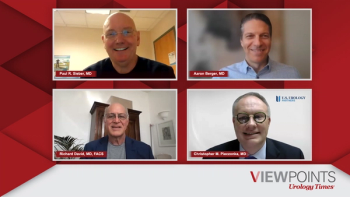
Key opinion leaders in urology share their credentials and highlight the general structure of their institution in regard to prostate cancer management.

“I couldn't change the fact that it was going to be a few months until I had help. But I could change my own response to the situation,” says Amanda C. North, MD.
“One of the things we do is communicate with our teams and help them with some guidance about how to make decisions about which patients can potentially be treated with alternative approaches,” says Hamid Emamekhoo, MD.

"What we found is that those with acute urinary retention took longer to ultimately pass their trial without a catheter, meaning that they were voiding without the use of any catheterization," says Claire S. Burton, MD.
Experts begin their panel discussion on OAB by describing the typical diagnostic process and initial conversations that they have with patients suspected of having the condition.

Urologist Benjamin Brucker, MD, urogynecologist Eman Elkadry, MD, and nurse practitioner Jenna Horton, NP introduce themselves, outline their credentials, and briefly describe the patients with overactive bladder (OAB) who they typically see in their clinical practice.

“Because this was the largest trial ever of testosterone replacement therapy, although the primary point of the trial was cardiovascular safety, we embedded within the trial several efficacy and other sub studies,” says A. Michael Lincoff, MD.

“There are real, tangible consequences when we prescribe medications to our patients, not just the [adverse] effects studied in clinical trials,” says Brian Cortese.

“I think one of the hottest topics for advocacy right now relates to reimbursement for telemedicine,” says Amanda C. North, MD.

“We are now doing more testing on the RNA side,” says Brittany M. Szymaniak, PhD, CGC.

“For this population of patients…testosterone replacement therapy does appear to be safe from a cardiovascular standpoint,” says A. Michael Lincoff, MD.

"The Inflation Reduction Act could impact the livelihoods of a lot of patients by reducing their annual out-of-pocket costs," says Brian Cortese.
"In 2021, we were finally able to demonstrate a statistically significant difference in burnout between men and women in urology with women having much higher burnout rates," says Amanda C. North, MD.
"My predominant role as a genetic counselor is really to serve our patient population and help support our providers," says Brittany M. Szymaniak, PhD, CGC.
"Within the Inflation Reduction Act, there is a provision that will cap the out-of-pocket contribution for Medicare beneficiaries, dropping to $3250 in 2024, as well as $2,000 in 2025," says Brian Cortese.
"We did an additional study where we surveyed all of the medical students who applied to urology this year... 1 in 5 applicants took programs off their list because they were located in states where abortion is illegal," says Chloe E. Peters, MD.

"I can't speak for the FDA, but I would hope and anticipate that the results of this trial may lead to a modification of the label and the warning," says A. Michael Lincoff, MD.

Experts summarize how the use of PSMA-PET imaging has impacted the field to date and share their hopes for the future.
The panel discusses the possibility of PSMA-PET becoming the standard-of-care imaging modality for prostate cancer, which may obviate the need for conventional imaging and bone scans, and then touches on the increasing availability of PSMA-targeted radiotherapies.
"If you were to look at this paper and others that are coming out like it, it appears that disposable cystoscopy is going to be the future for us," said David D. Thiel, MD.
“After I finished my fellowship, I came straight back to Montefiore. I was very drawn to taking care of the patients in the Bronx,” says Amanda C. North, MD.
Hamid Emamekhoo, MD, explains his approach to discussing the ongoing cancer drug shortage with his patients with genitourinary cancers.

"We make the argument in our discussion of this paper that any discussion further on cost needs to include encounters," says David D. Thiel, MD.