

“One important aspect to get across…is that access to this EAP is pretty easy," says Suzanne B. Merrill, MD, FACS.
“One important aspect to get across…is that access to this EAP is pretty easy," says Suzanne B. Merrill, MD, FACS.

Panelists discuss how future trials in metastatic castration-resistant prostate cancer (mCRPC) should focus on developing reliable biomarker-driven treatment selection strategies to optimize sequencing decisions and identify which patients will benefit most from specific therapies or combinations, particularly as the treatment landscape becomes increasingly complex.

Experts discuss where they are using FDA-approved treatments for bacille Calmette-Guérin (BCG)–unresponsive patients in their practice, how they choose between these treatments, and how these advances have impacted the timing of radical cystectomy for patients.
Panelists discuss how the phase 3 DORA trial investigates the combination of standard of care darolutamide with radium-223 in patients with metastatic castration-resistant prostate cancer (mCRPC), building upon the positive safety profile of novel hormone therapy combinations with radiopharmaceuticals seen in PEACE-3.
Experts briefly discuss 3 new FDA-approved treatments for patients who are unresponsive to bacille Calmette-Guérin (BCG) in the last 5 years—pembrolizumab, nogapendekin alfa inbakicept-pmln, and nadofaragene firadenovec—highlighting how each is administered, and share their impressions of the safety and efficacy of these agents.

"We found that the location that prescribers were registered in, as well as their fellowship training, was significantly associated with higher vibegron prescription rates,” says Grace Khaner.

“High risk, non–muscle invasive bladder cancer carries a significant risk of recurrence and progression. This emphasizes the need for careful patient selection, especially when we are considering bladder-sparing approaches," says Neeraja Tillu, MD.

"This now clarifies and substantiates the fact that there are not increased risks from a cardiovascular standpoint with [testosterone] therapy, at least at the doses studied," says Landon Trost, MD.

"There is evidence for a direct link between the exposures you get by doing your job as a firefighter and then developing cancer down the road," says Sima P. Porten, MD, MPH.

"A lot of times…decreased desire is affected by everything else: pain with sex, orgasm, arousal. Because if none of that is good, then desire isn't going to be good either," says Anna Myers, CNP.

“The impact on bone health is really significant with long-term androgen suppression," says Dr Louise Kostos.

An expert discusses how TAR-200 shows promise for non–muscle invasive bladder cancer (NMIBC) treatment, with medical professionals optimistic about its targeted delivery, potentially improved outcomes, and transformative approach to bladder cancer management.

The phase 2 STARLITE 2 trial is assessing 177Lu-girentuximab plus nivolumab in advanced clear cell renal cell carcinoma.

“I think we can really use AI in several different facets of endourology," says Perry Xu, MD.

“For all intents and purposes, how you've been practicing telehealth currently is exactly how you'll be able to practice it until September 30," says Chad Ellimoottil, MD, MS.

"I hope that these new guidelines and the removal of the black box warning on testosterone therapy will help more physicians feel comfortable providing testosterone therapy to men," says Helen L. Bernie, DO, MPH.

"Radium-223 continues to have a very significant role for patients with advanced castration-resistant prostate cancer," says Rana R. McKay, MD, FASCO.

"When we compared the 2 groups, those that received tamsulosin and those that did not, we did find a significant difference with regard to success rates," says Kate H. Kraft, MD, MHPE, FACS, FAAP. .
Experts share high-level results from the investigation of cretostimogene grenadenorepvec, an investigational targeted immunotherapy delivered intravesically for the treatment of non–muscle-invasive bladder cancer (NMIBC).
Panelists discuss how early implementation of RAD-ENZ combination therapy requires careful consideration of patient characteristics, disease burden, and long-term treatment planning while potentially offering the greatest benefit when initiated before significant disease progression occurs.
Panelists discuss how patients with bone-predominant mCRPC, good performance status, adequate bone marrow function, and limited visceral disease are ideal candidates for RAD-ENZ combination therapy, particularly when proper bone health monitoring and prophylaxis can be implemented.
Experts briefly discuss investigational mitomycin delivery systems UGN-102 and UGN-103, which are being evaluated in intermediate-risk non–muscle-invasive bladder cancer (NMIBC), and share their impressions of the safety and efficacy results from the ENVISION phase 3 trial for UGN-102.

“In 5200 men, very clearly, definitively, irrefutably, it has been shown that testosterone therapy is not associated with MACE over the course of the 12 to 24 months after commencement of testosterone therapy," says John P. Mulhall, MD.

“[There’s] a lot going on in bladder cancer in the non–muscle invasive, muscle-invasive space, as well as in some of the biomarkers, which is exciting and will definitely have a huge impact on the management of your patients," says Jason M. Hafron, MD, CMO.

"We found that female patients, Black patients, and patients with non-private insurance had a decreased odds of receiving opioids,” says Hailey Frye.

“A key point is the supply chain is very fragile, and there's not really a good financial incentive to make these drugs," says Ruchika Talwar, MD.

"Personally, I think monitoring and analyzing PSA kinetics is a great one because it's cheap and it's readily available,” says Dr Louise Kostos.

The trial is assessing the safety and tolerability of adaptive radiation therapy with concurrent sacituzumab govitecan in patients with MIBC.
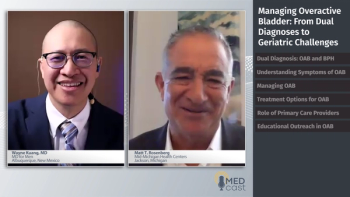
Wayne Kuang, MD; and Matt T. Rosenberg, MD, discuss how overactive bladder presents with distinct pathophysiological mechanisms between genders, requires different diagnostic approaches when distinguishing from benign prostatic hyperplasia in men, impacts quality of life in older adults, benefits from early primary care intervention, and necessitates improved patient advocacy and educational initiatives for optimal management outcomes.

"This certainly does feel like the beginning of the light at the end of the tunnel coming out of the BCG shortage," says Chad A. Reichard, MD.