



Kidney Cancer
Latest News
Advertisement
Latest Videos


CME Content


Advertisement
More News
The phase 3 ZIRCON trial is assessing TLX250-CDx as a noninvasive tool to identify clear cell renal cell carcinoma in patients with indeterminate renal masses.

The approval is based on data from the phase 3 CheckMate-9ER trial.

Hear from key opinion leaders in the urology space as they discuss 2 complex cases across the multidisciplinary approach in upper tract urothelial carcinoma and an incidentally discovered renal mass.
Ramaprasad Srinivasan, MD, PhD, provides background on the prognosis and treatment of patients with Von Hippel-Lindau–associated renal cell carcinoma and highlights the novel agent MK-6482.

Register for a live, interactive event featuring leaders in oncology reviewing and discussing patient cases in Bladder Cancer/Renal Carcinoma.

A large review showed that cancer specific survival was improved in overweight and obese patients with renal cell carcinoma compared with patients with normal BMI.
Combining telaglenastat with cabozantinib did not improve outcomes versus cabozantinib alone in a phase 2 trial.

Improvements in technology have renewed interest in the technique.

Recent research has revived the controversy regarding the role of cytoreductive nephrectomy in this setting.
Rana R. McKay, MD, highlights developments with immunotherapy and targeted agents in the treatment paradigm for non-clear cell renal cell carcinoma.

Findings from the phase 3 KEYNOTE-581/CLEAR trial (Study 307) showed that the combination improved overall survival, progression-free survival, and response versus sunitinib.
"There is unmet medical need in trying to determine if there is a differential benefit to using one therapy over another in the non-clear cell setting," Thomas E. Hutson, DO, PharmD.
Among a small group of patients with metastatic renal cell carcinoma who developed acute interstitial nephritis while on immune checkpoint therapy, 100% had a durable response to treatment.
At a median follow-up of over 2.5 years, the combination continued to show a significant benefit in overall and progression-free survival versus single-agent sunitinib.
Upfront nivolumab followed by response-dependent sequential use of ipilimumab did not optimize treatment outcomes in patients with advanced renal cell carcinoma.

The FDA is reviewing data from the phase 3 CheckMate-9ER trial, which showed that the combination significantly improved progression-free and overall survival compared with sunitinib in frontline renal cell carcinoma.
"Currently, there is significant variability in the design, conduct, and analysis of clinical trials for adjuvant treatment of both kidney cancer and bladder cancer. This variability negatively affects our ability to interpret trial results," said Richard Pazdur, MD.

The results may help guide treatment selection with immunotherapy versus targeted agents in patients with kidney cancer.
The combination significantly improved progression-free and overall survival compared with sunitinib in frontline renal cell carcinoma.
Investigators also reported that a subgroup of patients with 1 or more target kidney lesions experienced kidney tumor reduction and other benefits from the combination treatment.
“The combination of cabozantinib and atezolizumab demonstrated encouraging clinical activity in previously untreated patients with advanced ccRCC,” said investigator Sumanta Kumar Pal, MD.
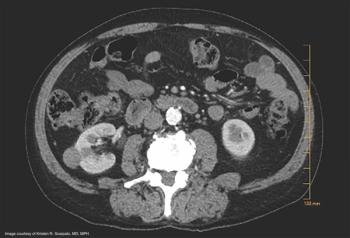
Renal mass biopsy should be used for patients in whom results would impact management decisions.

The combination improved overall survival versus sunitinib in patients with previously untreated advanced RCC.
Combination therapy is the first-line standard for metastatic renal cell carcinoma.
The novel HIF-2α inhibitor MK-6482 led to a decrease in the size of target lesions in almost 90% of patients with von Hippel-Lindau disease–associated renal cell carcinoma.
Advertisement
Advertisement
Trending on Urology Times
1
AMA issues Category I CPT codes for implantable tibial neuromodulation in UUI
2
The UroOnc Minute: Key Updates to the AUA NMIBC Guideline, With Peter E. Clark, MD
3
Aglatimagene besadenovec shows sustained immune remodeling in localized prostate cancer
4
John Sfakianos, MD, on integrating ctDNA into bladder cancer trials
5