



The phase 3 CONTACT-03 trial is exploring the combination of the multikinase inhibitor and immunotherapy agent in patients with renal cell carcinoma after exposure to an immune-checkpoint inhibitor.
The phase 3 CONTACT-03 trial is exploring the combination of the multikinase inhibitor and immunotherapy agent in patients with renal cell carcinoma after exposure to an immune-checkpoint inhibitor.
Minimally invasive surgery was associated with similar overall survival and disease-specific survival outcomes compared with open surgery in patients with early-stage kidney cancer.

When compared with sorafenib, tivozanib showed improved progression-free survival, and a more manageable safety profile for patients with relapsed or refractory metastatic renal cell carcinoma.
Dr. Kutikov discuss several noteworthy studies about kidney cancer from 2018.
"2018 was an exciting and productive year for kidney cancer research," write Amr A. Elbakry, MBBCh, MSc, and Ketan K. Badani, MD.
Activating interferon stimulated gene factor 3 could be a new direction for treating clear cell renal cell carcinoma, according to a recent study.
“The efficacy benefit and the favorable safety profile support aveluamb plus axitinib as a new first-line standard of care for advanced RCC,” says researcher Robert J. Motzer, MD.
“We believe that referral for kidney SABR is worthy of consideration in patients with solitary-kidney RCC who are faced with limited and risky management options,” says researcher Rohann Correa, MD, PhD.
Body mass index appears to be a prognostic factor for treatment outcomes in patients with metastatic renal cell carcinoma, but the direction of the association might vary across treatment modalities.
"Proper patient selection, including those with low-/intermediate-risk disease, is paramount," writes Badar M. Mian, MD.
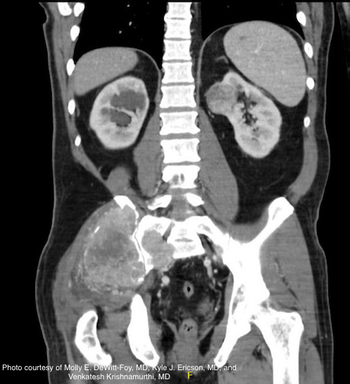
The authors discuss the case of a 57-year-old man who initially presents to a general surgeon with a chief complaint of right lower back and posterior neck pain, with associated soft tissue swelling. On presentation to the authors' institution, he had experienced regrowth of the masses with "ticking" in the right lumbar area that he correlated with his heartbeat. He also reported unintentional weight loss of 15 pounds over the previous 3 months.
Patients with advanced non-clear cell renal cell carcinoma have a high prevalence of germline mutations, including some that could be used to guide therapy.
The finding suggests that, in the setting of a CD117-positive renal tumor biopsy, this modality could reduce patient morbidity and health care costs by avoiding the need for resection in benign cases.
The protein Kidney Injury Molecule 1 shows promise as a blood-based biomarker for renal cell carcinoma diagnosis and for predicting overall survival after RCC diagnosis.
Although it may not be the last word on the topic, new research sheds light on the choice of cytoreductive nephrectomy and/or targeted therapy in patients with metastatic renal cell carcinoma.

Here’s what to do when a patient disregards medical advice.
“I don’t expect appreciation... But I believe patients do appreciate what we do, and it’s nice to receive thanks," says one urologist.
“Florida, specifically South Florida, is a very tough place to practice. There’s a fairly prominent infiltration of Medicare HMOs with a lot of obstruction to doing anything for the patient that’s necessary," says one urologist.
Other pipeline products discussed in this round-up include agents for metastatic urothelial cancer, clear cell renal cell carcinoma, and stress urinary incontinence.
“A decade ago it was rare to have advanced practice providers as part of routine urologic care. Now they’re integral and a necessary part of any active urologic practice,” says Bradley A. Erickson, MD, MS.
Practical strategies are available to help you collaborate, not compete.
“[Researcher Arnaud Méjean, MD, PhD, has] really flipped the existing paradigm that we have in the management of advanced kidney cancer,” says Sumanta K. Pal, MD.
Retrospective analyses of data collected in a real-world study provide assurance about using nivolumab (Opdivo) to treat elderly patients with metastatic renal cell carcinoma who have failed previous therapy.