




Kidney Stones
Latest News
Advertisement
Latest Videos






CME Content


Advertisement
More News

In this interview, Margaret S. Pearle, MD, PhD, discusses the AUA’s guideline on medical management of stone disease and also touches on disposable ureteroscopes and percutaneous access.
The development of an ultrasonic stone propulsion system marks a significant advance in the treatment of kidney stones. This video explains how the system, which is still in development, is used to facilitate stone passage.

Pretreatment for 14 days with tolterodine (Detrol) and Tamsulosin (Flomax) did not appear to relieve ureteral stent symptoms better than tamsulosin alone as measured by the validated Ureteral Stent Symptom Questionnaire, say the authors of a recent study.
Results of a study evaluating health-related quality of life in patients surgically treated for kidney stones suggest a need to rethink the outcome target and focus on patient counseling to set appropriate expectations.
Also learn about a new stone device, an at-home testosterone enanthate injection, and more.
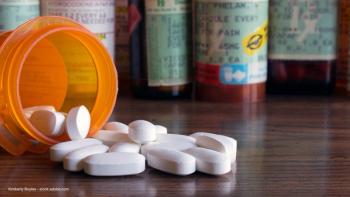
A sizable proportion of opioid-naïve patients who undergo stone surgery become chronic opioid users, according to a study conducted by urologists from Emory University, Atlanta.

In this interview, Thomas Chi, MD, discusses how he performs PCNL, explains why he uses ultrasound instead of fluoroscopy, and offers advice to urologists looking to gain more experience with the procedure.

"We must better identify patients with higher risk factors for recurrence and follow them more effectively," writes Stephen Y. Nakada, MD.

Many urologists don't follow guidelines calling on them to image their patients after ureteroscopic stone disease treatment, researchers say.

These videos demonstrate significant advances in percutaneous nephrolithotomy technique that can serve to optimize outcomes, reduce OR time, and help achieve optimal results.

A mobile app for stone metaphylaxis and an algorithm defining specific indications for stent omissions were among the other highlights in endourology/stones at AUA 2018.
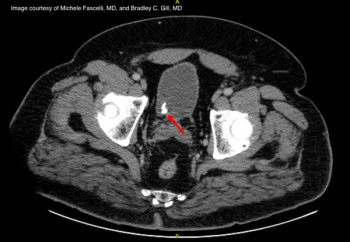
An elderly male with hypertension, lumbar spinal stenosis, morbid obesity, and ED presents with acute right-sided worsening of his chronic back pain. A distal right ureteral stone is found on CT and his symptoms respond well to medical therapy, but he later develops severe right flank pain.

Findings of a retrospective study confirm that unplanned encounters are common after ureteroscopy.

A recent study "revealed that inadequate pain control, presence of a ureteral stent, and a first-time stone treatment were the most common reasons for unplanned utilization of health care services [following ureteroscopy]," writes Brian R. Matlaga, MD, MPH.

A 42-year-old female undergoes right percutaneous nephrolithotomy (PCNL) for a complete staghorn calculus. As a routine after PCNL, a chest-x-ray was obtained using fluoroscopy. What abnormality is seen?

When treating kidney stones, debate continues over the use of dusting versus basketing. In this interview, Olivier Traxer, MD, describes both methods, lists his preferred laser settings, and explains why he changed the way he uses ureteral access sheaths.
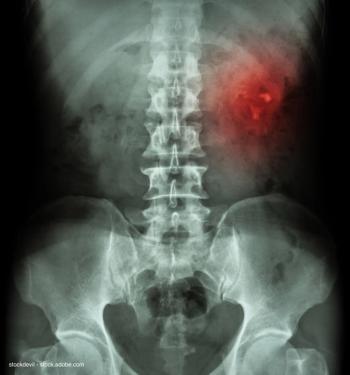
A study analyzing stone-free rates after ureteroscopy suggests that urologists might consider applying refined patient selection criteria in order to achieve better outcomes.

A preliminary analysis of data from a randomized controlled trial supports the efficacy of a low-oxalate diet for reducing urinary oxalate excretion in patients with idiopathic hyperoxaluria, but shows little or no benefit for daily dietary supplementation with vitamin B6 25 mg/magnesium 400 mg or a diet-supplement combination.
Videos demonstrating ureteroscopy techniques, the debate over medical expulsive therapy, and research into ureteroscopy's possible effect on erectile function were among our most-read stone disease articles of 2017.
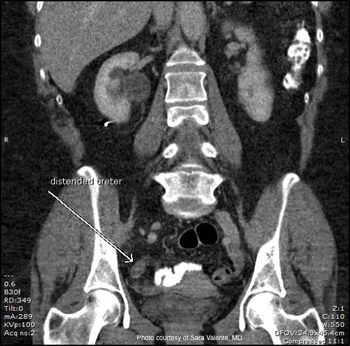
A 61-year-old female complains of acute-onset right-sided flank and abdominal pain. She describes associated nausea, but denied urinary symptoms, hematuria, fever, or chills.
Flexible ureteroscopy using a digital single-use flexible ureteroscope known as PUSEN achieves stone-free rates on par with reusable flexible ureteroscopes, with a total surgery time averaging 45 minutes.
Other products and services discussed in this round-up include a biosimilar for cancer, an American College of Surgeons manual on quality initiatives, a kidney cancer microsite, and more.

A new single-use digital flexible ureteroscope (LithoVue) compares favorably in performance to reusable scopes, at least for routine urteroscopy, with a possible advantage of being more economical.

Findings of a study investigating biomechanical stresses on the urologist while performing flexible ureteroscopy indicate that reusable and single-use digital ureteroscopes have a more favorable ergonomic profile than a reusable fiberoptic instrument.

A study analyzing variation in spending for patients undergoing ureteroscopy or shock wave lithotripsy for urinary stone disease is a step towards helping urologists understand cost reduction opportunities.
Advertisement
Advertisement
Trending on Urology Times
1
Evidence for Combining Prostatic Urethral Lift With Radiotherapy
2
After curative-intent treatment, prostate cancer recurrence is still an unmet need
3
Rezūm outperforms combination pharmacotherapy for BPH symptoms at 1 year
4
AACU, WOCN Society urge safeguards in Medicare catheter bidding
5