



Prostate Cancer
Latest News
Advertisement
Latest Videos

CME Content







Advertisement
More News

"This device has been really well studied, and we have lots of data on it," says Andrew C. Peterson, MD, MPH.

There was a 2-fold increase in risk of mortality by cardiovascular disease in the group who received hormone therapy.

Press Release
“The benefit of the clinic is a holistic approach to the survivorship care that takes into account things that we as urologists don’t usually consider in our everyday patient encounters,” said Niels Johnsen, MD, MPH, assistant professor of Urology, Division of Reconstructive Urology and Pelvic Health, Vanderbilt University Medical Center.

The application is supported by the phase 3 PROpel trial, which showed that adding olaparib to frontline abiraterone acetate and prednisone/prednisolone significantly improved radiographic progression-free survival in patients with mCRPC.

"It is evident...that the safety of 5-ARIs as it relates to prostate cancer outcomes is contingent upon the clinician understanding its effect on PSA level and making appropriate adjustments to ensure timely deployment of diagnostic imaging and biopsy," writes Badar M. Mian, MD.

Stephen J. Freedland, MD, highlights emerging data to look out for that might address unmet needs in prostate cancer testing and treatment.

"This article serves as a summary of the literature published in the past 3 years, documenting the impact of exercise and physical activity on prostate cancer development and on cancer-specific, treatment-related, and patient-reported outcomes," writes Christine Ibilibor, MD, MSc.
Dr Freedland discusses the clinical implications of using genomic test results for management of patients with prostate cancer.
A key opinion leader provides an overview of study data investigating the clinical validity and clinical utility of the currently available genomic testing options in prostate cancer.

The FDA has granted 510(k) clearance to an artificial intelligence software program that may enhance the efficiency and accuracy of prostate cancer diagnosis.
The Avenda system combines the company’s proprietary iQuest AI-based margin prediction software algorithms with its FocalPoint laser ablation device.

The rate of positive surgical margins was higher among patients who did not have a preoperative MRI.
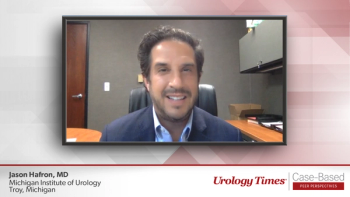
Dr Jason Hafron concludes his discussion of mCSPC by highlighting the need to work towards a cure for the disease, and two major clinical trials investigating triplet treatment regimens.
Jason Hafron, MD, revisits the patient profile and discusses factors that inform treatment decision-making in mCSPC.
An expert provides an overview of the types of androgen deprivation therapy (ADT) for mCSPC, other therapies that can be used in combination with ADT for treatment intensification and compares the safety and efficacy of the various regimens.
Jason Hafron, MD, presents the profile of a 66-year-old man with metastatic castration-sensitive prostate cancer (mCSPC).
Adding the PD-1 inhibitor to docetaxel led to a trend toward modest improvement in survival versus docetaxel alone; however, the results did not meet the trial’s threshold for statistical significance.
Dr Mark Emberton shares what developments are visible on the horizon and what they represent for the future of focal therapy and treatment of clinically localized prostate cancer.
An expert’s brief commentary on follow-up strategies in patients receiving focal therapy, including monitoring for disease relapse or recurrence.
An experienced clinician shares his personal experience with preventing and managing side effects related to focal therapy in patients with clinically localized prostate cancer.
A focused discussion on how the availability and use of focal therapy technology has changed treatment paradigms and affected patient outcomes.
An oncologic urologist from the United Kingdom (UK) discusses the diffusion of focal therapy options for clinically localized prostate cancer in the United States and UK.
Dr Mark Emberton reviews safety and efficacy data supporting the use of focal therapy in patients with prostate cancer.
An in-depth discussion of emerging focal therapy options for clinically localized prostate cancer.
Insights on the drawbacks of older treatment approaches for clinically localized prostate cancer and how strategically implementing focal therapies may address remaining unmet needs and clinical challenges.
Advertisement
Advertisement