

“What [we] found was that those men who received a penile implant had a significant reduction in depression and psychological distress," says Mohit Khera, MD, MBA, MPH.
“What [we] found was that those men who received a penile implant had a significant reduction in depression and psychological distress," says Mohit Khera, MD, MBA, MPH.

In this video, part 4 of a 4-part series, panelists discuss how primary care providers can address patient questions on prostate cancer screening.

"Patients are having a hard time getting diagnosed because physicians are leaving medical training and medical education without getting this solid curriculum around female sexual dysfunction," says Maria Uloko, MD.
In this video, part 3 of a 4-part series, panelists discuss treatment planning for prostate cancer, particularly in older patients.
In this video, part 2 of a 4-part series, panelists discuss the increasing prevalence of de novo metastatic hormone-sensitive prostate cancer.
In this video, part 1 of a 4-part series, panelists discuss the nuances and challenges of prostate cancer screening.
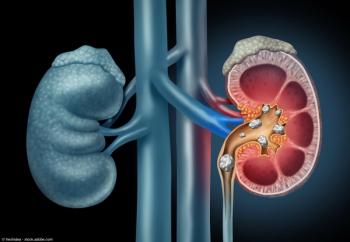
Jared S. Winoker, MD, addresses the wide range of stone burdens treated by the CVAC system for the study.

A prostate cancer expert breaks down likelihood of a diagnosis of metastatic prostate cancer and touches on available treatment options.

The AI tool outperformed MRI in assessing for SVI.

Karyn S. Eilber, MD, discusses treatment of genitourinary syndrome of menopause.
The risk of stricture formation was 4.6% in the TFL cohort vs 2.4% in the holmium laser cohort.

According to Adam B. Weiner, MD, a urologist at Cedars-Sinai Medical Center, men should begin prostate cancer screening around ages 50 to 55.

"There was a significant increase in overall fatigue after performing flexible ureteroscopy," says Sarah Razavi, MD.

“I think it does give us confidence that clinical trials can predict how these drugs will work in the real world," says Stephen J. Freedland, MD.
“The key finding is [that] this might be, in itself, a novel risk factor for bladder cancer," says Laura E. Davis, MD.

Nearly 60% of patients taking vibegron remained on treatment at 1 year.

An expert details key post-procedural recommendations following onabotulinumtoxinA injection for OAB.

Recent data suggest that obesity may be a risk factor for increased pain on transperineal biopsy.

An expert walks through specific actions that urologists and their teams can take before, during, and after the procedure.

Among the guideline’s recommendations is the use of local low-dose vaginal estrogen as first-line therapy for GSM.

The study was published in JCO Oncology Practice.
Joshua M. Heiman, MD, details key findings from the POuND OUT study.

Amy E. Krambeck, MD, recaps her talk from AUA 2025.

John Michael DiBianco, MD, discusses findings from the BLUES trial.

The miR Sentinel Prostate Cancer Test is a standalone liquid biopsy urine test.

Investigators found that benefits of treatments that are observed in trials also appear in the real world.

The trial has enrolled 201 patients with localized prostate cancer to date.
The CR rate was 71% in patients with BCG-unresponsive NMIBC with CIS with or without papillary disease.

"It’s a very good time to be taking care of patients with bladder cancer," says Joshua J. Meeks, MD, PhD.

“In this well-selected patient population, it is possible to treat with systemic therapy alone," says John L. Gore, MD, MS.