

Alexandra Drakaki, MD, discusses guidance from a modified Delphi panel on managing peripheral neuropathy in patients with locally advanced or metastatic urothelial carcinoma receiving enfortumab vedotin.
Alexandra Drakaki, MD, discusses guidance from a modified Delphi panel on managing peripheral neuropathy in patients with locally advanced or metastatic urothelial carcinoma receiving enfortumab vedotin.
This episode, titled ‘Clinical Considerations for PSMA PET Agents in Advanced Prostate Cancer,’ the expert faculty review the currently FDA-approved PSMA PET diagnostic agents and their labeled indications, which are largely similar and include initial staging, biochemical recurrence, and evaluation for radioligand therapy.
David Morris, MD, FACS, discusses expert panel recommendations on intravesical drug-releasing systems in bladder cancer, highlighting early drug release dynamics, tolerability, and optimizing patient comfort.

Giulia Almiron da R. Soares discusses survey findings examining the factors influencing women’s decisions to pursue careers in urology.
In this segment, Dr. Charles J. Ryan asks Dr. Jayram to discuss the key clinical considerations that guide the selection of androgen receptor pathway inhibitors when intensifying therapy for metastatic castration sensitive prostate cancer (mCSPC).
In this segment, Dr. Charles J. Ryan asks Dr. Jayram to discuss the patient specific considerations that influence the transition from deciding to intensify therapy to selecting a particular treatment strategy in metastatic castration sensitive prostate cancer (mCSPC).
Christopher M. Pieczonka, MD, discusses practical strategies to optimize tolerability and minimize early discontinuation with indwelling intravesical drug-releasing systems for bladder cancer.
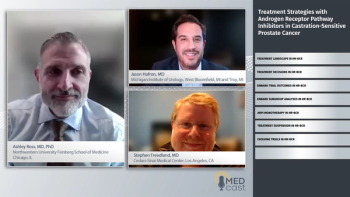
The faculty discusses how ARPI monotherapy may fit into the management of high-risk biochemically recurrent prostate cancer, with a focus on patient selection, trade-offs of monotherapy versus combination therapy, and practical counseling around efficacy, quality of life, and adverse events. The conversation also explores emerging questions around biomarkers, PARP inhibitors, treatment intensification, and how monotherapy may evolve as a therapeutic option in select patients.
The faculty discuss how androgen receptor pathway inhibitor–based strategies are reshaping the management of high-risk biochemical recurrence, with an emphasis on risk stratification, imaging, and patient selection for systemic therapy. The conversation also explores how long-term clinical evidence, treatment suspension, and emerging study designs are informing more individualized treatment decisions in practice.
Gordon A. Brown, DO, FACOS, summarizes overall survival trends, safety findings, and clinical considerations for managing adverse events with dual pathway inhibition.

Hugo's 7-degree-of-freedom instrumentation, power-based electrosurgical architecture, and visual haptic feedback support precise reconstructive performance, while the platform's strong IDE trial outcomes are attributed to a proficiency-based progression training model that assesses both surgeons and operative teams before independent practice.

Matthias Saar, MD, discusses findings from the phase 2 INDUCTA study, evaluating the use of inductive hormonal therapy to achieve operability in patients with T4 prostate cancer.

Despite promising candidates across tumor, immune, and systemic marker categories, no biomarker yet reliably predicts BCG response or identifies which NMIBC patients would benefit from adding checkpoint inhibitor therapy—a gap that limits informed shared decision-making and broader adoption of IO-BCG combinations despite positive trial data.
Meri-Margaret Deoudes discusses findings from the Bladder Cancer Advocacy Network’s "New Faces of Bladder Cancer" survey.
In ‘Expanding Clinical Use of PSMA PET in Advanced Prostate Cancer,’ our experts delve into how PSMA PET imaging is being incorporated into treatment decisions for patients with advanced and metastatic prostate cancer.
Daniel Shapiro, MD, FACS, discusses how emerging biomarker strategies and evolving combination therapies are reshaping risk stratification and treatment decision-making in kidney cancer.
In this segment, Dr. Charles J. Ryan asks Dr. Alan H. Bryce how clinicians balance the benefits of treatment intensification with the potential for added toxicity in patients with metastatic castration sensitive prostate cancer (mCSPC), particularly in older individuals or those with significant comorbidities.
In this segment, Dr. Charles J. Ryan asks Dr. Murilo De Almeida Luz to discuss how treatment intensification strategies may differ across various clinical presentations of metastatic castration sensitive prostate cancer (mCSPC).

Anjali Kapur, MD, discusses a post-market analysis of the safety of the eCoin implantable tibial nerve stimulator for patients with urge urinary incontinence.
In this video, Gordon A. Brown, DO, FACS, explores post hoc analyses from CAPItello-281 evaluating increasing PTEN deficiency thresholds and their relationship to treatment response.

Dalia Kaakour, MD, MPH, highlights key findings from a retrospective review of cardiovascular system toxicities in patients initiating novel hormonal therapies for advanced prostate cancer.

Bogdana Schmidt, MD, MPH, identified several subgroups most likely to harbor occult systemic disease and therefore potentially benefit from adding immunotherapy to BCG:
Matthew D. Galsky, MD, discusses the mechanism of action for FX-909, a first-in-class agent targeting PPARγ in advanced urothelial carcinoma.
The PRIMARY2 phase 3 trial found that PSMA PET-CT in men with normal or equivocal MRI results safely halved the number of prostate biopsies, maintained non-inferior detection of clinically significant cancer, and reduced insignificant cancer diagnosis by more than half.
Data from the CLIMATE trial indicate that detectable miR-371 post-orchiectomy is a marker of MRD in patients with clinical stage 1 testicular germ cell tumor.
The Hugo RAS system requires wider, offset port placement compared to conventional platforms, and its open console design promotes a more ergonomically sound upright posture that may reduce the cervical spine strain associated with prolonged use of immersive closed-console robotic systems.
Christopher M. Pieczonka, MD, discusses the design and interim findings from the phase 2 QUILT 2.005 trial.

Neha Vapiwala, MD, pointed to the shift toward more personalized approaches and the expanding role of radiopharmaceutical therapies.

Sara Coca Membribes, MD, highlights several emerging therapeutic strategies with near-term clinical implications.
In this segment, Dr. Charles J. Ryan asks Dr. Alan H. Bryce to explain why androgen deprivation therapy (ADT) alone is no longer considered adequate treatment for most patients with metastatic castration sensitive prostate cancer (mCSPC).