

Richard N. Schlussel, MD, discusses how advances in robotic surgery and artificial intelligence are expected to transform care in pediatric urology.
Richard N. Schlussel, MD, discusses how advances in robotic surgery and artificial intelligence are expected to transform care in pediatric urology.

Jamie Michael, MD, highlights a study exploring the impact of MRI and genomics on "extreme" grade reclassification in men on active surveillance.

Dose interruption rather than discontinuation addresses most gemcitabine intravesical system (Inlexzo) adverse events, with designated champions supporting consistent patient management, according to Elizabeth Mobley, MD.
Elizabeth Mobley, MD, shares practical tips for counseling patients and managing adverse events during treatment with the gemcitabine intravesical system.
Proactive adverse event counseling and a specific hydration protocol are the primary tools for supporting patient retention through the gemcitabine intravesical system's (Inlexzo) extended treatment course, according to Mobley.

University of Florida chief residents share practical advice for trainees on building mentorship networks, maintaining well-being, and navigating the personal and professional challenges of urology residency.

New FDA-approved perioperative options reshape bladder cancer care; learn how teams coordinate referrals, biomarkers, and bladder-sparing follow-up.
Ryan K. Flannigan, MD, FRCSC, highlights a phase 2 study of the sustained-release lidocaine formulation ST-01 as a potential nonsurgical treatment for chronic scrotal content pain.

Ravi Munver, MD, discusses a propensity score–matched comparison of the AquaBeam system and the second-generation AI-powered HYDROS platform for BPH.

Enfortumab vedotin-ejfv (Padcev) plus pembrolizumab's (Keytruda) expanded approval shifts the perioperative MIBC conversation from cisplatin eligibility to optimal systemic strategy, according to María Natalia Gandur Quiroga, MD, MSc.

Daniel J. George, MD reviews the data behind the FDA approval of capivasertib for PTEN-deficient metastatic prostate cancer.

As the treatment landscape continues to evolve, the expert faculty discuss how real-world considerations, including treatment access, insurance coverage, and patient costs, can significantly influence therapeutic decisions, sometimes as much as the clinical evidence itself.
As treatment options continue to expand, the expert faculty discuss where current evidence remains limited and identify key areas for future research that may further refine treatment selection and disease management.

CVAC and FANS reflect different surgical philosophies—dusting vs fragmentation—with distinct ergonomic trade-offs and shared intrarenal pressure risks that urologists must actively monitor, according to Krambeck.

Amar U. Kishan, MD, explains how to translate the ArteraAI result into a meaningful patient conversation, reflects on what the cost-effectiveness data mean for the future of AI-guided precision oncology, and closes with a single takeaway for community urologists.

Sender Herschorn, BSc, MDCM, FRCSC, discusses a subgroup analysis of the COURAGE trial showing that vibegron provided comparable efficacy and favorable safety in men 75 years and older with persistent OAB symptoms receiving pharmacotherapy for BPH.
New perioperative bladder cancer options reshape referrals and biomarker-driven planning, helping more patients get safer, personalized care.
Experts debate bladder MRI limits after TUR/chemo and how ctDNA/utDNA may refine staging and bladder-sparing decisions in muscle-invasive disease.
Urocross produced deepening IPSS improvement through 24 months post-retrieval, with Kevin T. McVary, MD, FACS, attributing a post-removal symptomatic boost to completed prostatic remodeling and full preservation of future treatment options.

Kristen Scarpato, MD, discusses 2026 AUA/SUO Advanced Prostate Cancer Guideline amendment recommendations on the use of PSMA-PET imaging for staging and treatment selection.
Results from a cross-sectional study suggest that unmet social needs are associated with kidney stone disease and worse stone-specific quality of life.
This episode, titled “Emerging Treatment Strategies in mCSPC,” features panelists discussing the rapidly evolving treatment landscape in metastatic castration-sensitive prostate cancer (mCSPC) and the growing number of therapeutic approaches being incorporated alongside androgen deprivation therapy (ADT) and androgen receptor pathway inhibitors (ARPIs).
In “Risk Stratification and Treatment Intensification Strategies in mCSPC,” our panel explores how clinicians use clinical, molecular, and genomic risk factors to personalize treatment decisions for patients with metastatic castration-sensitive prostate cancer (mCSPC). The expert faculty discuss how disease volume, timing of metastasis, tumor burden, PSA kinetics, and patient comorbidities influence risk stratification and guide the selection of doublet, triplet, and metastasis-directed treatment approaches.
Matthew Truesdale, MD, FACS, discusses validation data showing that IsoPSA improves risk stratification for clinically significant prostate cancer in men with elevated PSA both with and without pre-biopsy mpMRI.
"This is really going to make access to care a lot better, and workflow is going to be a lot easier," says Ben H. Chew, MD, MSc, FRCSC.
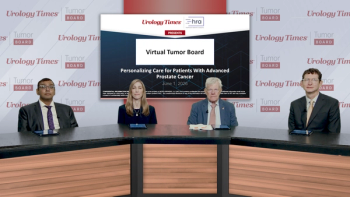
In the final episode, “Treatment Intensification in Metastatic Castration-Sensitive Prostate Cancer,” the panelists explored the evolving role of treatment intensification strategies for patients with metastatic castration-sensitive prostate cancer (mCSPC). Using the case of a 63-year-old man with de novo high-volume metastatic disease, the expert faculty discussed how disease burden, patient fitness, comorbidities, and individual treatment goals influence decisions regarding doublet versus triplet therapy.
In this episode of The UroOnc Minute, host Adam Weiner, MD, is joined by David Canes, MD, for a thoughtful discussion on practical strategies to improve efficiency, reduce physician burnout, and preserve meaningful patient-centered care in urologic oncology.
Amar U. Kishan, MD, translates cost-effectiveness findings on the ArteraAI test into practical guidance for clinicians, payers, and health systems.
Enucleation is appropriate for the vast majority of patients with BPH, but certain patient profiles—including prior radiation, significant neurologic conditions, morbid obesity, and dementia—warrant caution or referral to specialists, whereas the most consistent technical failure among surgeons past their learning curve is inadequate apical tissue removal driven by discomfort with sphincter proximity, according to Amy E. Krambeck, MD.

Gopa Iyer, MD, reviews early NEXUS-01 data evaluating the investigational anti–Nectin-4 ADC LY4052031, highlighting the importance of CYP2D6-guided dosing to optimize safety.