
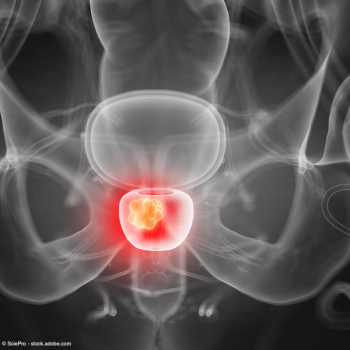
The theranostic 64Cu/67Cu-SAR-BBN combines the imaging product 64Cu-SAR-BBN and the targeted therapy 67Cu-SAR-BBN.
The theranostic 64Cu/67Cu-SAR-BBN combines the imaging product 64Cu-SAR-BBN and the targeted therapy 67Cu-SAR-BBN.
The investigators assessed data from the UNITE study, a retrospective study of patients treated with enfortumab vedotin and other agents.
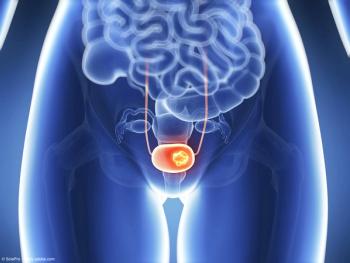
“Our results suggest that bladder-sparing treatments may be a safe approach in selected patients. Survival outcomes were not inferior compared to early radical cystectomy," says Wei Shen Tan, MD.
Pelvic lymph node involvement and polymetastases detected with PSMA-PET imaging were linked to significantly lower overall survival rates in patients initially diagnosed with non-metastatic, castration-resistant prostate based on conventional imaging.

Treatment with the first-line combination of pembrolizumab and lenvatinib led to durable anti-tumor activity in patients with non–clear cell renal cell carcinoma.

Clinical research has demonstrated a 10-minute onset interval for the topical gel formulation MED3000, compared to an interval of at least 30 minutes with PDE5 inhibitors, such as Cialis and Viagra.

"The most alarming finding is that there were 0 instances of DREs in the NAMCS dataset over the entire 5-year period, and there were no PSAs conducted in American Indian/Alaska Native men after 2014,” says Christopher M. Gillette, PhD.

"This [guideline]... is probably the most broad in scope and incorporates a lot of the things that were missing or not yet mature enough to be included in the previous guidelines," says Badrinath Konety, MD, MBA.
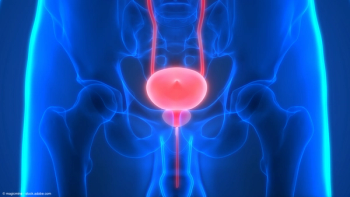
"TAR-200 is a sort of a pretzel device. It's a novel drug delivery mechanism that's placed inside the bladder for sustained release of gemcitabine," explains Siamak Daneshmand, MD.
"We successfully demonstrated that the overexpression of TRAF4 prompts the conversion of androgen-sensitive prostate cancer cells into castration-resistant cells,” says Ping Yi, PhD.
"The addition of an immune checkpoint inhibitor after tri- or tetra-modality therapy might improve long-term outcomes for patients with bladder cancer,” said Maria De Santis, MD.

A total of 74.3% of respondents indicated that more training dedicated to care for patients in the LGBT community was needed.

Telehealth is here to stay. Lean into the technology as the new line of business that it is.
“Combined MRI-targeted and systematic biopsies were nearly twice as likely to result in downgraded pathology at prostatectomy compared [with] systematic biopsies," says Ilon C. Weinstein.

The economic burden is based on three components: excess medical care expenditures, lost labor market productivity, and premature death.

"Pandemic meetings were different because they were virtual. To be honest, those weren’t really good. I prefer to go to the meeting and be with other people and see them face-to-face," says Robert Gossett, MD.

"ChatGPT not only has a low rate of correct answers regarding clinical questions in urologic practice, but also makes certain types of errors that pose a risk of spreading medical misinformation," says Christopher M. Deibert, MD, MPH.

“We are excited to report that a simple, low-cost intervention can positively [affect] young men’s willingness to engage with their health," says Wade Gutierrez.
"One of the notable things was the complications are frequent—which is something that was previously known about these surgeries—but they're minor," says Kayla Blickensderfer.

Projections were made under 3 different circumstances: the rate of women entering urology continues to follow logistic growth, there is no further growth of women into urology, and retirement rates among women mirror that of men in urology.

"Overall, there are plenty of options for keeping cash. The trick is determining the best option for your needs," writes Jeff Witz, CFP.
"It gives me a very rewarding experience…. I see patients with low-grade prostate cancer and when they become advanced prostate cancer, I already have a good relationship with them and don’t have to send them somewhere else," says Abhinav Sidana, MD, MPH.
Disitamab vedotin is a HER2-targeted antibody-drug conjugate and toripalimab is a PD1-inhibitor.

"Clinicians, now more than ever, have many data entry duties. The clinical encounter’s efficiency is dictated by the ease of the EHR," write Jesse D. Bracamonte, DO, FAAFP, and Michael Underhill, DO.

"Among our accomplishments were the first robotic ureteral reconstructions and completing our first 100 robotic cases within the first half-year," says Michael W. Witthaus, MD.

Correct code selection depends on whether procedure is simple or complex.
“This research shows the importance of diversity in clinical trials," said lead author Daniel J. George, MD.
At a median follow-up of 67.2 months, the combination of pembrolizumab and axitinib continued to show an overall survival and progression-free survival benefit over sunitinib monotherapy in the first-line setting.
“Both the SWOG S1011 and the LEA trial show very clearly that a bilateral standard node dissection confined to the true pelvis is the standard of care for patients with curable muscle-invasive bladder cancer," says Seth P. Lerner, MD, FACS.
“The addition of atezolizumab to cabozantinib did not result in improved clinical outcomes in patients with mRCC who progressed on or after prior ICI treatment,” said Toni K. Choueiri, MD.